
Most people swipe a sunscreen stick across each cheek once — and in one study, stick users ended up with about a sixth of the amount the SPF number is tested at.
Short answer:
- Yes, a sunscreen stick works — but only if you put on enough. One quick swipe is not enough.
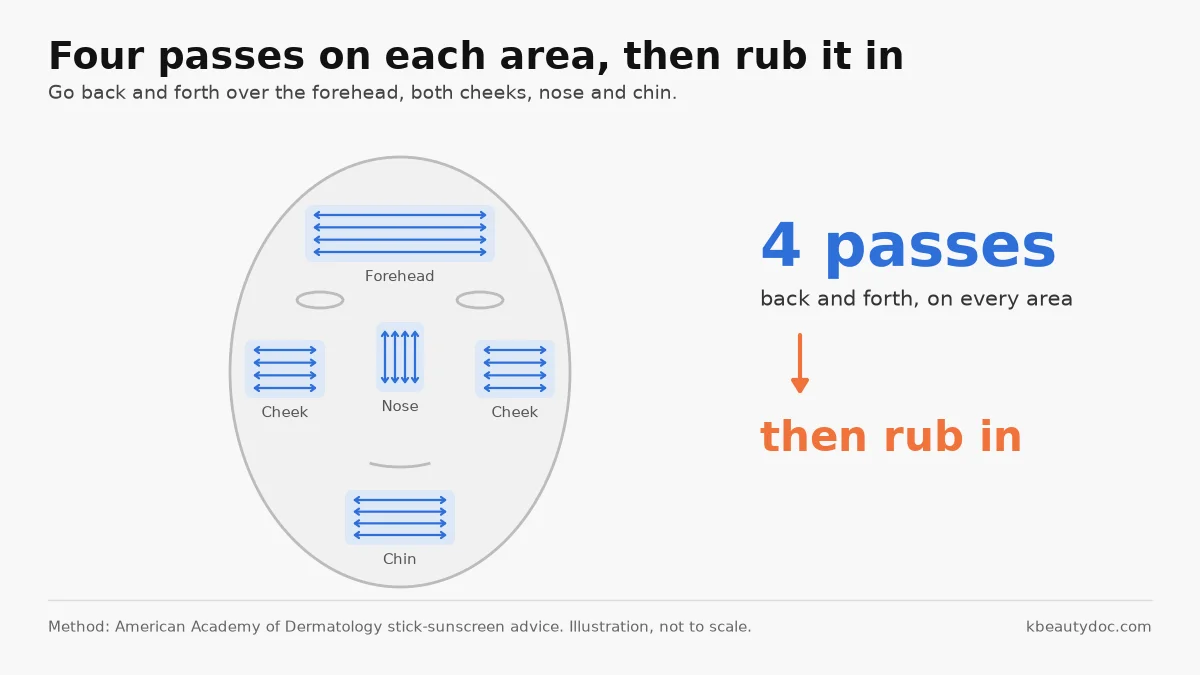
- Go four times back and forth over each area, then rub it in. That is the American Academy of Dermatology’s advice.
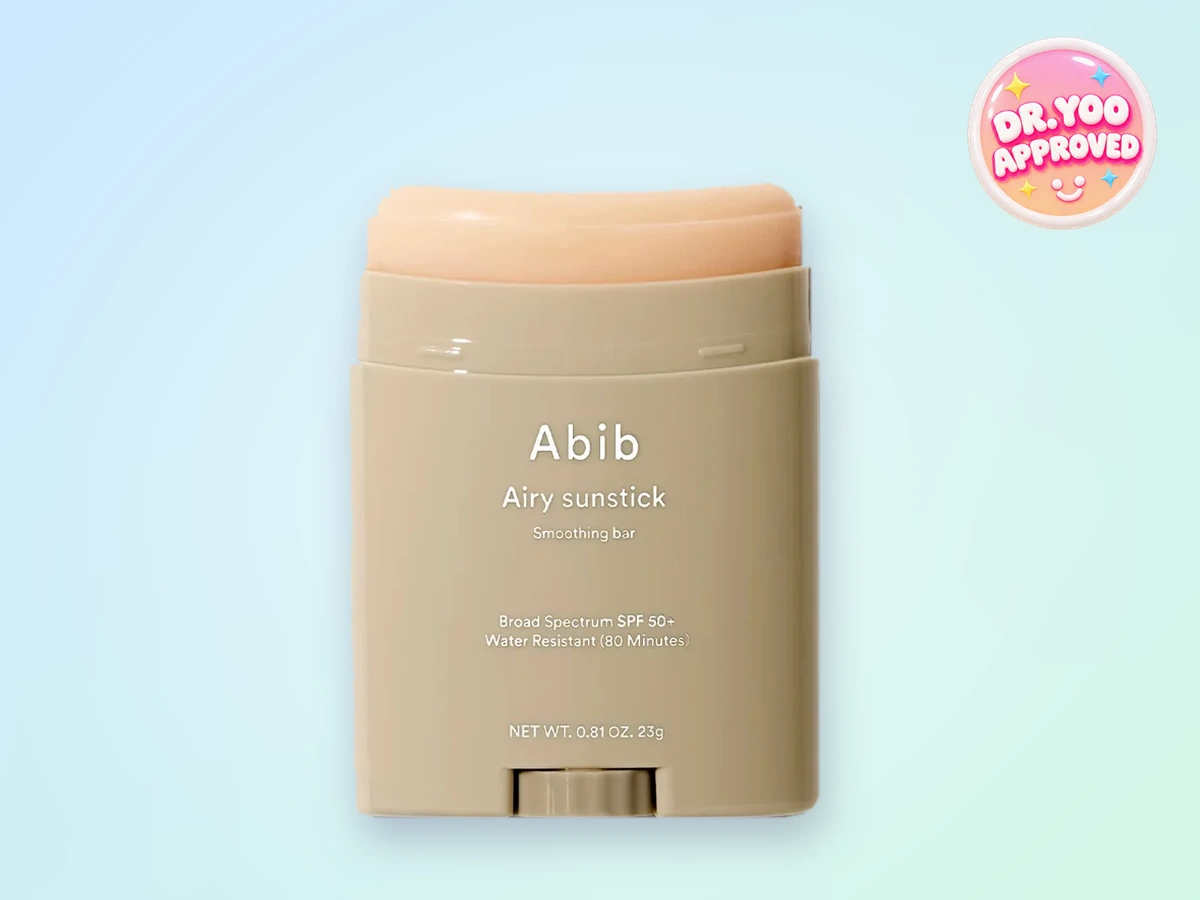
- The Abib Airy Sunstick is a semi-matte chemical-filter stick for oily and combination skin. It is best for top-ups during the day.
Shiny by lunch and need to top up over makeup?
This is the stick I would look at first.
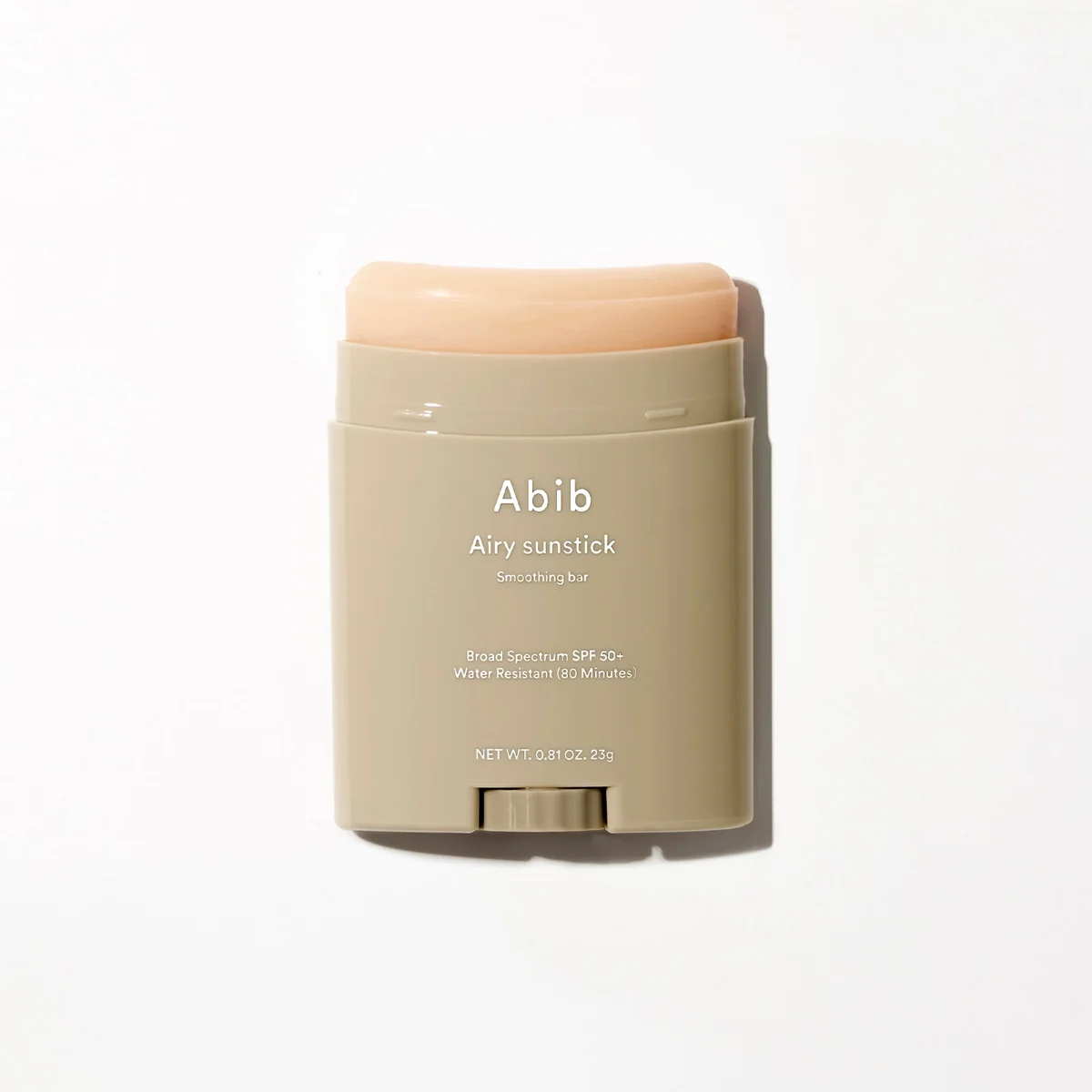
No zinc oxide or titanium dioxide, so there is nothing white to leave behind. Silica and silicones give the semi-matte finish oily skin tends to like.
Why does one swipe fall short?
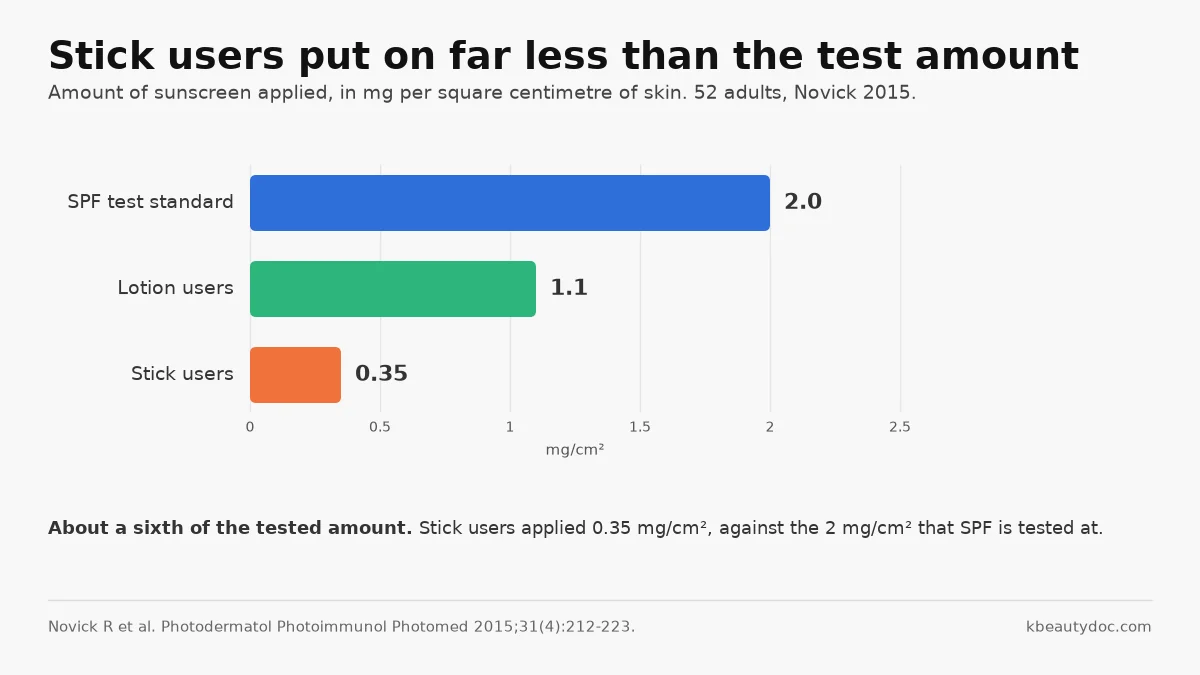
SPF is measured with 2 mg of sunscreen on every square centimetre of skin. In real life, people put on far less than that [1].
A stick makes the gap bigger. In a study where 52 adults applied lotion, spray and stick sunscreen, stick users put on about 0.35 mg/cm² — against 1.1 for lotion [2]. The label said SPF 50. The skin got much less.
How many swipes reach 2 mg/cm²? I could not find a peer-reviewed study that counts it for any stick. The American Academy of Dermatology says four passes back and forth over each area, then rub it in. I treat four as the minimum, not the target.
What is actually in the Abib Airy Sunstick?
The US drug label lists four filters: homosalate 9.5%, octocrylene 5%, octisalate 4.5% and avobenzone 3% (DailyMed label). Avobenzone does the long-wave UVA work. It is labelled water resistant for 80 minutes.
The base is dimethicone, synthetic wax and silica, with camellia seed oil and plant waxes. Ectoin and allantoin sit near the end; the brand says they soothe.
A naming trap: Amazon sells it as the “Protection Bar”, but the case says “Smoothing bar”. Abib’s Quick Sunstick Protection Bar is a different stick.
Does a sunscreen stick clog pores?
Sticks are waxy, and old “comedogenic” lists flag waxes and esters like isopropyl palmitate. But those lists tested raw ingredients. In a human study, finished products containing “comedogenic” ingredients were not necessarily comedogenic [3].
This stick itself has no published pore test. My clinical judgement, not a proven fact: if you break out easily, the bigger risk is a thick waxy layer left on overnight. Cleanse it off properly.
Who is it for — and who should skip it?
- Oily or combination skin that hates a greasy film.
- Top-ups over makeup — the same logic as in my Korean sunscreen guide.
- Under the eyes — easy with a stick, but octocrylene can make some eyes sting; see why sunscreen burns your eyes.
- Skip it if your skin is dry and flaky (a wax stick drags over flakes) or if chemical filters have irritated you before.
What I tell my patients
Use a lotion or cream in the morning, and the stick to reapply. Four passes per area, every two hours outdoors, and again after swimming or sweating. A stick you actually carry beats a better sunscreen left at home.
FAQ
Does a sunscreen stick work as well as lotion?
It can, if you apply enough. In one study, stick users applied about a third as much as lotion users, so the problem is usually the amount, not the format [2].
Does a sunscreen stick clog pores?
Not necessarily. Pore-clogging depends on the finished product, not single ingredients [3]. If you are acne-prone, wash it off fully at night.
How many swipes of sunscreen stick do you need?
The American Academy of Dermatology says four passes back and forth over each area, then rub it in. No study I found gives an exact number for reaching the tested amount.
As an Amazon Associate I earn from qualifying purchases. This article contains affiliate links: if you buy through them, I may earn a small commission at no extra cost to you. It does not change what I recommend.
References
- Petersen B, Wulf HC. Application of sunscreen — theory and reality. Photodermatol Photoimmunol Photomed 2014;30(2-3):96-101. doi:10.1111/phpp.12099
- Novick R, Anderson G, Miller E, Allgeier D, Unice K. Factors that influence sunscreen application thickness and potential preservative exposure. Photodermatol Photoimmunol Photomed 2015;31(4):212-223. doi:10.1111/phpp.12171
- Draelos ZD, DiNardo JC. A re-evaluation of the comedogenicity concept. J Am Acad Dermatol 2006;54(3):507-512. doi:10.1016/j.jaad.2005.11.1058
Disclaimer: I write about cosmetics and shops based on clinical experience. Product mentions reflect my clinical opinion; availability and formulas change, so check the current label. Skin responds differently from person to person, so patch test anything new, and see a doctor about a skin condition.

14 years in practice · replies to messages herselfPhysician in non-surgical aesthetic medicine, practising in Ansan, South Korea. Every article here is written from clinical practice and the published literature.
About the author · Contact