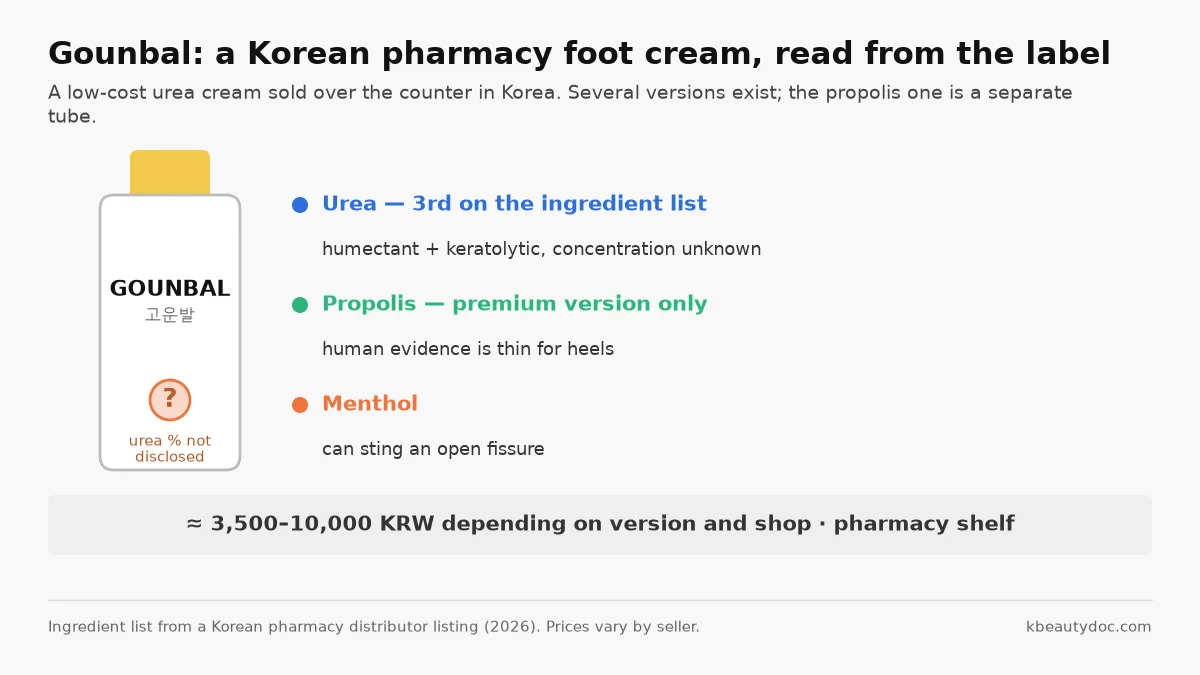
Short answer first: Gounbal (고운발) is an inexpensive Korean foot cream built around urea, sold mostly through pharmacies, and it suits ordinary thickened, dry, rough heels. One version adds propolis and royal jelly. It is a moisturiser — not a treatment for a fungal nail, a bleeding fissure, or a diabetic foot. If your heels are dry and callused, it is a cheap thing to try.
I bought this with my own money — no sample, no payment, no relationship with the maker. Korean reviewers have a phrase for exactly this: 내돈내산 (nae-don-nae-san, “my money, my purchase”).
What the product actually is
Gounbal comes from Wellbeing Health Farm Co., Ltd. ((주)웰빙헬스팜) in Incheon. The name is plain Korean: goun bal, “smooth feet”. It is not one product but several, distinguished mainly by lid colour, and a pharmacist may stock more than one.
The two you are most likely to be handed:
- 웰빙 약국전용 고운발, 100 g — the pharmacy-channel version.
- 명품 고운발, 110 g — the “premium” one, described by pharmacy distributors as a keratin-softening cream with royal jelly and propolis added.
Price surprises visitors. Korean price-comparison listings showed the 110 g tube from about 3,500 KRW, while the maker’s own shop lists its premium tube nearer 9,900 KRW and a 50 g tube at 5,000 KRW — call it 3,500–10,000 KRW depending on size and channel. Exported versions sell for several times that.
On classification I have to be honest: I could not confirm an official regulatory category. The Korean drug-product database returned no licensed drug or quasi-drug under this name, and the ingredient list follows the descending-order style Korean cosmetics use. So the sensible reading is cosmetic, not medicine — an inference from label format, not a licence number. One retailer files it under a “quasi-drug” shop category, which is a shelf label, not a regulator’s.
Reading the ingredient list
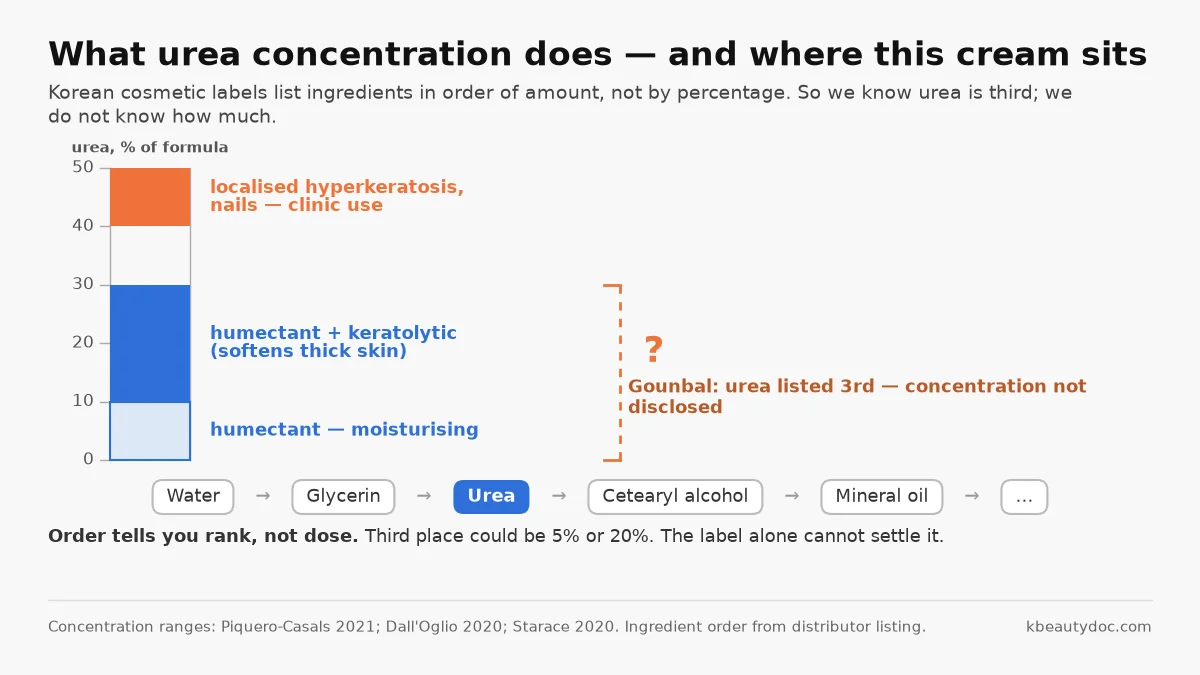
A pharmacy distributor publishes the full list for the 100 g version. In order: purified water, glycerin, urea, cetearyl alcohol, mineral oil, stearic acid, polysorbate 60, glyceryl stearate and its SE form, sorbitan sesquioleate, microcrystalline wax, dimethicone, Artemisia vulgaris extract, arginine, grape seed oil, carbomer, tocopheryl acetate, menthol, beeswax, ethylhexylglycerin, caprylyl glycol, disodium EDTA.
Urea sits third. Korean cosmetic labels give descending order but not percentages, so I could not confirm the urea concentration in any version — not from the maker, not from distributors. That matters, because urea behaves differently at different strengths:
- Below about 10% it works mainly as a humectant, holding water in the stratum corneum [1][2].
- Around 10–30% it also loosens keratin bonds — humectant and keratolytic [1].
- 40–50% is the range used on localised hyperkeratotic plaques and nails [3].
A 2025 systematic review of 31 studies of topical urea found consistent improvement in dryness, scaling and water loss through the skin [4]. The ingredient is well supported. The strength in this tube is not published.
Propolis is what the premium version is marketed on. The evidence is mostly preclinical: a review describes antibacterial, anti-inflammatory and antioxidant activity largely from laboratory and animal work [5]. The strongest human trial I found added 5% topical propolis to standard care in diabetic foot ulcers; ulcer size fell faster over four weeks, though the inflammatory measures did not differ [6].
For cracked or callused heels specifically, I found no direct clinical evidence for propolis. Treat it as a plausible addition, not the reason to buy. And note that propolis is a recognised contact allergen — positive in 3.4% of patients patch-tested by the North American Contact Dermatitis Group in 2017–2018 [7]. If bee products have troubled you before, take the version without it.
The rest is unremarkable and sensible for feet: glycerin and mineral oil to hold and seal water, waxes and dimethicone for an occlusive film, grape seed oil, vitamin E acetate, arginine, mugwort extract — and menthol, which gives the cooling feel and can sting on an open fissure.
Why a Korean pharmacy cream reads differently
No percentage on the front. Western urea creams sell on “10%” or “25%”. Korean labelling does not require it and this brand does not volunteer it, so you buy on ingredient order.
The pharmacy is a retail channel, not a prescription gate. Korean pharmacies sell cosmetics and supplements alongside medicines, so “pharmacy-only” is a distribution decision by the maker. The same logic runs through what is actually worth buying in Korea.
How I would tell someone to use it, in general terms
General information, not advice for your feet specifically.
Apply to damp skin after a shower — urea and glycerin work on water already there. The distributor’s direction is two to three times a day, massaged in; once or twice is realistic for most people.
Socks over the top at night add occlusion and make the biggest visible difference in a week.
A pumice or foot file, gently, on damp skin, once or twice a week. The cream softens; the file removes. Filing hard on dry skin is how fissures start — the argument behind the Italy towel versus the foam glove.
Give it two to four weeks. Callus turns over slowly. Stop if it stings persistently or the skin turns red and itchy — that suggests irritation or allergy, not progress.
Who it suits, and who should be examined first
Reasonable to try: ordinary dry, rough, thickened heels; skin that roughens every winter; feet in closed shoes all day.
See a doctor before self-treating:
- Diabetes, neuropathy, or poor circulation. Foot skin here is not a cosmetic matter, and a small break can become a serious one.
- Deep fissures that bleed, weep, or hurt to walk on. That is a wound.
- Thick, discoloured, crumbling nails, or scaling between the toes — a pattern that often means fungal infection, which a moisturiser does not address.
- One thickened plaque that will not settle or keeps returning in the same spot.
- Known bee-product allergy — skip the propolis version.
The principle is the one I apply to reading any Korean product label: the back tells you more than the front.
How to buy it
Show the name: 고운발 (roughly “go-un-bal”); adding 풋크림 removes any ambiguity. At the counter, “고운발 있어요?” works — “do you have Gounbal?” For the propolis one, ask for 명품 고운발 (myeongpum gounbal).
It is not a duty-free item. A neighbourhood pharmacy is cheapest; some beauty retailers carry the 110 g tube too, alongside the toner pads and other pharmacy-adjacent categories. Check the lid colour — the family looks nearly identical from a distance.
FAQ
Is Gounbal a medicine or a cosmetic?
I could not confirm an official category from a regulatory database, and no drug or quasi-drug licence under that name came up. The ingredient list follows the Korean cosmetic format, so treating it as a cosmetic moisturiser is the reasonable assumption.
How much urea does it contain?
Not published. Korean cosmetic labels give ingredient order, not percentages. Urea appears third on the pharmacy version’s list, so it is present in a meaningful amount, but the number itself is not disclosed.
Does the propolis do anything for cracked heels?
There is no direct trial evidence for that use. Propolis shows antibacterial and anti-inflammatory activity in laboratory work, and one randomised trial in diabetic foot ulcers found faster size reduction when 5% propolis was added to standard care. Neither tells you what it does on a dry heel.
Can I use it on my hands or elbows?
Urea creams are used on many thickened areas. The face is different — a foot formula containing menthol is not designed for facial skin.
Will it help a fungal nail?
No. High-strength urea appears in some nail preparations to soften the plate as part of treatment, but that is a different formulation and concentration, and the infection needs diagnosing first.
How long until I see a change?
For simple dryness, softening within a week or two is typical; thick callus takes longer. If nothing has shifted in a month, the problem is probably not plain dryness.
Is it safe in pregnancy or for children?
Topical urea and glycerin are unremarkable in that context, but the premium version contains a bee product and the formula contains menthol. Check any specific situation with your own clinician rather than a blog.
References
- Dall’Oglio F, Tedeschi A, Verzì AE, Lacarrubba F, Micali G. Clinical evidences of urea at medium concentration. International Journal of Clinical Practice 2020;74(S187):e13815. DOI 10.1111/ijcp.13815
- Piquero-Casals J, Morgado-Carrasco D, Granger C, Trullàs C, Jesús-Silva A, Krutmann J. Urea in dermatology: a review of its emollient, moisturizing, keratolytic, skin barrier enhancing and antimicrobial properties. Dermatology and Therapy (Heidelberg) 2021;11(6):1905-1915. PMID 34596890
- Starace M, Alessandrini A, Piraccini BM. Clinical evidences of urea at high concentration on skin and annexes. International Journal of Clinical Practice 2020;74(S187):e13740. DOI 10.1111/ijcp.13740
- Jawed I, et al. Effect of topical treatment with urea in ichthyosis, atopic dermatitis, psoriasis and other skin conditions — a systematic review. Annals of Medicine and Surgery 2025;87(1):276-284. PMID 40109645
- Oryan A, Alemzadeh E, Moshiri A. Potential role of propolis in wound healing: biological properties and therapeutic activities. Biomedicine & Pharmacotherapy 2018;98:469-483. DOI 10.1016/j.biopha.2017.12.069
- Afkhamizadeh M, et al. Topical propolis improves wound healing in patients with diabetic foot ulcer: a randomized controlled trial. Natural Product Research 2018;32(17):2096-2099. PMID 28826262
- DeKoven JG, Warshaw EM, Reeder MJ, et al. North American Contact Dermatitis Group patch test results: 2017-2018. Dermatitis 2021;32(2):111-123. DOI 10.1097/DER.0000000000000729
Disclaimer: I write about cosmetics and shops as general information, not as a recommendation of any particular product or retailer. I receive no sponsorship, samples or payment from the brands mentioned. Skin responds differently from person to person, so patch test anything new, and see a doctor about a skin condition.

Physician in non-surgical aesthetic medicine, practising in Ansan, South Korea. Every article here is written from clinical practice and the published literature.
About the author · Contact