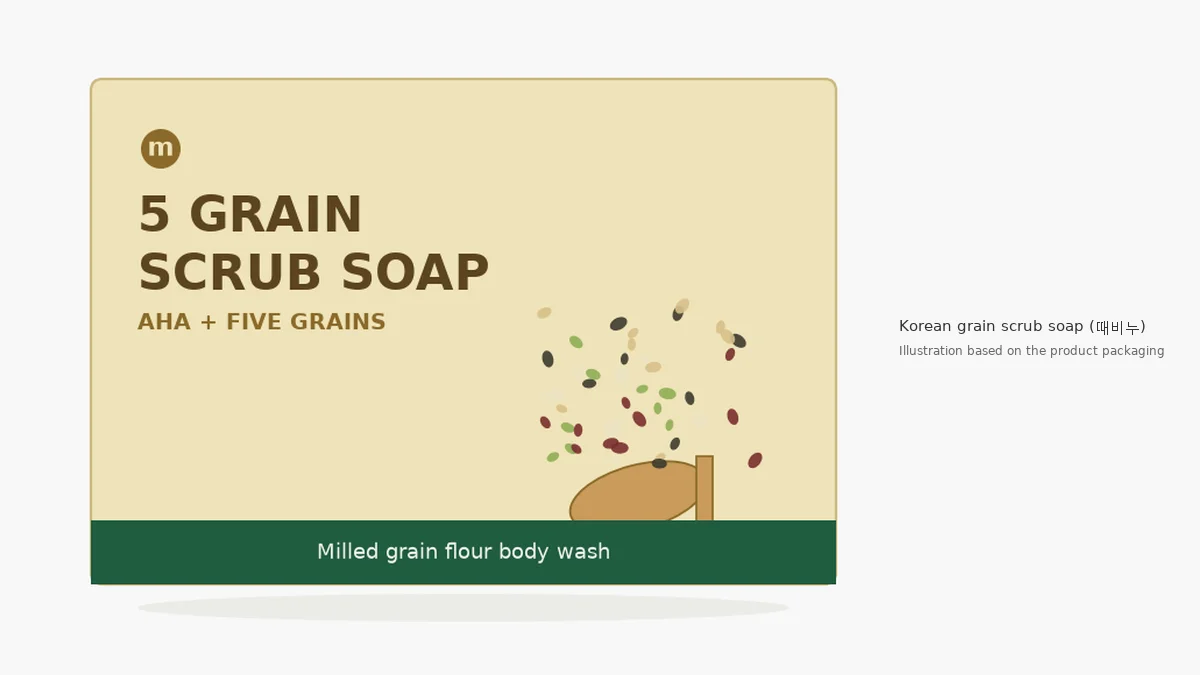
Short answer first: a Korean grain scrub soap is a cleansing bar with milled grains in it, and its honest job is body polishing — making rough, bumpy skin feel and look smoother. It is worth trying for keratosis pilaris (“strawberry legs”) and for the bumpy skin that follows hair removal. It clears neither, the grains are not doing what the packaging implies, and the mitt you use it with can do far more harm than the soap will.
I own one of these bars and an Italy towel, and I mostly do not use the towel because it is unpleasant. That turns out to be the useful part of the story.
What the category actually is
Korean shops call these 때비누 (ttae-binu), literally “dirt soap”: a saponified bar with finely milled grain flour in it. The best-known supermarket version, Mukunghwa’s five-grain bar, lists adzuki bean, mung bean, rice, soybean and Job’s tears, plus fruit extracts the label calls a source of AHA. It costs about the price of a coffee — worth picking up while you are in Korea.
Two things are missing from every label I have read: the acid percentage and the pH. Korean cosmetic labels give ingredient order, not concentration — the same gap I ran into reading a pharmacy foot cream. Assume very little acid, and judge the bar on what it is: a cleanser with mild grit.
Problem one: keratosis pilaris
Keratosis pilaris is the rough, goose-flesh stippling on upper arms and thighs, and it is the main thing people mean by “strawberry legs” — though the nickname also covers dark follicles after shaving and pigment from old ingrown hairs. Three causes, one word.
The mechanism is not simply dead skin blocking a pore. Biopsy work found follicular plugging, hair-shaft abnormalities and a striking absence of sebaceous glands, which the authors read as an early step rather than a consequence [1]. A gland that is not there cannot be scrubbed back. A dermatology review treats the condition as one to manage rather than resolve [2]. Realistic aim: less rough, less visible, more comfortable.
What has trial evidence is a leave-on acid, not a bar of soap. In a randomised comparison, twice-daily 10% lactic acid and 5% salicylic acid creams both cut lesion counts substantially over 12 weeks, lactic acid somewhat more but with more irritation [3].
The acid is the treatment. The soap and mitt are the gentle refining step that lets it land on smoother ground.
Problem two: ingrown hairs after hair removal
A hair that curls back into the follicle wall makes a red, sore bump — the usual reason people reach for a scrub.
Here the strongest evidence is not exfoliation at all. In men with pseudofolliculitis, long-pulsed Nd:YAG hair removal left the treated side with far fewer papules at 90 days [4], and a second study, using sessions 3–4 weeks apart, found sustained reduction in papules, pustules and hair over three months [5]. That interval matters if you book a course, and it helps to know what a laser does inside the follicle before comparing it with a home device.
I could not find a clinical trial testing physical exfoliation for ingrown hairs. That it helps is clinical judgement, not a proven fact. The timing is not: do not scrub skin you shaved, waxed or lasered in the last several days.
Grain by grain: label claim versus checked evidence
Rice bran carries the two most respectable molecules. A 1% ferulic acid cream lowered the melanin index in a split-face study [6], and phytic acid, inside a professional peel, matched a glycolic peel for melasma with less discomfort [7]. Note what both were — not a bar rinsed off in 60 seconds.
Adzuki bean contributes the saponins that make the lather feel as it does, but its published skin work is an animal model using an oral extract. Black sesame gives sesamol, an antioxidant that inhibits tyrosinase in cell work and reduced UV-induced pigmentation in mice [8] — cells and mice, not arms. Job’s tears extracts also inhibit tyrosinase in culture. The tradition is centuries old; the clinical file is not.
Then the claim worth knocking down: these bars are often sold on natural enzymes that digest dead skin. Soap is alkaline, and washing pushes skin surface pH up toward the pH of the bar — where barrier disturbance and irritation come from [9,10]. I found no data showing grain enzyme activity survives that.
The Italy towel, and how to make it bearable
The mitt — 이태리타올 — is viscose rayon, registered as a Korean utility model in 1962 and named for the imported Italian fabric it was first cut from; accounts of who made the first one differ. It is deliberately harsh, and new ones are the worst. What softens it, in order of how much difference it makes:
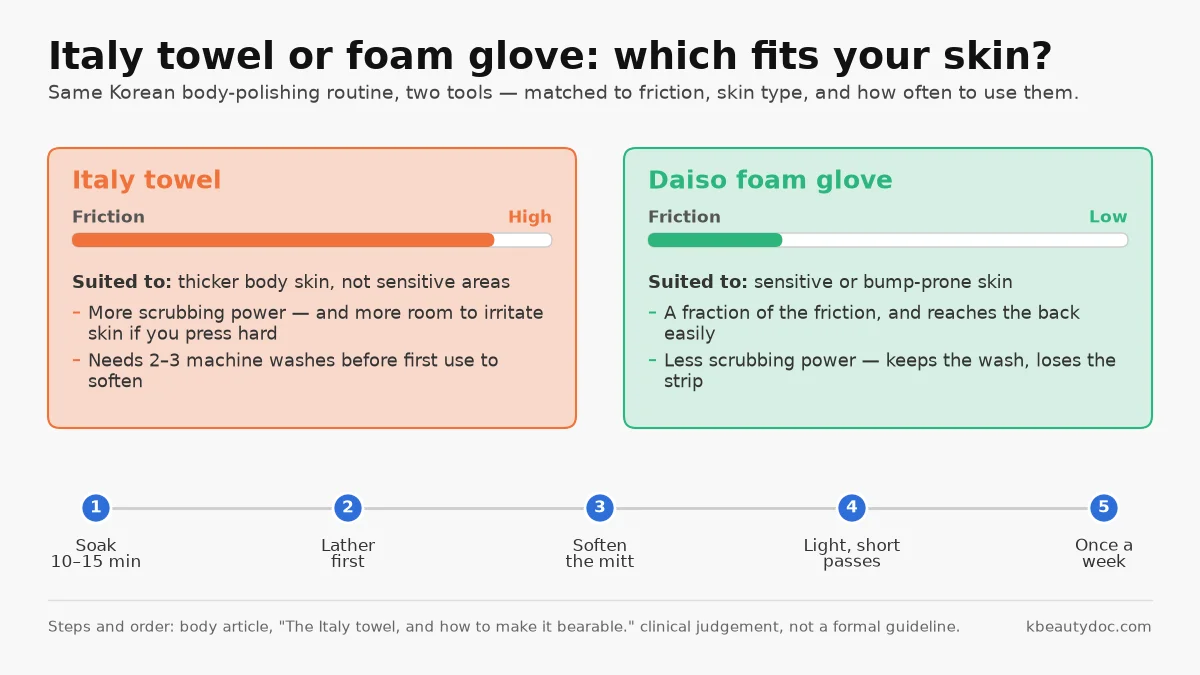
- Machine-wash it two or three times before first use. The nap relaxes; fabric softener helps further but cuts grip.
- Never use it dry. Soak it in hot water until it goes limp.
- Soak yourself first — 10 to 15 minutes. Softened skin gives way; dry skin resists and you compensate with force.
- Lather the soap onto skin first, then let the mitt glide rather than drag.
- Take your hand off it. Short light passes in one direction. Stop at faintly pink, never red or stinging.
- Body only — arms, legs, back. Not face, neck, chest, or over moles.
- Once a week is plenty; twice is the ceiling.
The grey rolls are not a purity meter: they are soaked skin cells plus soap.
The 1,000-won foam glove instead
Yes — the mesh foam gloves sold in Daiso work, and for most people they are the better tool. They whip the bar into lather, give a fraction of the friction, and reach the back.
For keratosis pilaris that is close to a free trade, since the measured improvement came from the acid rather than the abrasion. A soft glove weekly plus a lactic-acid lotion most nights is the version people stay with. The same principle runs through acids in leave-on formats: contact time beats force.
When to skip scrubbing entirely
- Active eczema, sunburn, or any open, weeping or crusted skin.
- Within about a week of laser hair removal, waxing or a peel — or as long as the clinician who treated you specifies.
- Isotretinoin, or inflamed pustular acne on the back or chest.
- Diabetes, neuropathy or poor circulation, where a friction injury is not a cosmetic matter.
- Brown patches appearing exactly where you scrub hardest — shoulder blades, shins, forearms. Long-term nylon-towel rubbing is a recognised cause of frictional pigmentation and cutaneous amyloid deposits [11,12]. Management begins with stopping, so noticing early matters.
General information, not advice about your own skin.
FAQ
Will grain scrub soap get rid of my strawberry legs?
No. Keratosis pilaris is managed rather than cured. The realistic goal is smoother texture, and in trials that came from leave-on lactic or salicylic acid, not a cleansing bar.
Is the mitt or the soap doing the work?
Mechanically, the mitt. The soap softens and lubricates. The mitt is also the part that can injure skin.
How often should I use it?
Once a week suits most body skin, twice at the outside. Daily scrubbing is how people arrive with over-worked skin.
Do the grains actually do anything?
Rice bran’s ferulic and phytic acid have human data — as a leave-on cream and a professional peel, not a rinse-off bar. The rest have cell and animal work only.
Can I use a Daiso foam glove instead of the Italy towel?
Yes, and for sensitive or bump-prone skin it is often the better choice: the lather and the wash with far less friction.
Can I scrub after laser hair removal or waxing?
Not in the days immediately after. Wait until the skin is calm — about a week is a reasonable general marker — and follow what your treating clinician told you.
My shins and back have gone brown where I scrub. Is that normal?
It is common, and a signal to stop. Prolonged friction from nylon towels is a documented cause of frictional pigmentation. Have it examined rather than scrubbing harder.
References
- Gruber R, Sugarman JL, Crumrine D, et al. Sebaceous gland, hair shaft, and epidermal barrier abnormalities in keratosis pilaris with and without filaggrin deficiency. Am J Pathol 2015;185(4):1012-1021. DOI: 10.1016/j.ajpath.2014.12.012
- Wang JF, Orlow SJ. Keratosis pilaris and its subtypes: associations, new molecular and pharmacologic etiologies, and therapeutic options. Am J Clin Dermatol 2018;19(5):733-757. DOI: 10.1007/s40257-018-0368-3
- Kootiratrakarn T, Kampirapap K, Chunhasewee C. Epidermal permeability barrier in the treatment of keratosis pilaris. Dermatol Res Pract 2015;2015:205012. DOI: 10.1155/2015/205012
- Ross EV, Cooke LM, Timko AL, et al. Treatment of pseudofolliculitis barbae in skin types IV, V, and VI with a long-pulsed neodymium:yttrium aluminum garnet laser. J Am Acad Dermatol 2002;47(2):263-270. DOI: 10.1067/mjd.2002.124081
- Weaver SM, Sagaral EC. Treatment of pseudofolliculitis barbae using the long-pulse Nd:YAG laser on skin types V and VI. Dermatol Surg 2003;29(12):1187-1191. DOI: 10.1111/j.1524-4725.2003.29387.x
- Zhou J, Kobayashi M, Kimura H, et al. Exploratory study on the effect of ferulic acid derived from rice bran on dull skin. Drug Discov Ther 2026;20(3):245-253. DOI: 10.5582/ddt.2026.01024
- Faghihi G, Taheri A, Shahmoradi Z, Nilforoushzadeh MA. Solution of azelaic acid (20%), resorcinol (10%) and phytic acid (6%) versus glycolic acid (50%) peeling agent in the treatment of female patients with facial melasma. Adv Biomed Res 2017;6:9. DOI: 10.4103/2277-9175.200784
- You Y, Wu M, Liu Y, et al. Sesamol inhibited ultraviolet radiation-induced hyperpigmentation and damage in C57BL/6 mouse skin. Antioxidants 2019;8(7):207. DOI: 10.3390/antiox8070207
- Ali SM, Yosipovitch G. Skin pH: from basic science to basic skin care. Acta Derm Venereol 2013;93(3):261-267. DOI: 10.2340/00015555-1531
- Hawkins S, Dasgupta BR, Ananthapadmanabhan KP. Role of pH in skin cleansing. Int J Cosmet Sci 2021;43(4):474-483. DOI: 10.1111/ics.12721
- Macsween RM, Saihan EM. Nylon cloth macular amyloidosis. Clin Exp Dermatol 1997;22(1):28-29. DOI: 10.1046/j.1365-2230.1997.1770598.x
- Yoshida A, Takahashi K, Tagami H, Akasaka T. Lichen amyloidosis induced on the upper back by long-term friction with a nylon towel. J Dermatol 2009;36(1):56-59. DOI: 10.1111/j.1346-8138.2008.00586.x
Disclaimer: I write about cosmetics and shops as general information, not as a recommendation of any particular product or retailer. I receive no sponsorship, samples or payment from the brands mentioned. Skin responds differently from person to person, so patch test anything new, and see a doctor about a skin condition.

Physician in non-surgical aesthetic medicine, practising in Ansan, South Korea. Every article here is written from clinical practice and the published literature.
About the author · Contact