A patient came to my room convinced she had developed grey pigmentation under both eyes. It was mascara — three days of it, because the remover that had always worked for her did not touch the formula she had switched to in the spring.
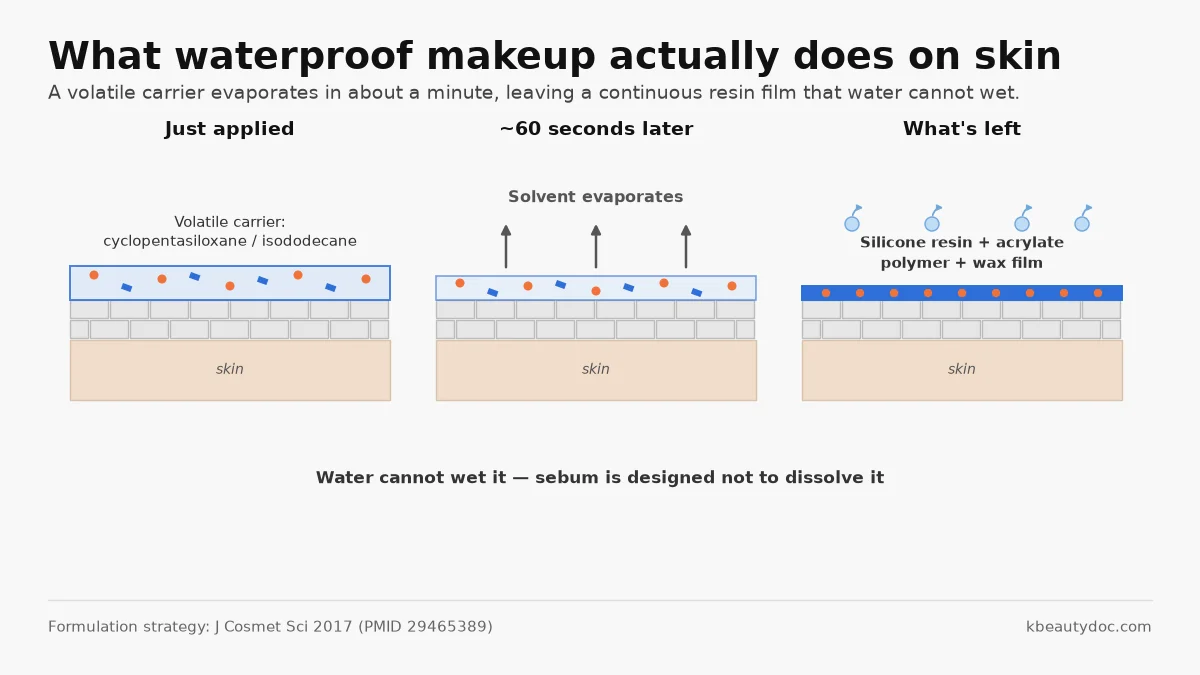
The short version. Waterproof makeup no longer simply repels water. It builds a film on your skin: a volatile solvent carries pigment onto the face, evaporates within a minute, and leaves a continuous layer of silicone resin, acrylate polymer and wax. Water cannot wet that film, and modern versions are engineered so your own sebum cannot loosen it either. That is why washing harder does nothing, and why the answer is a solvent — an oil or balm — then a normal foam.
“Waterproof” has never meant what it sounds like
In sunscreen, regulators stopped allowing the term altogether: the US FDA permits only “water resistant (40 minutes)” or “water resistant (80 minutes)”, because everything eventually comes off. Makeup is not regulated the same way, but the physics are identical. What changed over twenty years is not that the film became unbreakable — it is that it became much better at resisting the three things that used to defeat it: water, sweat and oil.
What is actually in the tube
Open the ingredient list of a long-wear liner or mascara and you are reading a small polymer formula.
The volatile carrier. Cyclopentasiloxane, isododecane or a light isoparaffin makes up much of the wet product. Its job is to spread thinly, then leave. Within roughly a minute of contact with skin at 32 °C it has largely evaporated, and everything dissolved in it is deposited as a solid layer. Nothing about that layer is liquid any more, which is the whole trick.
The silicone resin. Trimethylsiloxysilicate is the workhorse. It is not an oil but a rigid three-dimensional silicone network — think of a glassy mesh rather than a grease. Polypropylsilsesquioxane does a similar job. These resins give adhesion and gloss retention and are the main reason a modern formula survives a swim.
The organic film formers. Acrylates copolymer, acrylates/dimethicone copolymer, ammonium acrylates copolymer, VP/eicosene copolymer. Water-based waterproof mascaras lean on these: the water evaporates, the polymer particles coalesce into a continuous flexible sheath around each lash.
Waxes and treated pigments. Beeswax, carnauba and synthetic waxes are solid at skin temperature and give body. Pigments are usually surface-treated with triethoxycaprylylsilane or dimethicone, so iron oxides behave like tiny hydrophobic beads rather than powder that sweat can wet.
The part that genuinely evolved: sebum resistance
Twenty years ago a “waterproof” product could survive a pool and still slide off a shiny T-zone by lunchtime, because sebum dissolves the oils that hold pigment in place.
The formulating answer is a deliberate “hard plus soft” architecture: rigid resins and particles blended with softer oils, tuned so the two mix happily with each other but badly with sebum [1]. Wear time stopped being a matter of piling on more wax. That is the honest technical answer to “why is it harder to remove than it used to be.”
Formulas are changing again for a different reason. In the EU, cyclopentasiloxane (D5) is being cut to a 0.1% limit in leave-on cosmetics under Regulation (EU) 2024/1328 — an environmental decision, not a skin-safety one — pushing brands toward carriers such as isododecane.
Why your face wash loses this fight
A foaming cleanser works by micelles picking up sebum and loose dirt. A cross-linked resin film is not a droplet of sebum; there is nothing for a micelle to carry away, and the surfactant simply sits on top. Meanwhile, surfactant left behind in the skin after rinsing is exactly what damages the barrier [2]. Washing twice as hard costs you barrier and buys you very little pigment.
What does work is a solvent of matching polarity. Cleansing oils and balms use esters and light hydrocarbons that swell and disperse the film, plus emulsifiers so water can then carry the mixture off. The foam that follows is there to clear the oily residue and the emulsifier, not the makeup. The tool matters too: the puff, not the formula, is where cushion breakouts usually start. The two-step sequence is formulation logic and clinical habit rather than a randomised trial — a reasonable inference, not proven fact.
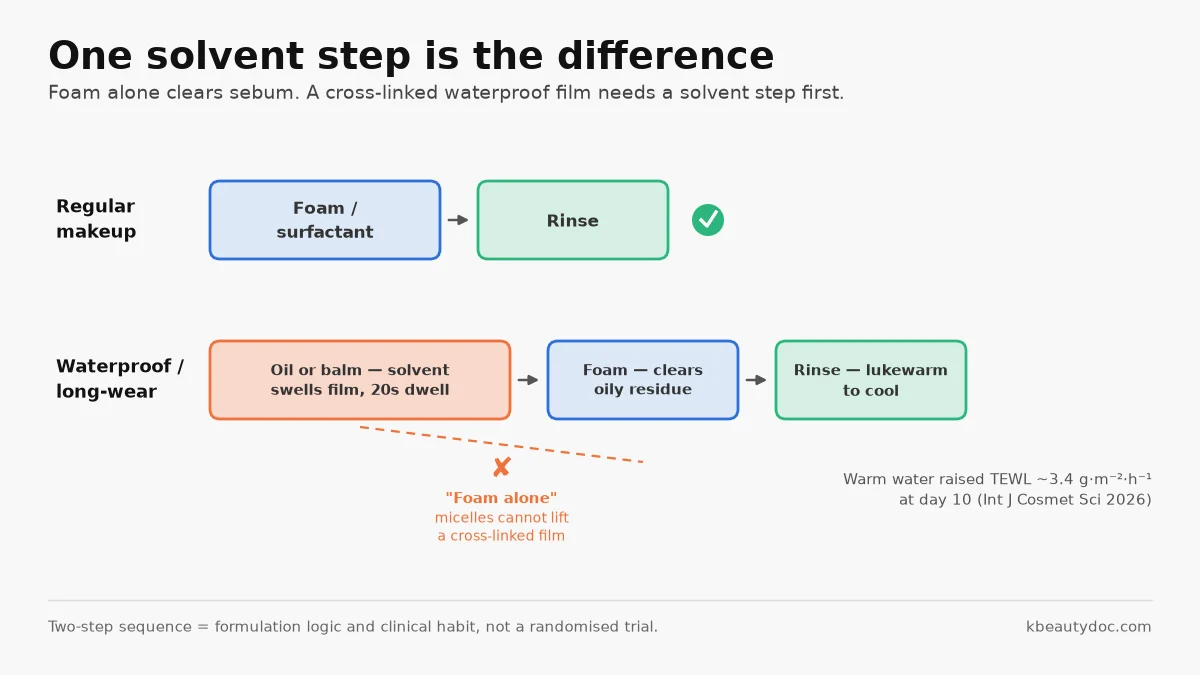
One thing has been tested. In a ten-day randomised study of adults using a cleansing balm, washing with warm water measurably increased water loss through the skin, while cool water did not — and cool water used less of it [3]. Temperature and dwell time are the levers, not pressure. The same restraint applies to the routine in my guide to Korean cleansing foams.
What I care about as a dermatologist
The eyelid, not the cheek. Eyelid skin is the thinnest on the face, and the damage I see comes from friction, not chemistry. Let a soaked pad rest for twenty seconds and let the solvent work. Eye cosmetics migrate across the lid margin into the tear film, and applying inside the lash line is worse than outside [4]. One study also found more loss of the small oil glands in the lid among makeup users than non-users [5] — an association, not proof that mascara causes it.
Breakouts. A film left on overnight is occlusive, but the blanket fear of “acne cosmetica” has not aged well: in a case-control study, people who used more cosmetics had less adult acne, not more — though individual products can still be culprits [6]. Judge the one product, not the category.
Allergy. The polymers themselves are rarely the problem: patch testing across the UK and Ireland found allergy to the common acrylate co-polymers to be rare [7]. Fragrance and preservatives remain the likelier suspects in an itchy lid.
If a rash, persistent stinging or eye discomfort keeps returning, that is a reason to be examined in person rather than to keep swapping removers. And if a product stings your eyes the moment you apply it, the mechanism may be the same one I describe for sunscreen in the eyes — a fluid film migrating where it was never meant to go.
FAQ
Is waterproof makeup bad for my skin?
Not inherently. The risks are mechanical and situational — friction during removal, a film left on overnight, and product migrating into the eye.
Why did my old remover stop working?
Formulas moved from wax-heavy to resin-and-polymer systems. A bi-phase remover built for waxes may not swell a silicone resin film, so a balm or oil with more ester content often does better.
Do I really need two cleansing steps?
For a film-forming product, one solvent step and one surfactant step is the logical pair. For a light tinted moisturiser, a single mild wash is usually enough. Extra steps are not virtue.
Is micellar water enough?
Often not for long-wear eye products. Micelles are good at sebum and light makeup; a cross-linked film needs a solvent, or a long soak and patience.
Hot water melts it better, doesn’t it?
Slightly, but the trial above showed warm water measurably raised water loss through the skin over ten days [3]. Lukewarm to cool, with more dwell time, is the better trade.
Can leftover mascara really look like pigmentation?
It can and it does. Grey-brown shadow that lifts with an oil pad over a few nights was never melanin.
Should I use waterproof formulas after a clinic procedure?
Ask the clinician who treated you — it depends entirely on what was done and how the skin is healing. While a barrier is repairing, less film and less rubbing is the general principle.
References
- Li Z, Maxon B, Nguyen K, Lee M, Gu M, Pretzer P. A general formulation strategy toward long-wear color cosmetics with sebum resistance. Journal of Cosmetic Science 2017;68(1):91-98. PMID 29465389
- Walters RM, Mao G, Gunn ET, Hornby S. Cleansing formulations that respect skin barrier integrity. Dermatology Research and Practice 2012;2012:495917. doi:10.1155/2012/495917
- Long S, Fenn C, Harvey J, Ward S. Cool versus warm water for facial cleansing: a randomised controlled clinical study of skin barrier, skin physiology, cleansing efficacy and water consumption. International Journal of Cosmetic Science 2026. doi:10.1111/ics.70120
- Wang MTM, Craig JP. Investigating the effect of eye cosmetics on the tear film: current insights. Clinical Optometry 2018;10:33-40. doi:10.2147/OPTO.S150926
- Ercan ZE. Effect of eyeliner and mascara use on tear film and meibomian glands. Saudi Journal of Ophthalmology 2022;36(1):113-116. PMID 35971493
- Singh S, Mann BK, Tiwary NK. Acne cosmetica revisited: a case-control study shows a dose-dependent inverse association between overall cosmetic use and post-adolescent acne. Dermatology 2013;226(4):337-341. PMID 23859829
- Soriano L, Chowdhury MMU, Cousen P, Dawe S, et al. Sensitisation to the acrylate co-polymers glyceryl acrylate/acrylic acid co-polymer, sodium polyacrylate and acrylates/C10-30 alkyl acrylate cross-polymer is rare. Contact Dermatitis 2024;91(6):491-496. doi:10.1111/cod.14679
Disclaimer: I write about cosmetics and shops as general information, not as a recommendation of any particular product or retailer. I receive no sponsorship, samples or payment from the brands mentioned. Skin responds differently from person to person, so patch test anything new, and see a doctor about a skin condition.

Physician in non-surgical aesthetic medicine, practising in Ansan, South Korea. Every article here is written from clinical practice and the published literature.
About the author · Contact