The dirtiest object in most makeup bags is not the makeup. It is the small damp sponge sitting on top of it.
The short answer
A cushion puff is warm, wet, pressed against your face, then shut in a plastic box for a week — a friendlier home for microbes than the preserved, factory-tested liquid underneath. So if a cushion seems to have made your skin worse, the sponge is the first thing I look at, not the ingredient list. The routine below is deliberately boring: wash the puff weekly with the cleanser already in your bathroom, dry it fully, wipe the lid, wash your hands before opening the compact, and replace the sponge before the formula runs out. Nothing here asks you to buy anything.
Why the sponge, and not the formula
The liquid in the pan is a manufactured product with a preservative system, tested before sale. What is not tested is what happens once a used sponge is pressed back into it.
The numbers are unusually clear for a cosmetic question. A UK laboratory study cultured donated, in-use products and found bacteria in 79–90% of them [1] — but damp makeup sponges were in a different league, with far heavier growth including fungi and gut bacteria. The behaviour explains it: 93% had never been cleaned, and 64% had been dropped on the floor and used anyway.
Korean cushions have been looked at specifically. A study of 81 in-use samples found bacteria in 20.0% of cushion compacts versus 2.8% of tubes, pumps and pressed compacts [2], and the authors’ advice was to wash the puff weekly. The same figure appears in my guide to reading cushion labels.
Now the honest part: that study found no direct correlation between the organisms it isolated and acne, so “a dirty puff causes your breakouts” is not something I can state as fact. What I can say is that every press carries sebum, dead cells and whatever your fingertips touched last back into a moist pan, and that keeping the sponge clean costs nothing. Plausible mechanism, cheap fix, weak outcome data — clinical judgement, not a proven chain of cause and effect.
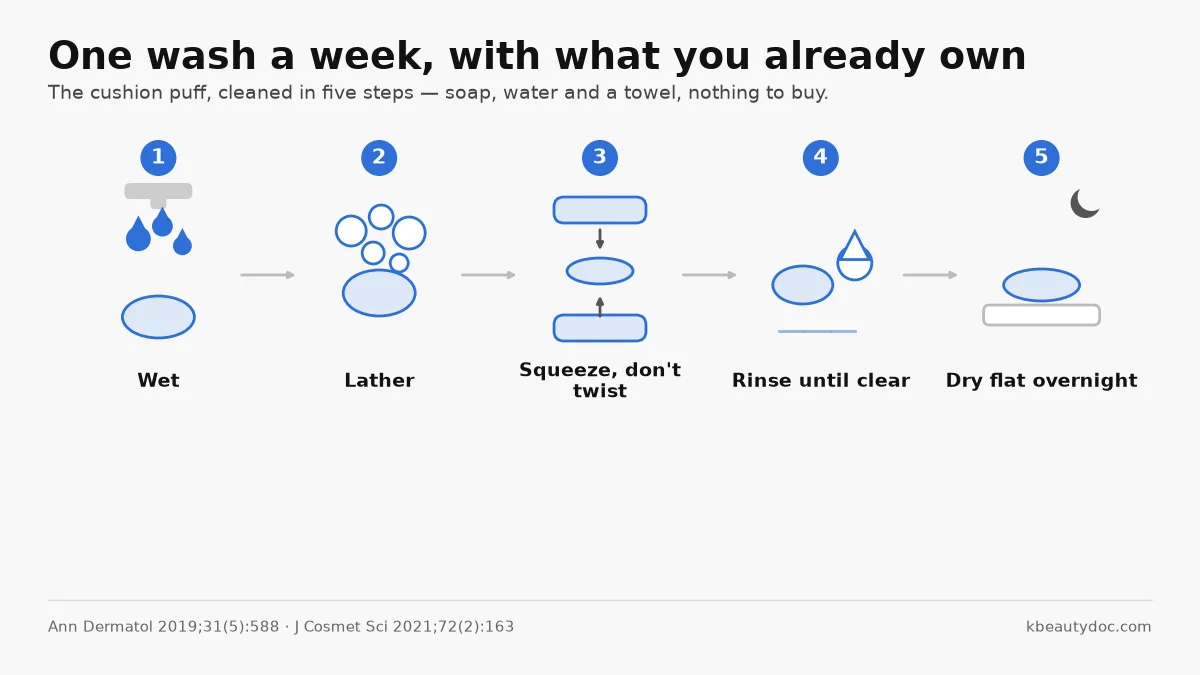
The weekly wash, in five steps
- Wet the puff under lukewarm water. Not hot — heat achieves nothing and stiffens some sponge materials.
- Work in whatever you already wash with — hand soap, a bar, or your face cleanser. A Polish laboratory comparison took a used sponge from 617 bacterial colonies down to three with soap, against plain water [3]. They used a bactericidal soap; ordinary soap is my substitute, and that is judgement rather than tested fact.
- Squeeze, do not rub or wring. Press it between your palms so water moves through. Twisting tears the internal structure and the puff stops laying product evenly.
- Rinse until the water runs clear. Pigment hides in the middle; if the squeeze water is still beige, keep going.
- Dry it flat and fully, out of the compact, on a clean towel, overnight. This is the skipped step that matters most — a sponge sealed damp into a lid is a small humid box.
All five use water, soap and a towel. Do it on the night you cleanse thoroughly anyway — the routine in my Korean cleansing foam guide already has your hands in the sink.
Four habits that cost nothing
Wipe the inside of the lid with a dry tissue while the puff is out. That plastic sits on a wet sponge all day.
Wash your hands before opening the compact. You touch the puff, the lid and often the pan.
Do not share a cushion or lend the puff. Sharing moves one person’s skin flora into another’s moist pan.
Keep the spare puff. Most refills ship with one. Rotate them — one in use, one drying — and the excuse for closing a wet sponge into a box disappears.
Take the makeup off properly. A foam does not lift waterproof formulas built on film formers; oil first, then foam.
Two timing points. In Korean summer humidity, or on days you are masked for hours, wash more often than weekly: mask wearing is associated with more facial skin complaints, with acne the most commonly reported in a survey of 833 people, [4]. And treat the sponge as the shortest-lived part of the product. European cosmetics carry an open-jar symbol with a month count, required for products lasting over 30 months [5]; read your own compact’s number rather than a figure from a blog.
What not to do
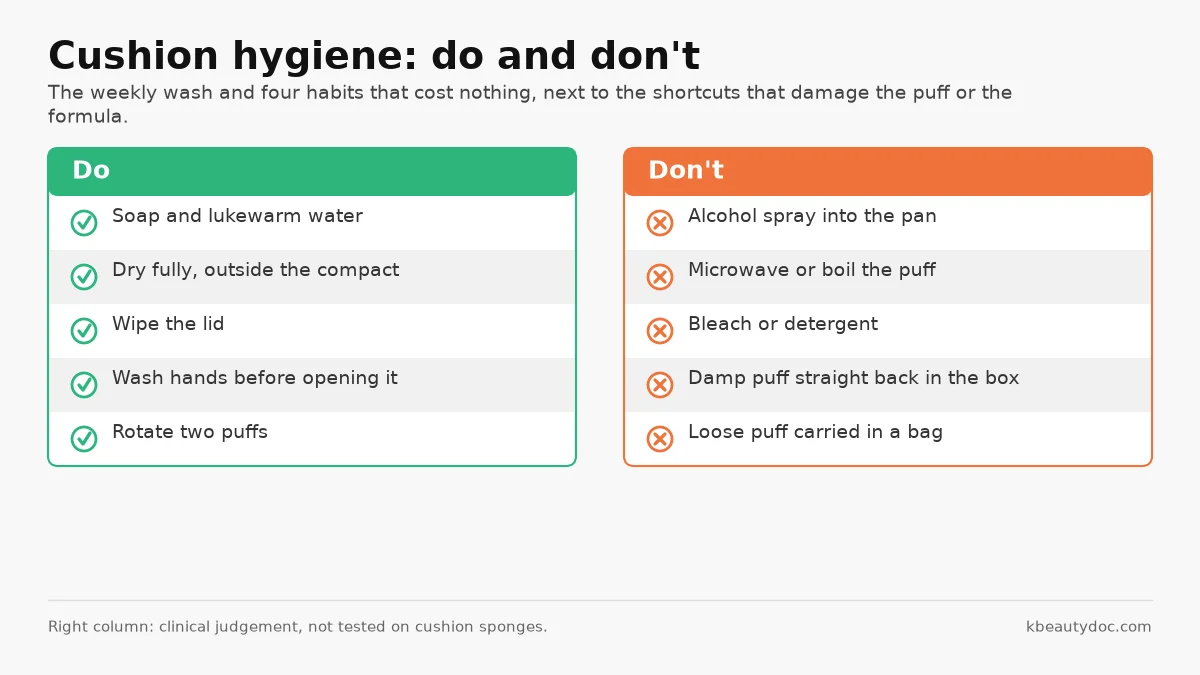
Do not spray alcohol into the pan. Disinfecting a separate applicator in a lab is not the same as soaking a formulated emulsion; alcohol can split the product and change how it applies.
Do not microwave or boil the puff. These sponges are polyurethane or latex-type foam, and that much heat deforms them.
Do not use bleach or detergent. Residue sits in a porous sponge you then press onto your face, and neither has been evaluated for this use.
Do not wash it and put it straight back, and do not carry a loose puff in a bag. A damp sponge in a shut compact undoes the wash; a loose one collects lint and comes back damp.
If you are breaking out, is it the cushion?
No article can tell you what is happening on your own face. But two general patterns are worth knowing before you throw a compact away.
Where. Product-related bumps sit where the product goes and is pressed hardest — cheeks, jaw, the mask line. Hormonal patterns cluster along the lower face and follow a cycle, not a product.
When. If the change began within days of a new compact, the formula is a fair suspect. If a cushion you have used for eight months suddenly seems to be the problem, the sponge and the calendar are likelier than ingredients that have not changed.
When it is the formula, not the sponge. Three things account for most of it. Fragrance allergens — limonene, linalool, citronellol near the end of the list — give stinging and itch rather than bumps. Silicones and film formers, the reason a cushion survives twelve hours, also make it harder to remove, and what stays on overnight is what sits in a pore. The UV filters, since a cushion is also a sunscreen, often explain a warm prickling face that is irritation, not acne. Reading those three lines on the box separates a formula problem from a hygiene one.
Change one thing at a time, then wait two to three weeks — roughly how long a comedo takes to become visible. Oil and pores have their own logic, which I cover in why oil widens pores. If bumps are painful, spreading or leaving marks, have a clinician look in person instead of experimenting further — in Korea there are prescription options worth asking about.
FAQ
How often should I really wash the cushion puff?
Weekly, per the Korean study that cultured used cushions — more often in humid weather or if you are masked for hours.
Can I just use water?
Water alone did worse than soap in the applicator study — 617 colonies down to three with soap. Soap is already in your bathroom.
What soap should I buy for this?
None. Hand soap, a plain bar or your face cleanser all work. A routine that needs no shopping trip is the one people keep doing.
How long does the puff need to dry?
Overnight, flat, outside the compact. If it feels cool or heavy, it is still wet.
Should I replace the sponge or the whole cushion?
The sponge first — it has the shortest useful life, and refills usually include a new one.
Does a dirty puff cause acne?
Not shown directly — the container study found no clear correlation between the bacteria it isolated and acne. Washing is hygiene and better application, not treatment.
I had a clinic procedure. When can I use my cushion again?
Ask the clinician who treated you — it depends on what was done. While skin is healing, a re-used sponge is one thing I would keep away from it, and after work that leaves open points, such as punch techniques for acne scars, the wait is longer than after a light laser.
References
- Bashir A, Lambert P. Microbiological study of used cosmetic products: highlighting possible impact on consumer health. Journal of Applied Microbiology 2020;128(2):598-605. PMID 31597215
- Contribution of container types on cosmetics contamination. Annals of Dermatology 2019;31(5):588. PMID 33911656
- Załęcki P, Twardowska J, Nowicka D, Andrzejewski W. Effectiveness of the disinfection of reusable make-up applicators — initial experiences. Journal of Cosmetic Science 2021;72(2):163-171. PMID 35361322
- Techasatian L, Lebsing S, Uppala R, et al. The effects of the face mask on the skin underneath: a prospective survey during the COVID-19 pandemic. Journal of Primary Care & Community Health 2020;11:2150132720966167. PMID 33084483
- Regulation (EC) No 1223/2009 on cosmetic products, Article 19(1)(c) — period-after-opening labelling. Official Journal of the European Union. EUR-Lex CELEX:32009R1223
Disclaimer: I write about cosmetics and shops as general information, not as a recommendation of any particular product or retailer. I receive no sponsorship, samples or payment from the brands mentioned. Skin responds differently from person to person, so patch test anything new, and see a doctor about a skin condition.

Physician in non-surgical aesthetic medicine, practising in Ansan, South Korea. Every article here is written from clinical practice and the published literature.
About the author · Contact