Three things to know first
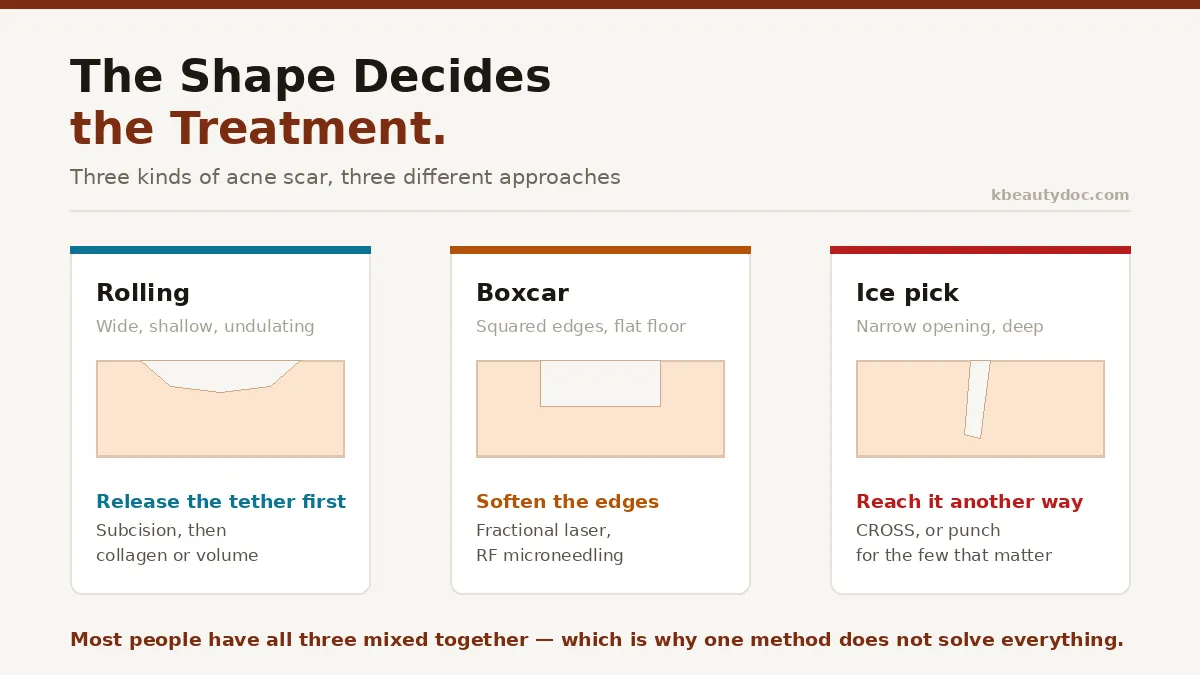
- Rolling, boxcar, ice pick — the shape decides the treatment. Each needs a different approach.
- Get the shape wrong and even good equipment will not work.
- On a short trip, treating only the few that bother you most is the realistic plan.
First, look at them properly
Under front-on lighting scars are hard to see: nothing casts a shadow. Use angled light — turn your face sideways at a window, or shine a lamp from the side, and the depressions appear. Clinics assess them the same way.
The three shapes
Rolling — wide and shallow, like a wave
Edges are indistinct and the depression broad, giving an undulating surface. The problem is not at the surface: fibrous tissue beneath tethers the skin downward, and that pull presses it in. So treating only the surface lets it sink again.
Boxcar — a squared-off pit
Sharply defined edges with a flat floor, like a chickenpox mark. The angular edge casts a shadow, which makes it look deeper than it is.
Ice pick — narrow and deep
A very small opening running deep into the skin. These are the deepest of the three, yet the narrow opening makes them look like dots from above.
Most people have more than one type. Rolling and boxcar with a few ice pick scars is typical, which is why one method does not solve everything.
Treating each shape
Rolling — release the tether first
Subcision is used: a fine needle is passed under the skin to cut the fibrous tissue pulling it down. Once released the surface lifts, and collagen stimulation or volume is added so it does not sink again.
The order is the point. Filling the surface without releasing the tether does not last.
Boxcar — soften the edges
Since the angular edge creates the shadow, shaving the edges into a gentler slope is the approach.
Fractional lasers and RF microneedling do this, softening the boundary gradually across multiple sessions.
Deep boxcar scars are different. Surface work alone is insufficient where the depth is considerable.
Ice pick — two routes
Narrow opening, considerable depth means ordinary lasers struggle to reach: a laser treats a broad surface, and this scar runs deep through a small hole.
CROSS — a high-concentration agent placed precisely inside the scar channel, prompting regeneration from within. It works, but not in one session, and needs repeating every few weeks.
Punch — the scar is cut out with a small circular instrument. One session finishes that scar, but it needs healing time.
What I run into in the room
Most people arrive believing a fractional laser handles acne scars, and the hardest part of the visit is explaining that the shape decides the plan. Boxcar and rolling scars can often be worked on by taking the fractional settings higher. Ice pick scars are the ones that break the rule: a large one may be considered for punch excision, while a small one may need TCA CROSS [1] — a drop of high-strength trichloroacetic acid placed into the pit alone. In Asian skin I am careful with that, because pigmentation afterwards is a realistic outcome. This is how I reason, not a plan for anyone I have not examined.
If you are visiting
CROSS does not fit a travel schedule. It is built on repetition, and one session before flying home achieves little.
So the realistic choice is punch — not across the whole face, only the few that genuinely bother you.
The two or three you notice in the mirror every day are the ones worth treating.
And you need to allow time in the schedule.
Punch is surgery
Not a procedure — a small operation. Prepare accordingly.
What it does is this: it converts a round pit into a fine line.
The scar is excised and the edges drawn together. Instead of a round depression, a short line remains — far less visible than a pit.
How it heals
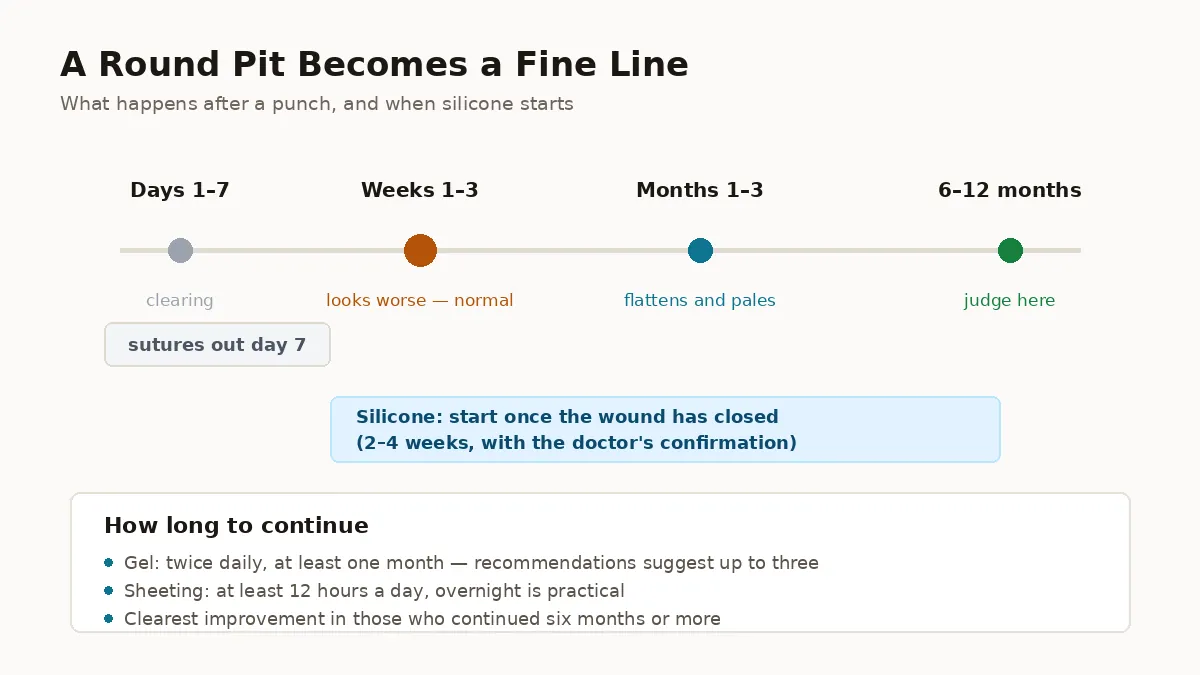
First few days — clearing. Redness and slight swelling: the starting signal, not a problem.
Weeks 1 to 3 — filling. New tissue fills the gap. The line looks distinctly red, and many people feel it looks worse than before.
Months 1 to 3 — refining. The collagen laid down in a hurry is reorganised; redness recedes and the line flattens.
Months 6 to 12 — settling. It keeps fading. Judge the final result here.
Do not assess at week three — construction is in progress.
What the schedule requires
Sutures come out — generally at seven days.
Two options — stay long enough to have them out, or have them removed at home. Decide before the procedure, not after.
Have it early in the trip — done on the last day, nobody sees how it heals.
And you will have marks on your face for those days, which matters if photographs are planned. When you do start covering them, the sponge matters more than the shade — a re-used cushion puff on healing skin is the part I would change first.
Silicone products — when, and for how long
This is the best-evidenced part of scar aftercare.
International scar management recommendations classify silicone gel and sheeting as first-line — for preventing and for treating linear scars.
When to start
Once the wound has fully closed — never before.
Generally two to four weeks after surgery, confirmed with the doctor who operated. Suture removal is often the reference point.
Starting late is safer than starting early, though once the scar has settled the effect diminishes.
How long to use it
Gel — twice daily for at least one month, with recommendations suggesting up to three months.
Sheeting — at least 12 hours a day, overnight being the practical approach. Pooled analyses found the clearest improvement past six months.
In short — start once the wound is closed and continue at least three months, ideally six.
Why it works
Silicone over a scar stops water escaping. Dry scar tissue signals that healing is incomplete, so the body keeps laying down collagen — that is how a scar thickens. Hold the hydration and that signal settles. Nothing is absorbed: it works by covering, which is why consistency matters more than the product.
If it is not working
If two months of consistent use produces no change, discuss it again — a raised, itchy or painful scar may need more.
While it heals
Do not pick the crusts. Removing them early leaves a worse mark.
Avoid UV. New tissue is vulnerable, and exposure now is what makes red marks persist.
Be careful where the skin moves. Constant tension widens the line, particularly around the mouth.
Actives come later. Acids, retinoids and spicule products wait until healing is complete; the home spicule dose is not the clinic dose.
What to know
Scars do not disappear. They are converted into a form that shows less.
Active acne must be controlled first. Treating scars while new ones are still forming produces new scars alongside.
Combining methods is normal: mixed scar types, mixed treatment.
It takes months.
What to ask at consultation
“What types are my scars?” If several are mixed, ask what is planned for each.
“Is there anything that fits my schedule?” Say how many days you have.
“When and where do the sutures come out?” Settle before a punch.
“When do I start silicone?” You need confirmation that the wound has closed.
FAQ
Will one laser session remove my scars?
No. Scar treatment assumes multiple sessions, and the goal is to make them less noticeable.
Do lasers not work on ice pick scars?
The opening is narrow and the depth considerable, so ordinary lasers struggle to reach — CROSS or punch instead.
I only have a few days — what can I do?
Treating two or three scars that genuinely bother you with punch is realistic, but it needs healing time — schedule it early.
My scar looks bigger after the punch.
Common between weeks one and three, while new tissue forms. It fades from about a month.
Does the brand of silicone product matter?
Any silicone product, gel or sheet, works. What matters is covering consistently.
When do I stop using silicone?
At least three months, ideally six — judge when the scar stops changing.
Can I treat scars while I still have active acne?
Controlling the acne comes first, or new scars form alongside the treated ones.
References
- Lee JB, Chung WG, Kwahck H, Lee KH. Focal treatment of acne scars with trichloroacetic acid: chemical reconstruction of skin scars method. Dermatologic Surgery 2002;28(11):1017-21. PMID 12460296
Disclaimer: This article explains treatments in general terms and is not a diagnosis or a treatment plan. What happens varies from person to person, and no article can tell you what to expect. Please discuss your own case with a licensed medical professional where you live. I do not endorse specific clinics or device brands.

Physician in non-surgical aesthetic medicine, practising in Ansan, South Korea. Every article here is written from clinical practice and the published literature.
About the author · Contact