Potenza, a fractional laser, a chemical peel — three different classes of treatment, and only one of them fits your problem.
Patients researching Korean acne treatments on social media meet device names — Potenza most often. Those machines are good. But a brand name is one product within a category, and Korean clinics use several categories for acne and pores, each doing something different. Asking for a machine by name is ordering a tool without describing the job.
Here is what the categories actually are, what each is for, and the question that matters more than any of them.
The device classes at a glance
| Class | What it does | Best suited to | Downtime |
|---|---|---|---|
| RF microneedling | Needles deliver heat into the dermis; suppresses sebaceous activity, tightens pores, remodels scars | Oily skin, enlarged pores, boxcar and rolling scars | 2–4 days redness |
| Fractional ablative laser (CO2, erbium) | Removes microcolumns of tissue; strong resurfacing | Deeper, established scarring | 5–10 days, significant |
| Fractional non-ablative laser (1550/1927 nm) | Heats without removing tissue | Mild texture, post-inflammatory marks | 1–3 days |
| Vascular laser / IPL | Targets redness rather than texture | Post-acne erythema, active inflammatory redness | Minimal |
| Chemical peel | Chemical exfoliation, comedolytic | Active comedonal acne, congestion | Varies by agent |
| Subcision | Mechanical release of tethered scars | Rolling scars specifically | Bruising, several days |
Most acne-scar plans use more than one of these. Anyone offering a single device as the complete answer is simplifying for the sale.
RF microneedling — the class the brand names belong to
This is the category patients arrive asking about, so it is worth understanding.
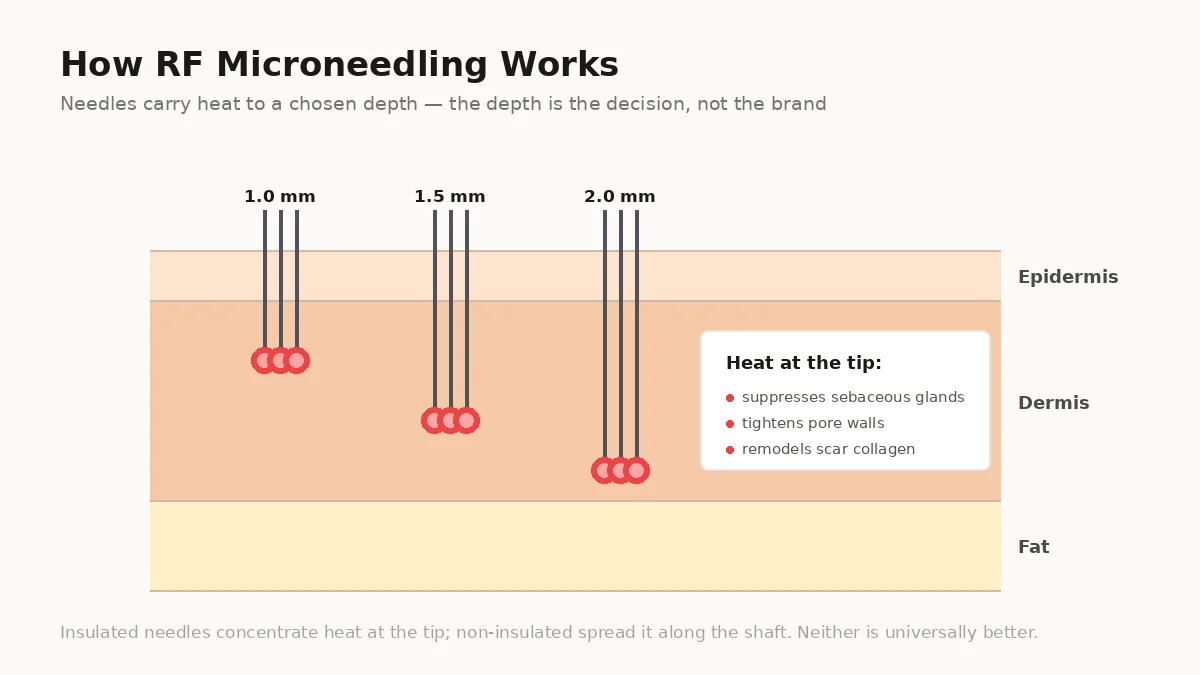
RF microneedling combines two mechanisms. Fine needles create controlled micro-injury in the dermis, and radiofrequency energy is delivered through those needles as heat at a set depth. The physical injury triggers a wound-healing response. The thermal energy does the heavier work — suppressing overactive sebaceous glands, contracting the tissue around enlarged pores, and remodeling scar collagen.
What actually varies between devices in this class: needle count and gauge, insulated or non-insulated needles, how precisely depth is set, and how energy is pulsed. Insulated needles concentrate heat at the tip and spare the epidermis; non-insulated ones spread it along the shaft. Neither is universally better.
What varies far more than the device: the depth chosen, the energy level, the number of passes, and how those are adapted across regions of the same face. Cheek skin is not temple skin is not jawline skin.
Realistic expectations. This is a course, not an event. Three to five sessions at four-to-six-week intervals is a common starting plan for scarring, with collagen remodeling continuing for months after the final session. Expect redness and a sandpaper texture for a few days after each session, and swelling on the first day.
Who it suits best. Oily skin with enlarged pores. Boxcar and rolling scars. Skin that is still producing active acne alongside scarring — the sebaceous suppression is useful here in a way that pure resurfacing is not. Pores that sag rather than widen are a different problem, answered by injectables, threads or laser.
Who it suits less well. Ice-pick scars, which are narrow and deep and generally need punch excision or focal ablative treatment. Purely red, flat post-acne marks, which are a vascular problem rather than a textural one.
Matching the class to the problem
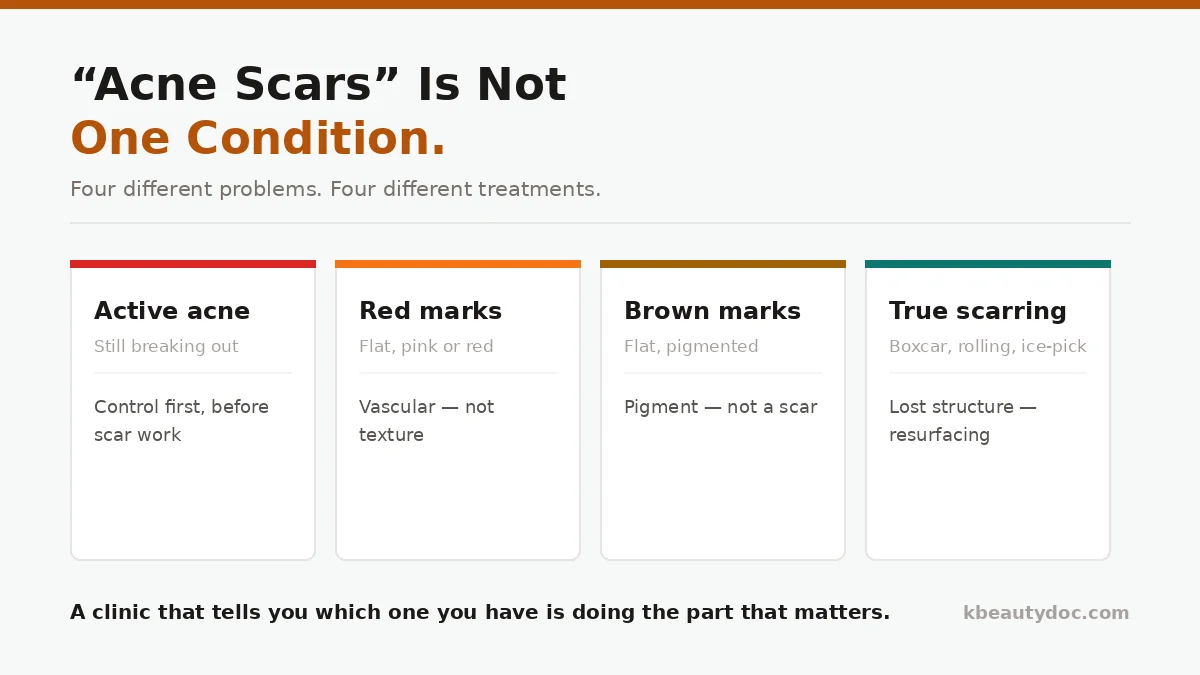
The most common mistake I see in patients arriving from overseas is treating “acne scars” as one condition. They are at least four.
Active inflammatory acne needs to be controlled before scar work begins — and inflamed and non-inflamed spots do not answer to the same prescription. Treating scars on skin that is still breaking out produces new scars alongside the ones you just treated, so medication may come first, and your scar treatment may not start on this trip.
Post-inflammatory erythema — flat red or pink marks — is dilated vasculature, not texture. It responds to vascular laser, and it also fades on its own over months. Aggressive resurfacing of flat red marks is unnecessary and can worsen pigmentation.
Post-inflammatory hyperpigmentation — flat brown marks — is pigment. It responds to topical treatment, gentle laser toning, and above all sun protection. It is not a scar.
True atrophic scarring — boxcar, rolling, ice-pick — is lost dermal structure. This is where RF microneedling, fractional lasers, and subcision belong, usually in combination and usually across several sessions.
A clinic that examines your skin and tells you which of these you actually have is doing the part that matters. A clinic that quotes a device name for “acne scars” has skipped it.
The most important factor is not the machine
In the age of social media marketing, patients frequently ask me, “Doctor, do you have [brand name]?”
A medical device is a tool. A heavily marketed laser in inexperienced hands disappoints, while a skilled physician with a less famous device in the same class can do genuinely well. What decides the result is understanding of energy delivery, skin anatomy, and how much a patient’s skin tolerates in one session.
There is also a factor patients underestimate: your doctor needs to listen. Skin history, medication, travel dates and pain tolerance all change the correct plan. Someone flying home in four days cannot have the same treatment as someone living in Seoul. What goes on the skin daily counts too — a cushion puff that is never washed undoes a good deal of clinic work.
So do not open with a device name. Say what your main concern is, how long you are here, what you have tried, and what you want to look different. A good physician will examine you and design a protocol — and will say if what you asked for is not right for your skin.
Before you book
Tell them about isotretinoin. If you have taken it, say when you stopped. It changes what is safe, and when.
Tell them your travel dates. Downtime is not optional and cannot be negotiated away. A treatment that leaves you red for a week is a bad choice three days before a wedding.
Ask what happens between sessions. Sun protection and barrier care after energy-based treatment materially affect whether you get pigmentation. If nobody discusses aftercare, that is information about the clinic.
Ask for the plan, not the machine. How many sessions, at what interval, what is being treated in each, and what the total cost will be.
FAQ
Is Potenza the best device for acne scars?
It is a well-regarded device within the RF microneedling class. Several devices in that class are used in Korean clinics with good outcomes. Device selection matters less than depth, energy, session count, and operator experience.
How many sessions will I need?
For atrophic scarring, three to five sessions at four-to-six-week intervals is a common starting plan, and more may be needed. A single session is not a scar treatment.
Can I do this on a short trip to Korea?
One session is possible, but expect redness for several days and understand that meaningful scar improvement requires a course. If you are here briefly, discuss whether a lower-downtime option makes more sense for this visit.
Does RF microneedling help with active acne, not just scars?
The thermal component can suppress sebaceous gland activity, which is why it is sometimes used in oily, actively breaking-out skin. It is not a substitute for medical acne treatment, and severe active acne generally needs to be controlled first.
Will it hurt?
Numbing cream is standard. There is a heat and pressure sensation, and deeper settings are less comfortable. Tell the operator during treatment if it is too much — settings can be adjusted.
What about my red marks that aren’t raised or indented?
Flat red marks are usually post-inflammatory erythema, which is a vascular issue rather than a scar. It often improves on its own over months and responds to vascular laser. Resurfacing is generally the wrong tool for it.
Disclaimer: This article explains treatments in general terms and is not a diagnosis or a treatment plan. What happens varies from person to person, and no article can tell you what to expect. Please discuss your own case with a licensed medical professional where you live. I do not endorse specific clinics or device brands.

Physician in non-surgical aesthetic medicine, practising in Ansan, South Korea. Every article here is written from clinical practice and the published literature.
About the author · Contact