A Korean clinic is not run like the one at home. That is not wrong, but it changes what you check.
Three things to know first
- Ask for the treatment plan, not the machine. A device name is not a plan.
- Get the price in writing before you agree. Including how many sessions.
- Book early in your trip, not the day before you fly. Downtime is real.
So what should you actually do?
Here is the short version, before the explanation.
Decide what bothers you, not what you want done. Say “these lines on my forehead” rather than “I want Botox.” A good clinic works out the treatment from the problem. If you name the treatment first, you will usually get it, whether or not it suits you — which is the difference between choosing by device name and choosing by a doctor’s judgement.
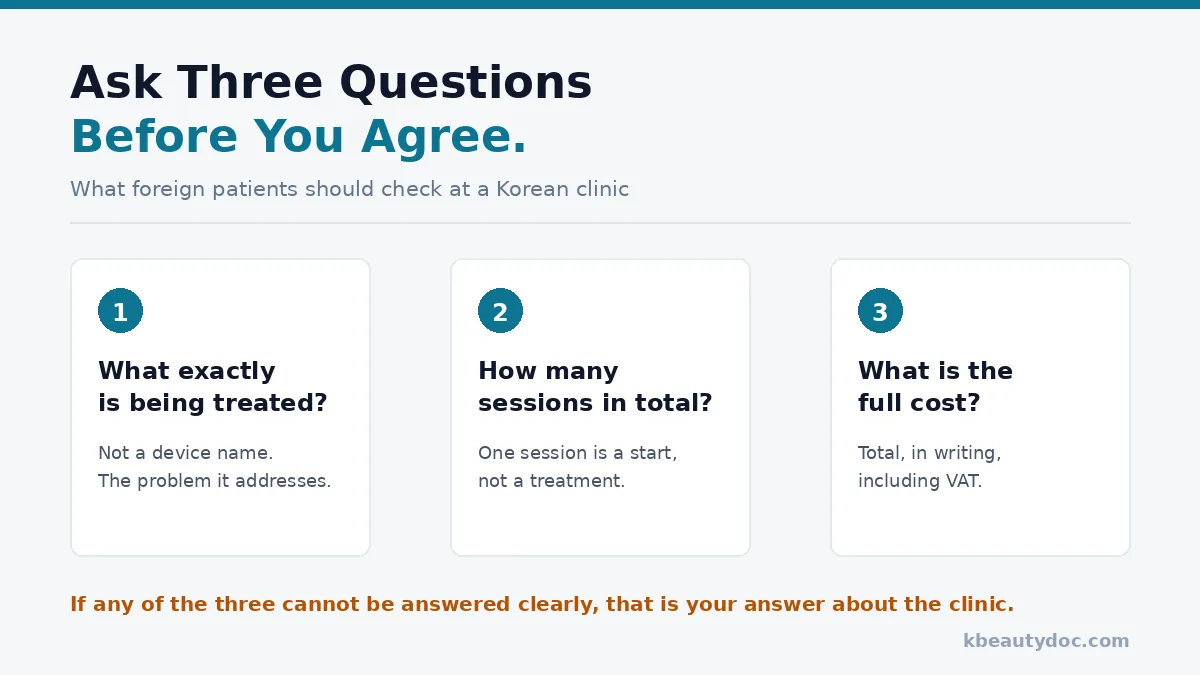
Ask three questions at consultation. What exactly is being treated, how many sessions in total, and what is the full cost. If any of the three cannot be answered clearly, that is your answer about the clinic.
Schedule in the first half of your trip. Redness, swelling and bruising are normal and they take days, not hours.
Bring your medication list and your history. Isotretinoin, blood thinners, autoimmune conditions and pregnancy all change what is safe.
That is the practical part. The rest of this explains why each of those matters.
The four things foreign patients worry about
I see international patients regularly. The concerns are consistent, and most are reasonable.
Language
Medical vocabulary is difficult even in your own language. Translation apps handle everyday words well and clinical nuance poorly — the difference between “this will reduce it” and “this will remove it” is what gets flattened.
What helps: write your questions down before you go, in short sentences. Ask the clinic in advance whether English-speaking staff will be present at the consultation, not just at reception. And ask for the treatment plan in writing — written text survives translation far better than spoken conversation.
Price
Pricing in Korean aesthetics is genuinely inconsistent between clinics, which is not the same as being dishonest. Costs differ by device, by consumable, by how many sessions are included, and by whether aftercare is bundled.
What helps: ask for the total, not the per-session price. Ask what is included — numbing cream, aftercare products, follow-up visits. And ask whether the quoted figure includes VAT, which is often listed separately in Korea.
If a price is dramatically below market, ask what is different. Sometimes the answer is reasonable — a promotion, a smaller area. Sometimes it is lower energy or fewer shots. Neither is wrong, but know which you are buying.
Consultation quality
The concern people usually phrase as “factory-style clinics” is really about one thing: who examines you, and for how long.
High-volume clinics exist everywhere, and volume is not automatically bad — a clinic doing a procedure many times a day may do it very well. The question is whether anyone looked at your skin first.
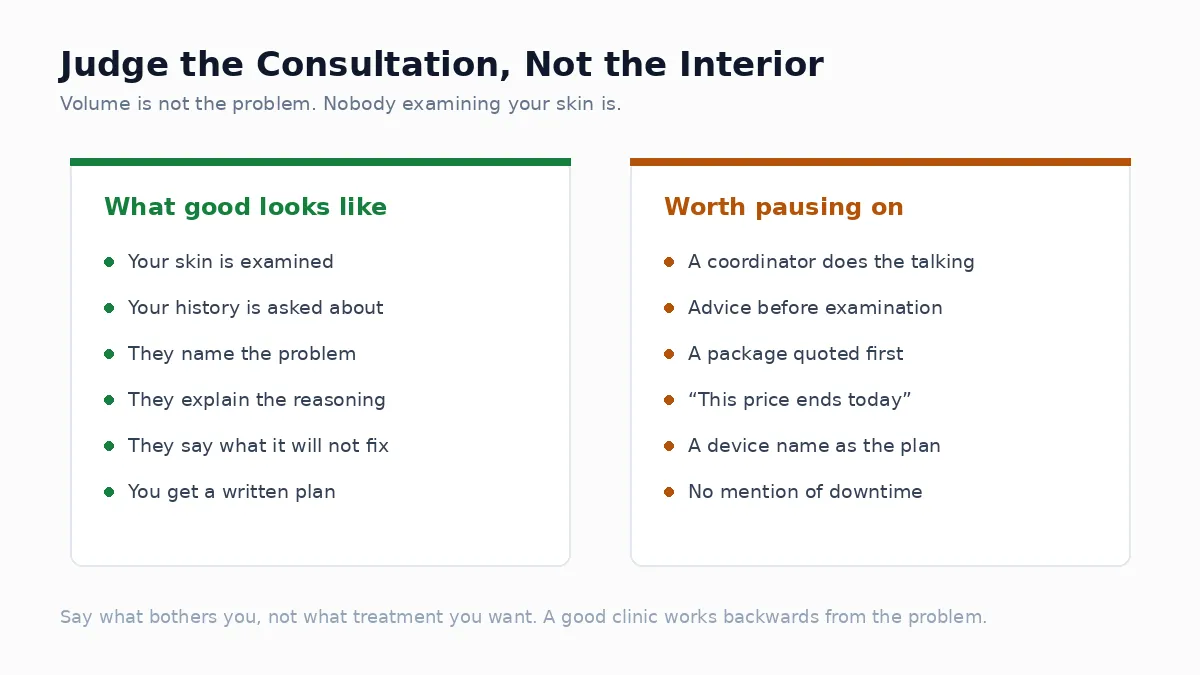
What to watch for. A consultation where a coordinator does most of the talking and the doctor appears briefly at the end — a coordinator-led structure is normal here, so what matters is whether your information reaches the doctor. A recommendation made before your skin was examined. A package quoted before your concern was discussed. Pressure to decide today because the price ends today.
What good looks like. Someone examines your skin, asks about your history, tells you what they think the problem is, and explains why the proposed treatment addresses it. They should also tell you what it will not fix.
Downtime
This is the concern people underestimate most.
Energy-based treatments produce redness for hours to days. Injectables can bruise. Resurfacing can leave you flaking for a week. None of this is a complication — it is the expected course — but it does not fit into a photo-heavy holiday if you scheduled it for the day before you leave.
What helps: treat downtime as a planning constraint, not an inconvenience. Ask specifically: how will I look tomorrow, and in three days? Then decide whether that fits your itinerary.
What to bring to the consultation
Your medication list. Not just skin medication. Blood thinners, hormonal treatments and immunosuppressants all matter.
Isotretinoin history. If you have taken it, know roughly when you stopped. It changes the timing of what is safe.
Photographs of your skin at its worst. Skin varies day to day, and what bothers you may not be visible on the day you attend.
A record of previous treatments. Product names and doses if you have them. This is particularly important for injectables, where units are not interchangeable between brands.
Realistic expectations about timing
A short trip constrains what is sensible, and it is worth knowing this before you book.
Treatments that suit a single visit: injectables for lines, a single session of skin boosters, a light laser with minimal downtime.
Treatments that do not: anything requiring a course. Laser hair removal, most acne scar work, and skin booster protocols are all multi-session by design. One session is a start, not a treatment.
A useful question to ask: “If I can only come once, what is the most sensible thing to do?” A clinic that answers this honestly — including “nothing, on this trip” if that is the truth — is one worth returning to.
After you fly home
Aftercare does not stop at the airport, and this is where preventable problems happen.
Sun protection is the single most important thing, particularly after any energy-based or resurfacing treatment. Pigmentation afterwards is largely driven by exposure in the first couple of weeks.
Keep your routine simple while your barrier recovers. Gentle cleanser, a bland moisturiser, sunscreen. This is not the week to start the products you bought — and what is worth buying at Olive Young, Daiso or duty-free is a separate decision from when to open it.
Keep a record of what you had done, including product names and quantities. It is more useful than your memory of it.
FAQ
Do I need to speak Korean?
No, but preparation helps. Write your questions down, ask in advance whether English-speaking staff will attend the consultation, and request the treatment plan in writing.
Are foreigners charged more?
Prices vary widely between clinics for legitimate reasons — different devices, consumables and session counts. Ask for the total in writing, including VAT.
How do I know if a clinic is high-quality?
Judge the consultation, not the interior. Did someone examine your skin, ask about your history, explain their reasoning, and state the limits? That matters more than the equipment list.
Should I book before I arrive?
Booking ahead is sensible for scheduling, but avoid paying in full for a package before anyone has examined you. Book the consultation; decide on treatment afterwards.
What if I only have a few days?
Say so and ask what makes sense in that time. Some treatments do not fit a short trip, and a clinic willing to say so is giving you useful information.
Can I get a treatment the day before flying?
Usually possible, rarely wise. Redness, swelling and bruising take days. Schedule early so there is time to settle and to return with questions.
Disclaimer: This guide is intended to help international visitors understand the Korean aesthetic medical system. I do not provide clinic recommendations or endorse specific facilities. Nothing here is personal medical advice, and decisions about your own care belong with a licensed doctor who has examined you.

Physician in non-surgical aesthetic medicine, practising in Ansan, South Korea. Every article here is written from clinical practice and the published literature.
About the author · Contact