Three things to know first
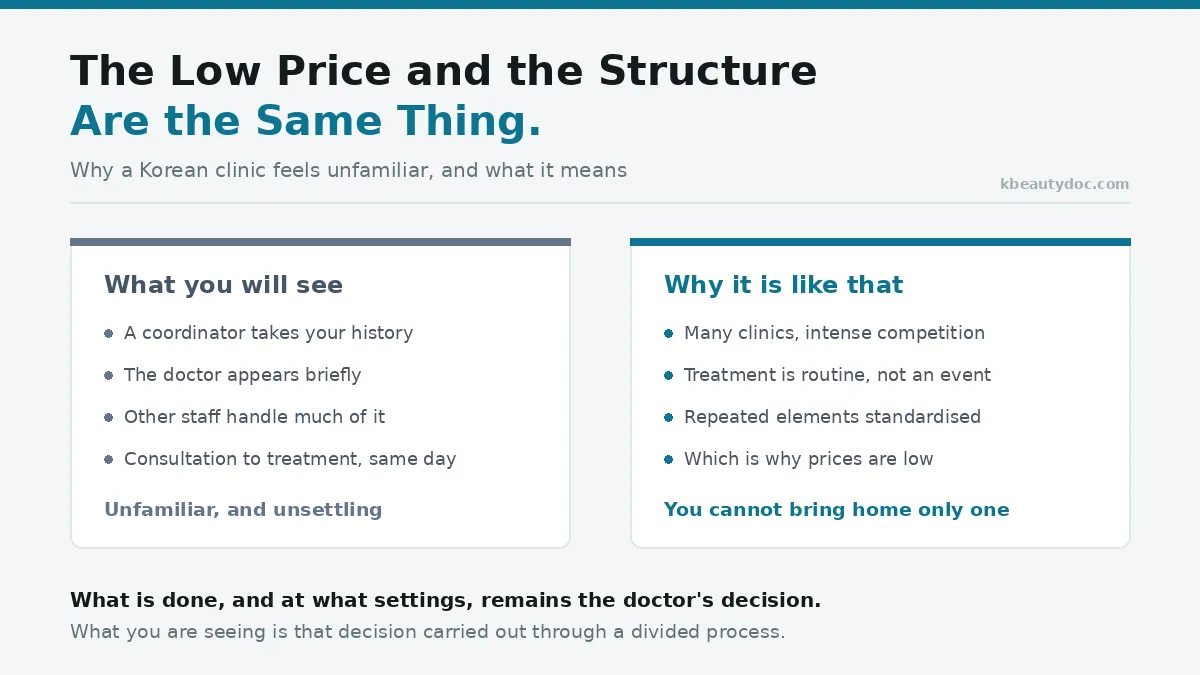
- The coordinator takes your history. The doctor appears briefly. That is the structure, not neglect.
- It is not wrong. But it does increase what you need to check.
- I am not a doctor in those districts. I am writing this because I would like you to remember Korea well.
These are probably what will surprise you
At a well-known clinic in Gangnam, Myeongdong or Hongdae, expect this.
The doctor does not look at your face for long. A consultation coordinator takes your history first, photographs are taken, and a plan is explained. The doctor appears afterwards, briefly.
It may look as though the doctor is not performing the treatment. Much of the preparation is handled by other staff.
It moves quickly. Consultation to treatment can happen the same day.
This differs from medicine where you live. If you are used to a doctor who examines, asks and performs personally, this feels unfamiliar and unsettling. Wondering whether it was done properly is a reasonable reaction. I have set out what else differs between a Korean and a Western clinic — language, price, downtime — separately.
Why the structure developed this way
I am explaining rather than defending.
Aesthetic medicine in Korea is unusually accessible. Many clinics, intense price competition, frequent treatment. It is closer to routine than to an event.
In that environment a structure emerges for seeing many patients efficiently: divided consultation, standardised steps, quick turnover.
Which is why prices are low. That is one of the reasons you came to Korea. The low price and that structure are two sides of the same thing. You cannot bring home only one of them.
One thing should be clear. Treatment takes place under the doctor’s direction — what is done and at what settings is the doctor’s decision, carried out through a divided process.
So what should you check?
If that is the structure, there is more for a patient to verify.
Listen to how the coordinator explains things
If your time with the doctor is short, the coordinator’s explanation is your window into the clinic.
What the staff know is what the doctor taught them. If they answer your questions properly, your concerns are more likely to reach the doctor.
Ask why
“Why does this suit my case?”
If the answer is an explanation, that is a good sign. If it is a recommendation, or a description of the equipment, it is worth pausing.
Write it down
If speaking is difficult, or interpretation worries you, write it out in advance and translate it: what bothers you, what you have had done, what you liked and disliked, how many days you have.
Speech evaporates. Paper the doctor reads directly.
Confirm the downtime
Having a treatment that leaves you red for days on the evening before your flight is a problem. Say how long you are staying and the plan changes. If the remaining days are for shopping instead, Olive Young, Daiso and duty-free are not interchangeable either.
Three signs worth pausing on
Judging whether a treatment is good is difficult. But whether information is travelling properly is something you can assess in the room.
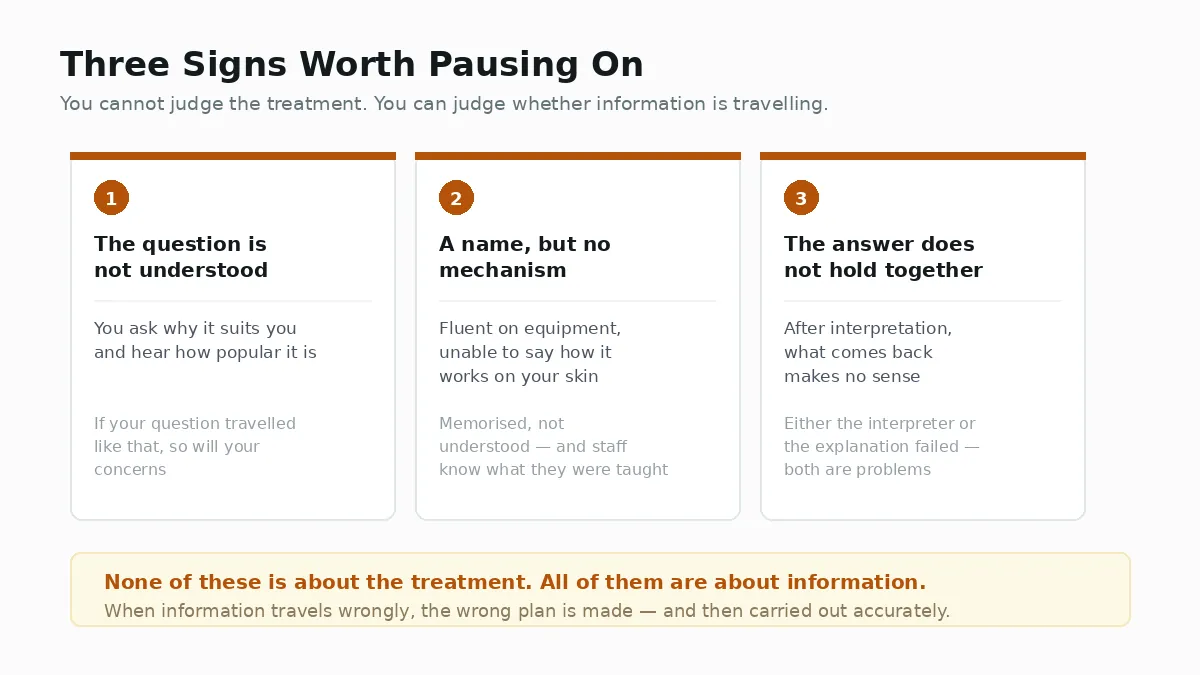
The question itself is not understood
Not a wrong answer — an answer to a different question. You ask “why does this suit me?” and hear how popular the treatment is. The question did not arrive.
If your question travelled like that, so will your concerns.
The device name is given but the mechanism is not
Fluent on equipment names and marketing phrases, but unable to answer “how does that work on my skin?” This is the same trap as choosing by device name rather than by a doctor’s judgement.
That means something was memorised but not understood. And what the staff know is generally what the doctor taught them.
The explanation that comes back does not hold together
This applies when interpretation is involved. You cannot verify whether the interpretation was accurate — but you can tell when the answer does not make sense.
Two possible reasons, and both are problems. If the interpreter did not understand, your words were probably distorted going the other way too. If the coordinator could not make them understand, the explanation was unclear to begin with.
Either way, information is not travelling properly.
What these three share
None of them is about the treatment. All of them are about information.
But when information travels wrongly, so does the treatment. If what is bothering you is conveyed incorrectly, the wrong plan is made — and then carried out accurately.
Why I am writing this
I am not a doctor who treats international patients in Gangnam or Myeongdong. I practise in Ansan, Gyeonggi Province, treating Korean patients.
So I am not writing this to bring you to my clinic. It would be inconvenient to reach, and I practise in Korean.
But this is how I see it.
The number of people coming to Korea for treatment grows every year. Some go home satisfied. Others go home knowing something was off.
I would like there to be fewer of the second kind.
I would like Korea remembered as a place where you can look better at a reasonable price and leave feeling good. That is easier if people arrive knowing what to ask, what is normal, and what is a sign to check.
I think that is also good for Korean medicine. Patients who arrive informed leave satisfied, come back, and tell others.
If you have a question
If a treatment this site has not covered interests you, or something you read here does not make sense, you are welcome to get in touch.
I cannot replace a consultation. I cannot diagnose from a photograph, and I cannot tell you which clinic to attend. That belongs in a consulting room.
But I can answer questions about how something works, or what you should be asking.
FAQ
The doctor barely looked at my face — is that acceptable?
At larger Korean clinics, a coordinator handles much of the consultation and the doctor sees you briefly. What is done and at what settings is still the doctor’s decision. If it concerns you, you can ask to speak with the doctor directly.
It looked like the doctor did not perform the treatment.
Preparation and process being divided is not the same as responsibility being divided. If you want to know, asking who does which part is the most direct route.
The coordinator explained almost everything. Can I trust that?
If the explanation is accurate and your questions are answered well, that is a good sign — because what the staff know is what the doctor taught them.
The price is low. Is that a concern?
Korea’s low prices come from having many clinics and intense competition. But an unusually low price has a reason, so get what is included and how many sessions in writing.
What are the warning signs?
The article covers three — the question itself not being understood, device names without mechanisms, and an explanation that does not hold together after interpretation. Beyond those: a treatment decided before your skin is examined, a price that ends today, and no mention of downtime.
Does this site recommend clinics?
No. It does not introduce or refer anyone to a particular clinic. Its role is to give you what you need to judge for yourself.
Disclaimer: This guide is intended to help international visitors understand the Korean aesthetic medical system. I do not provide clinic recommendations or endorse specific facilities. Nothing here is personal medical advice, and decisions about your own care belong with a licensed doctor who has examined you.

Physician in non-surgical aesthetic medicine, practising in Ansan, South Korea. Every article here is written from clinical practice and the published literature.
About the author · Contact