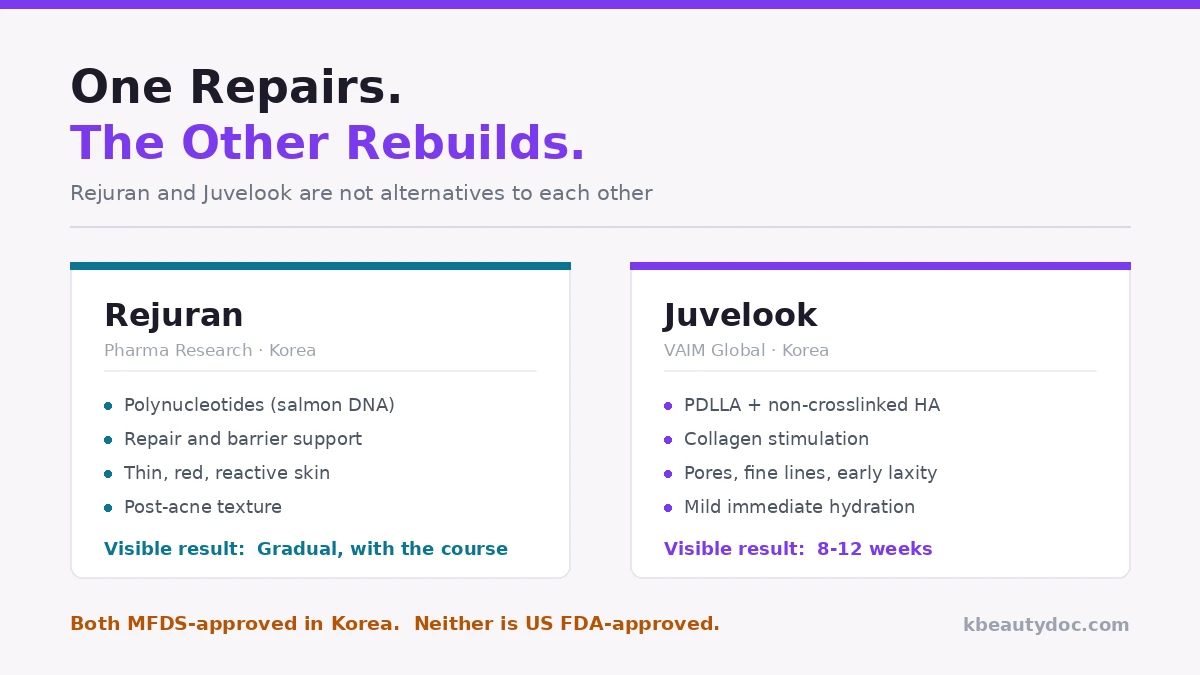
Rejuran and Juvelook are two of the most requested injectables in Korea, and they are constantly presented as alternatives. They are not. They work through different mechanisms and suit different skin problems — one is a repair signal, the other a collagen stimulus. Choosing by price or popularity is how people end up disappointed. Here is what each does, who each suits, and what to know before booking.
Quick comparison
| Rejuran | Juvelook | |
|---|---|---|
| Active material | Polynucleotides (PN) from salmon DNA | PDLLA + non-crosslinked hyaluronic acid |
| Manufacturer | Pharma Research (Korea) | VAIM Global (Korea) |
| Primary aim | Skin repair, barrier support, calming | Gradual collagen stimulation |
| Immediate effect | Minimal | Mild hydration from the HA fraction |
| Time to visible result | Gradual over the treatment course | 8–12 weeks |
| Best suited to | Thin skin, redness, sensitivity, acne-scarred skin | Enlarged pores, fine lines, early laxity |
| Typical course | Series of sessions | 3 sessions at about 1-month intervals |
| Common downside | Injection discomfort, temporary bumps | Slow onset, nodule risk if placed incorrectly |
| Korean MFDS | Approved | Approved |
| US FDA | Not approved | Not approved |
The last row matters more than most patients realise, and I come back to it below.
Rejuran: a repair signal, not a filler
Rejuran uses purified polynucleotide fragments from salmon DNA. It is not adding volume and it is not primarily a collagen stimulator — it is closer to a biological instruction to repair.
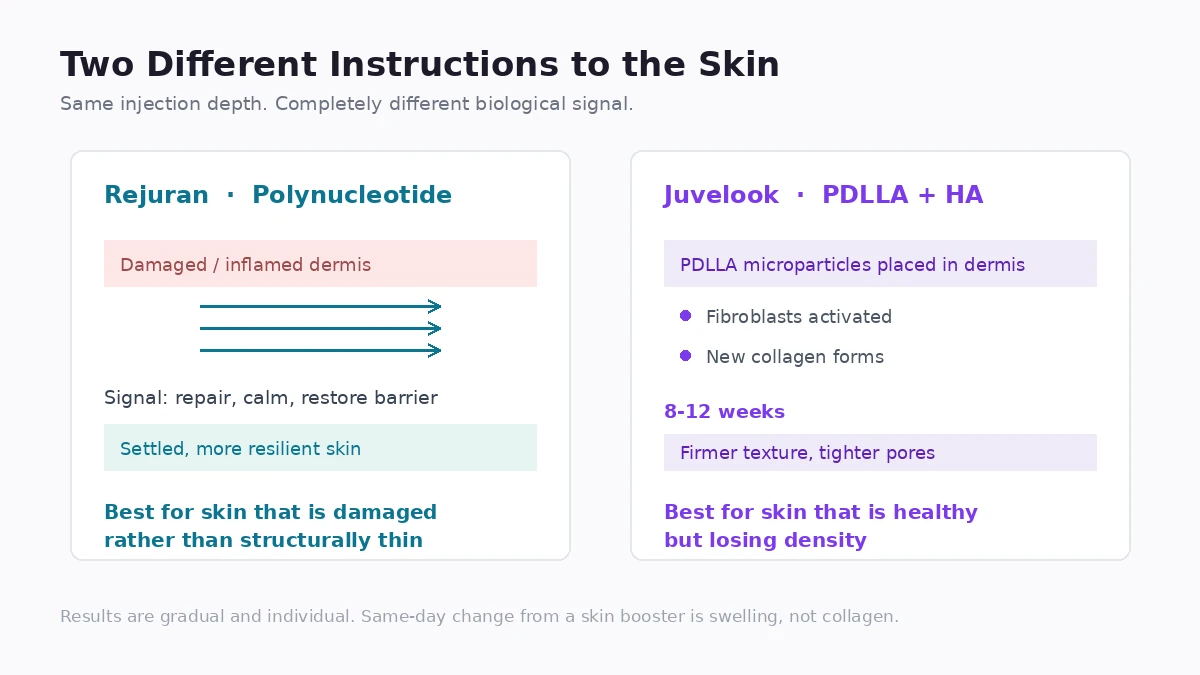
How it behaves clinically. Polynucleotides support the skin’s own repair processes and calm inflamed tissue, so the skin that responds best is damaged or reactive rather than simply thinned.
Who it suits. Thin skin. Persistent redness. Skin recovering from active acne, or with the textural damage acne leaves behind. Patients whose main complaint is that their skin feels fragile, irritated, or slow to recover rather than that it has sagged.
What patients dislike about it. It stings. Rejuran goes in as many small deposits, and the discomfort is real — most clinics apply numbing cream, and you should ask if it is not offered.
How Korean doctors actually use it: in a survey of 235 board-certified dermatologists, 88% said they inject polynucleotides, mostly for fine lines on the cheeks and around the eyes, uneven texture and dry skin; acne scars did not make the top six [1]. The survey was funded by Rejuran’s manufacturer.
Juvelook: a collagen stimulus with an immediate hydration layer
Juvelook combines PDLLA — poly-D,L-lactic acid — microparticles with non-crosslinked hyaluronic acid in a single vial.
How it behaves clinically. The HA fraction gives some immediate hydration and light plumping. The PDLLA fraction is the actual point of the product: it prompts fibroblasts to produce new collagen over the following weeks. That is why the meaningful result arrives at 8–12 weeks rather than on the day.
Why the polymer type matters. PDLLA is amorphous rather than semi-crystalline, which affects how evenly it degrades — the usual argument for separating it from older PLLA biostimulators. A difference of degree, not protection against nodules: depth and aftercare still matter.
Who it suits. Enlarged pores. Fine lines. Early loss of firmness. Skin that is fundamentally healthy but has lost density.
One thing to clarify at consultation. Two products share the brand name. The 50 mg formulation is the skin-quality one, for fine lines and pores. Juvelook Volume — sold internationally as Lenisna — uses larger particles at greater depth for volume. Different treatments, different prices: confirm which you are quoted.
The regulatory point nobody explains clearly
Both products are approved by Korea’s Ministry of Food and Drug Safety. Juvelook additionally holds CE certification in Europe and approval from Thailand’s FDA. Rejuran also holds CE certification.
Neither is approved by the US FDA.
I say that plainly because it is often blurred. Some sites use “FDA-approved” loosely, or quote Korean approval in a way that reads as US clearance. If a clinic calls a booster FDA-approved, ask which regulator they mean.
That does not mean the products are unregulated or untested. Both have peer-reviewed data and are licensed where you would receive them. It means the US approval process — separate, costly, and often not pursued for products aimed at Asia and Europe — has not been completed: a commercial fact, not a safety finding. The newest group is regulated differently again: Re2O and CellREDM are made from donated human dermis, while at the other end of the menu sit Juvederm and the Korean hyaluronic acid fillers, which add volume rather than signal repair.
How to choose
The choice usually follows one question: is your skin damaged, or is it thinning?
Damaged, reactive, post-acne or easily irritated skin usually does better starting with a repair-focused product. Healthy skin showing pores, fine lines and early loss of firmness usually does better with a collagen stimulus.
Many patients eventually use both in sequence — repairing first, then building — an order decided by examination, not by a price list. A third material sits on the same menu: Re2O against Rejuran and Juvelook compares all three by ingredient rather than brand.
And one caution that applies to every injectable in this category: results are gradual and individual. Anyone showing you a dramatic same-day transformation from a skin booster is showing you swelling.
Who should wait, and what to expect afterwards
Both go into the dermis, so both bruise, swell and leave small raised points for a day or two; polynucleotide injections also sting, and PDLLA carries a late risk of firm nodules weeks later. Having both on the same day stacks the swelling and makes a reaction impossible to attribute — a reason to sequence them, not a package to upsell.
People who are pregnant or breastfeeding, who have an active infection or inflamed spots in the treatment area, who have a bleeding disorder or take anticoagulants, or who have a history of keloid scarring are generally not candidates on the day. A recent procedure in the same area is a reason to postpone rather than combine. A doctor who examines you decides.
Home care that supports the same goals
You cannot copy an injectable with a cream. You can support the same process between sessions.
Alongside a repair-focused approach: ceramides, panthenol, centella. Some Korean products contain topical PDRN, related in origin to injectable polynucleotides but working at a different depth — do not expect the same thing.
Alongside a collagen-focused approach: peptides, niacinamide and adenosine have the most reasonable topical evidence for collagen and firmness.
In both cases: keep the routine plain while the injection points close — a gentle, low-pH wash rather than anything that foams hard or scrubs, which is the practical half of my Olive Young and Daiso cleansing foam comparison. And daily sunscreen does more for your result than any serum.
FAQ
Can I get Rejuran and Juvelook on the same visit?
Some clinics combine them; many sequence them. Both swell, so combining adds downtime and makes a reaction harder to attribute.
How many sessions do I need?
Both are a course, not a single treatment. Juvelook is commonly three sessions about a month apart, and the surveyed dermatologists most often recommended three polynucleotide sessions four weeks apart [1]. Ask for the planned number and the total cost before starting.
Is Juvelook the same as Sculptra?
No. Both stimulate collagen, but Sculptra uses PLLA without HA and produces no immediate effect, while Juvelook adds non-crosslinked HA for immediate hydration. They are also used at different depths.
Are these FDA-approved?
Not in the United States. Both are approved by Korea’s MFDS, and both hold CE certification in Europe. Juvelook is also approved in Thailand. If a clinic claims US FDA approval for either, ask them to clarify.
Which is better for acne scars?
Polynucleotide treatment is often offered for depressed acne scarring in Korea, though the survey above did not place scars among the leading indications [1]. Established scars usually need resurfacing or subcision too; an injectable alone is rarely the whole answer.
How long do results last?
For Juvelook, roughly 6–12 months after a completed course, varying with age and skin condition. Rejuran is maintained with repeat treatment rather than being a one-time result. Neither lasts indefinitely.
References
- Rho NK, Han KH, Cho M, Kim HS. A survey on the cosmetic use of injectable polynucleotide: the pattern of practice among Korean dermatologists. Journal of Cosmetic Dermatology 2024;23(4):1243-1252. PMID 38093498
Disclaimer: This is general information, not a diagnosis or a treatment plan. Brand names are discussed for information only and are not endorsements. Injections and prescription medicines should be chosen and given only by a licensed professional who has examined you, and what suits another person may not suit you.

Physician in non-surgical aesthetic medicine, practising in Ansan, South Korea. Every article here is written from clinical practice and the published literature.
About the author · Contact