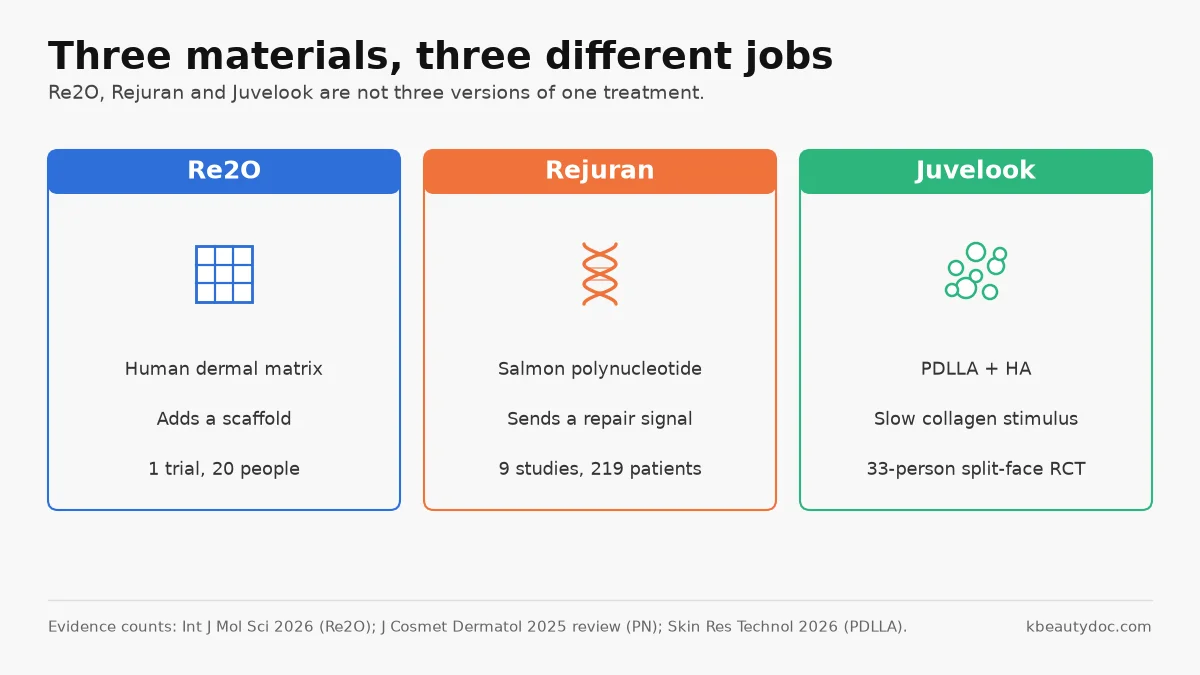
Three of the most requested injections in Korean clinics go in through the same fine needle — and are human collagen, salmon DNA and a corn-derived polymer.
The short answer
- Re2O (리투오) — human acellular dermal matrix: a collagen scaffold from donated human dermis.
- Rejuran (리쥬란) — polynucleotide from salmon DNA: a repair signal, not a structure.
- Juvelook (쥬베룩) — PDLLA microparticles with non-crosslinked hyaluronic acid: a slow stimulus that asks your own cells to build collagen.
- They are not three versions of one treatment. Material, legal class and published evidence differ.
I practise in Korea, and this is the comparison patients ask for most.
1. What is actually in the vial
Re2O is a 150 mg vial of human acellular dermal matrix (hADM): donated human dermis with the cells and residual DNA washed out, freeze-dried, then milled fine enough for a needle. What remains is mostly collagen. In Korean law it is a human tissue graft, not a device and not a drug — a category I covered in human tissue-derived skin boosters in Korea.
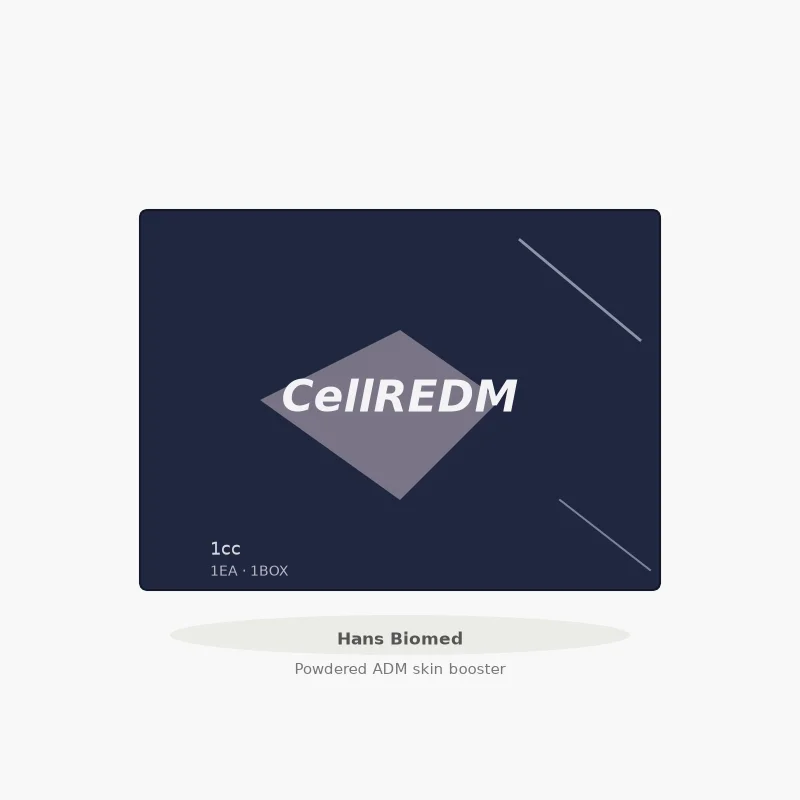
Illustration based on the product packaging. No product photograph of Re2O is published; shown is CellREDM, a powdered hADM booster of the same class. Reference: Hans Biomed official website (hansbiomed.com)
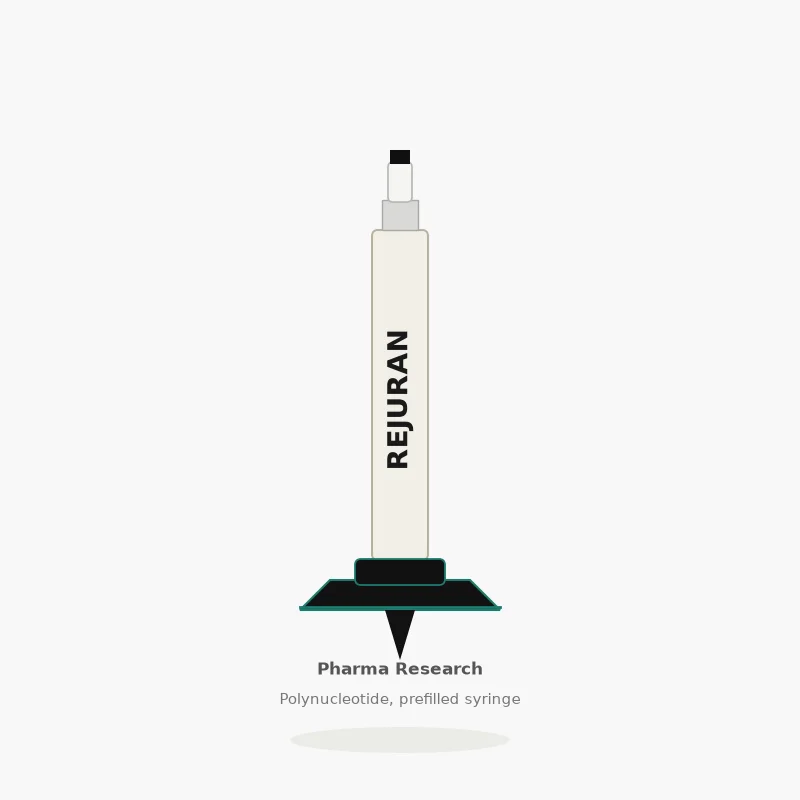
Illustration based on the product packaging; reference: Pharma Research official product page (pharmaresearch.com)
Rejuran is polynucleotide (PN) purified from salmon DNA. The maker’s product page gives the pack as two 2 cc syringes and the purpose as temporary improvement of facial wrinkles — the licensed claim, more modest than most clinic posters.
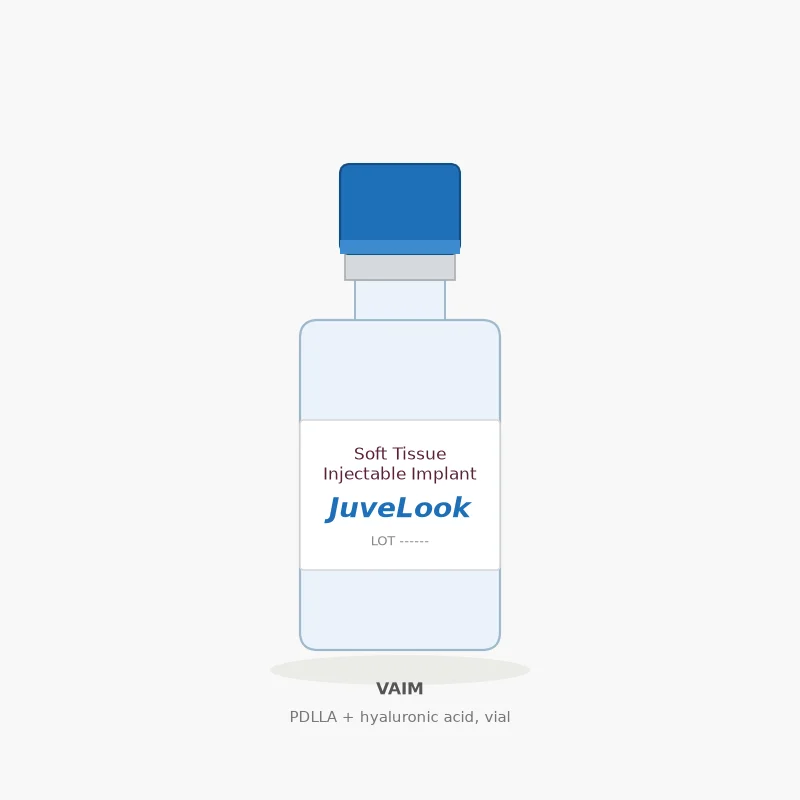
Illustration based on the product packaging; reference: VAIM official website (vaim.co.kr)
Juvelook is poly-D,L-lactic acid (PDLLA) plus non-crosslinked hyaluronic acid, supplied as a powder to reconstitute. The maker’s technology page describes spraying a PDLLA solution into a cold vat to form porous microparticles; the lactic acid is fermented from corn starch.
2. Three different mechanisms
Polynucleotides and PDLLA are often lumped together as “collagen boosters”. They are not doing the same job.
Re2O adds material. The matrix is a physical scaffold, and the idea is that your own cells move into it and rebuild. No inflammatory trigger by design.
Rejuran signals. Polynucleotides are longer DNA fragments than PDRN, and they act mainly on how the extracellular matrix is remodelled [1]. Nothing structural is left behind.
Juvelook provokes, gently. PDLLA breaks down slowly, and that breakdown recruits fibroblasts. Laboratory and animal work shows PDLLA particles are smaller and non-crystalline next to PLLA, yet clump together more [2] — bench data, not people, and a reminder that “amorphous is gentler” is a simplification.
3. How much human evidence each one has
Juvelook has the most published clinical work. Two studies — an uncontrolled series of 20 and a randomised half-face comparison in 33 — both reported smoother nasolabial folds after a three-session course, with swelling and bruising as the usual complaints [3][4].
Rejuran has the most use but softer trial data. A systematic review of polynucleotides found only nine studies of low to moderate quality, 219 patients in all, and little agreement on how best to use them [5]. Rejuran was the named comparator in a 218-person randomised half-face study of crow’s feet, where side effects were mild in both arms [6].
Re2O has one trial. Twenty people, twenty weeks, half-face: the Re2O side measured better for density, elasticity and wrinkle depth than the hyaluronic acid booster alone, with no serious adverse events [7]. Small and short, and one author discloses advising the manufacturer.
4. Sessions, intervals and how long it lasts
Only numbers from a maker’s document or a published protocol:
- Juvelook: both studies used three sessions about a month apart, followed up for three to six months.
- Rejuran: the maker’s page lists pack size and purpose but publishes no session schedule, and published PN protocols vary. A fixed “three sessions” rule is a clinic protocol, not a licensed instruction.
- Re2O: the only trial used one session; no schedule has been published.
Duration beyond those windows is not established for any of the three.
5. Side-effect profiles are not the same either
All three share the ordinary risks of any facial injection: bruising, swelling, tenderness, small bumps, and the uncommon but serious risk of infection or a blocked vessel. Beyond that they differ. Polynucleotide injections sting and leave papules at the injection points for a day or two. PDLLA carries a late risk of firm, non-inflammatory nodules weeks after injection [8][9], and a 2026 expert consensus deals with visual impairment after PDLLA-HA injection — rare, but the reason depth and technique matter [10]. For hADM the distinctive issues are regulatory and ethical rather than dermatological.
And who is generally left out on the day, whichever of the three: people who are pregnant or breastfeeding, who have an active infection or inflamed spots in the area, who have a bleeding disorder or take anticoagulants, or who have a history of keloid scarring. A recent procedure in the same area is a reason to postpone rather than stack. A doctor who examines you decides.
6. Side by side
| Re2O | Rejuran | Juvelook | |
|---|---|---|---|
| Material | Human acellular dermal matrix, 150 mg | Polynucleotide from salmon DNA | PDLLA + non-crosslinked HA |
| Origin | Donated human dermis | Salmon | Corn-derived lactic acid |
| Working idea | Adds a collagen scaffold | Sends a repair signal | Slow fibroblast stimulus |
| Korean legal class | Human tissue | Medical device | Medical device |
| Largest published study | 20 people, 20 weeks | 218 people, 12 weeks | 33 people, 24 weeks |
| Sessions in studies | 1 | Not published by maker | 3, a month apart |
| Distinctive risk | Evolving rules | Stinging, brief papules | Late nodules |
7. Which one suits whom
This section is clinical judgement, not a rule, and not advice for you personally. A doctor who has examined your skin may reason differently.
- Thin, crepey, deflated skin, usually forties and up. A scaffold approach is what I think about first, because that is who the Re2O trial recruited. A small survey of Korean dermatologists found they leaned to biostimulators such as PDLLA when a face had little fat left [11].
- Reactive, red, easily irritated or post-acne skin. A repair signal suits that better than a product that works by provoking a response.
- Healthy skin with visible pores, fine lines and early slackness. The classic PDLLA situation, overlapping with pores that change with age.
- Anyone uncomfortable with human-donor material, for personal or religious reasons. Not a medical contraindication, but a fair reason to choose one of the others. You are entitled to ask what a product is made of before you consent.
- Budget. hADM is the most expensive of the three here, and prices vary too widely to quote. If cost forces a choice, one finished course beats three half-finished ones.
Rejuran versus Juvelook goes deeper on regulatory status and home care, and choosing by device name in Korea explains why Korean menus are written as brand names.
FAQ
Can I have two of these in one session?
Some clinics combine them. All three swell, so combining adds downtime and makes a reaction harder to trace — a clinical decision, not a package deal.
Which one works fastest?
None is a same-day treatment. The Juvelook studies measured outcomes three months after a course, the Re2O trial ran 20 weeks, and PN studies report slow change. Anything dramatic on the day is swelling.
Is Re2O stronger because it is human collagen?
“Human” describes the source, not the strength. The published evidence for cosmetic use is one 20-person trial — less than either of the other two has.
Are any of them approved by the US FDA?
No. Rejuran and Juvelook are licensed as medical devices by Korea’s MFDS; Re2O is managed as human tissue under a separate law and carries no device licence.
Which is safest?
They carry different risks, not more or fewer: stinging and brief papules for polynucleotides, late nodules for PDLLA, unsettled regulatory questions for hADM.
Do I need repeat courses forever?
Everything in this class breaks down over time, and no study followed patients beyond about six months after the last session.
I am visiting Korea for a week. Which fits a short trip?
A single session fits; a three-session course does not. Injectables are easier to manage when the person who treated you is reachable afterwards.
References
- Comparison of Polynucleotide and Polydeoxyribonucleotide in Dermatology. Pharmaceutics 2025;17(8):1024. PMID 40871045
- PLLA and PDLLA Fillers: Linking Crystallinity and Mechanical Stability. In Vivo 2026. PMID 42049428
- A Clinical Study on the Efficacy and Safety of Injectable PDLLA for Nasolabial Fold Correction. Journal of Craniofacial Surgery 2026. PMID 42479568
- A Split Face Study Comparing PDLLA Based Product and PLLA on the Nasolabial Fold. Skin Research and Technology 2026. PMID 41532837
- The Effectiveness of Polynucleotides in Esthetic Medicine: A Systematic Review. Journal of Cosmetic Dermatology 2025. PMID 39645667
- Comparing PCL and PN Fillers in the Correction of Crow’s Feet. Journal of Cosmetic Dermatology 2025. PMID 39313949
- Lee YI, et al. Injectable Particulated Human Acellular Dermal Matrix Booster for Skin Restoration. International Journal of Molecular Sciences 2026;27(5):2193. PMID 41828422
- Poly-d,l-lactic Acid (PDLLA) Application in Dermatology: A Literature Review. Polymers 2024;16(18):2583. PMID 39339047
- Energy-Based Device Management of Nodular Reaction Following PDLLA Injection. Journal of Cosmetic Dermatology 2025. PMID 39283001
- Consensus Opinion on Safe Injection Technique and Management of PDLLA-HA200-Induced Visual Impairment. Journal of Craniofacial Surgery 2026. PMID 41359890
- Real-World Clinical Practice on Skin Rejuvenation Among Korean Board-Certified Dermatologists. Annals of Dermatology 2025. PMID 40432360
Disclaimer: This is general information, not a diagnosis or a treatment plan. Brand names are discussed for information only and are not endorsements. Injections and prescription medicines should be chosen and given only by a licensed professional who has examined you, and what suits another person may not suit you.

Physician in non-surgical aesthetic medicine, practising in Ansan, South Korea. Every article here is written from clinical practice and the published literature.
About the author · Contact