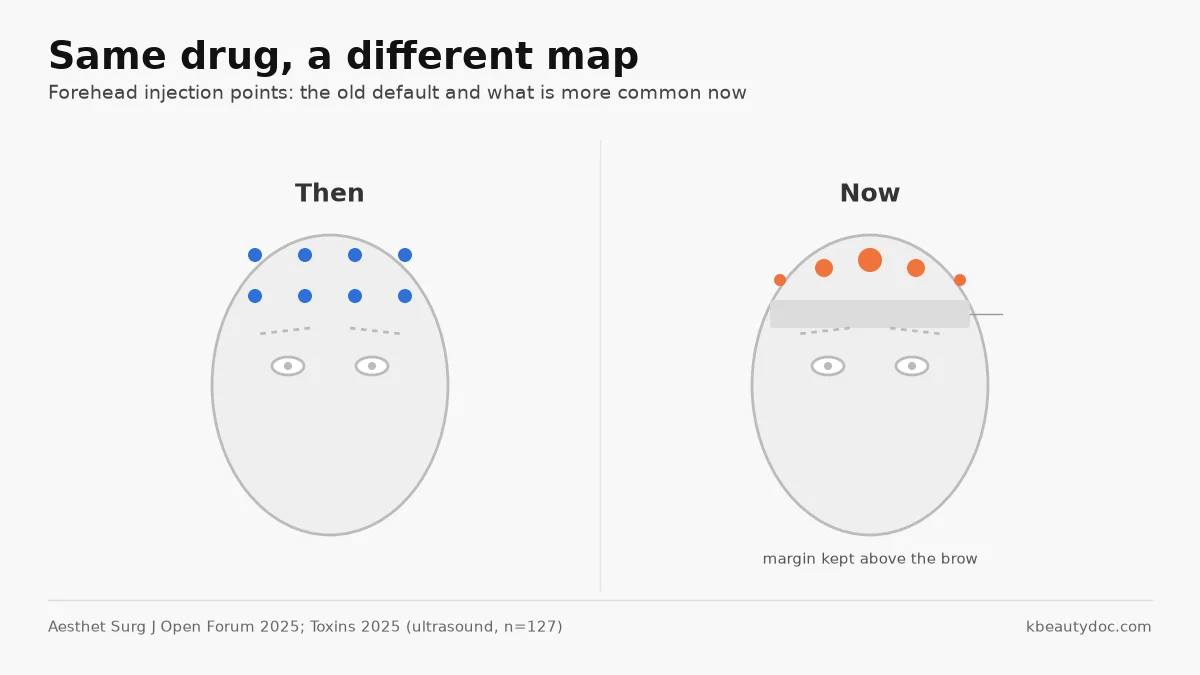
The forehead pattern I was taught — a tidy row of dots straight across, the same dose in each — is the pattern I have largely stopped using, and so have most injectors I talk to.
Three things to know first
- The change is real. Upper-face injecting moved from a fixed grid of points toward a plan built around one person’s muscle.
- It changed because standard patterns kept producing the same complaints — heavy brows, an odd brow shape, a face that moved less than its owner wanted.
- “Lower dose” is not automatically better. Going below the licensed dose shortens the effect and does not buy extra safety.
So what does this mean for you?
If you were told your forehead “cannot” be treated — that usually means your brow already sits low, and relaxing the muscle that holds it up would drop it further.
If your last treatment left your brows heavy — that is the most discussed problem in the field right now, and it is about placement, not product.
If you liked being able to raise your eyebrows — say so out loud. Preserving brow elevation is a stated goal in most published strategies, but only if the injector knows.
What actually changed
| The older default | What is more common now | |
|---|---|---|
| The map | One standard pattern for most faces | Points chosen after watching your own muscle move |
| Forehead points | An even row, same dose each | Uneven dosing; the outer forehead treated more lightly |
| How low to go | Points fairly close to the brow | A margin above the brow, so the lifting fibres keep working |
| Glabella | Fixed five-point pattern | Depth and site adjusted to how you frown |
| The goal | Flatten the lines | Keep the lines quiet while the face still reads as expressive |
None of this is a new drug — the same molecule as before, placed differently.
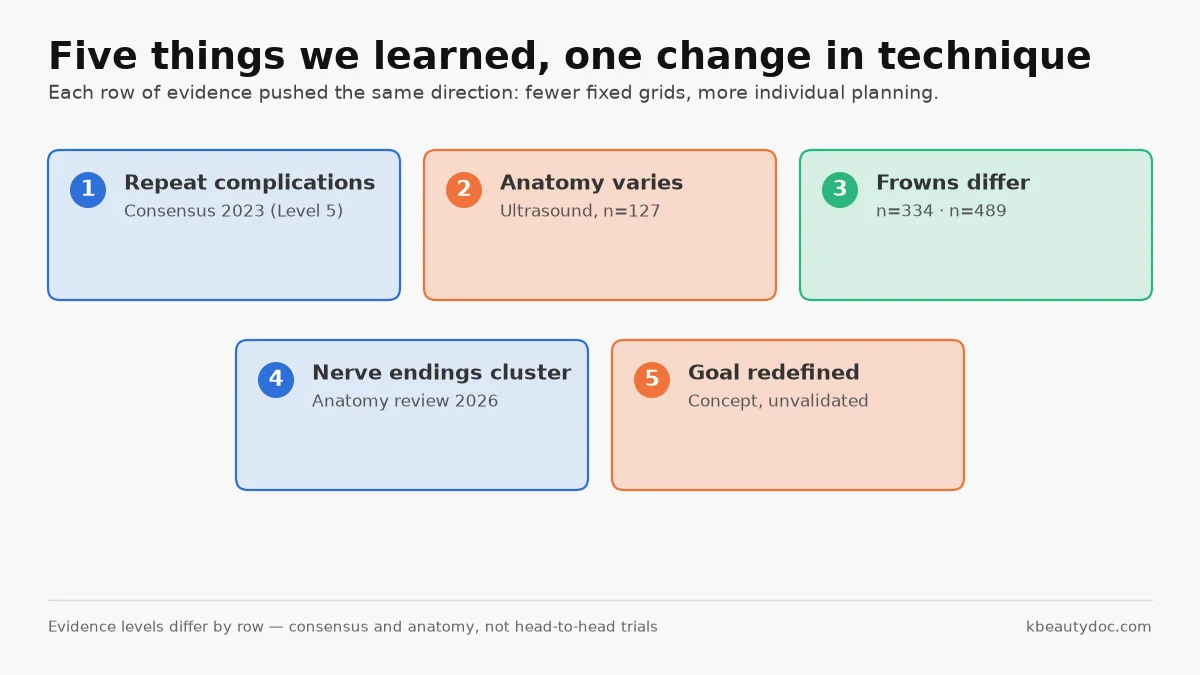
Why it changed — six reasons
1. The standard patterns kept producing the same problems
A consensus group concluded that heavy brows, odd eyebrow shape, altered smiles and flattened cheeks were linked to standard patterns that ignore individual anatomy [1] — collective expert opinion, the lowest level of evidence, not a trial.
Droopy eyelid says the same from another angle: reported rates run several times higher for inexperienced injectors [2]. It fades as the effect wears off, but the gap between those numbers is technique.
2. The anatomy varies more than the map assumed
Ultrasound of the upper face in 127 adults found left-right differences in muscle thickness and depth reaching 40%, thicker forehead muscles in men, and deeper muscles in heavier people [3]. One depth and one dose per point cannot fit that much variation — good measurement, though, not outcome data.
3. People do not frown the same way
A study of 334 adults found five distinct frown patterns, and each person’s own pattern returns once the toxin wears off [4]. The advice that followed: give the hard-working muscles more, spare the ones that barely join in. The same frown complex is what the mood research singled out, where the evidence sits behind the claims.
Population matters too. In 489 Chinese patients the mix of patterns differed from Caucasian and Korean reports [5], and a pan-Asian consensus had already argued that doses differ with face shape [6]. A Korean ultrasound series described a further variant, where the frown is pulled upward by the forehead muscle and does not settle with the usual pattern [7].
4. We learned where the nerve endings cluster
Toxin acts where nerve meets muscle, and those junctions are not spread evenly. A review places them high and deep in the forehead muscle, towards the inner and deeper part of the frown muscle, low between the brows, and scattered around the eye [8].
These are likely zones, not X-marks-the-spot. But “aim higher, deeper and more medial” is a different instruction from “space five dots evenly.”
5. A second, genuinely different technique appeared
Microdroplet injection — microbotox, mesobotox, skin botox — dilutes the toxin into the skin rather than the muscle. A review of 20 articles found effects appearing within a fortnight and lasting a few months [9], and an expert roundtable describes using it for pore appearance, oiliness and jawline definition [10]. Both are small studies plus opinion: popular in Korea well ahead of the data.
6. The goal itself was redefined
The older target was a flat line score. A newer proposal, built around balancing opposing muscles, measures success as how long the face keeps a harmonious expression rather than how long a muscle stays blocked [11]. That idea is awaiting validation, not a rule — but it explains why an injector may leave part of a muscle working, and why the retaining ligaments limit what muscle relaxation can do.
What has not changed — and this part matters
Enthusiasm for “less” has run ahead of the evidence. A review of dose-response data found that treating below the licensed dose means a shorter effect, weaker response and lower satisfaction — with no sign that it lowers the risk of side effects [12]. Standard frown-line dosing lasts a median of about four months.
The modern approach is about where and how deep, not about using less. If a very low dose is presented as the technique itself, ask what the dose-response data say about how long that result will last.
Two steady facts: units are set by each manufacturer and cannot be compared across brands, and when a treatment stops working the cause is usually not true resistance.
Two limits that sit outside technique
Judge the result at two weeks, not on day 3, and do not ask for a top-up before then — the effect is still building, and early repeat dosing is the pattern associated with antibody formation. Repeat treatments are generally spaced at least three months apart.
Botulinum toxin is also generally not used in pregnancy or breastfeeding, in people with a neuromuscular disorder such as myasthenia gravis, where there is infection or inflamed skin at the injection site, or after a previous reaction to a toxin product. A doctor who examines you decides.
What to ask, without asking for a prescription
These questions make any injector explain their plan.
- “Will you watch me raise my brows and frown before you mark anything?” Watching the face move is the basis of the newer approach.
- “How close to my eyebrow will the lowest points sit?”
- “Which muscles are you deliberately leaving alone, and why?”
- “If my brow feels heavy in two weeks, what do we do?”
Nothing here can tell you your own dose or points. That belongs to an in-person assessment.
FAQ
Is the new technique better than the old one?
It is better matched to individual anatomy — a narrower claim. Head-to-head trials against standard grids are largely absent; the supporting literature is consensus, anatomy and small series.
Why do doctors online say the technique changed but never say why?
The “why” is anatomy, and anatomy does not fit in a fifteen-second clip. Standard patterns ignored how much faces differ, and the brow problems that followed forced the rethink.
Does this mean my previous treatments were done wrong?
Not necessarily. Standard patterns were accepted teaching for years and suited many faces. The shift is toward fitting the pattern to the person, not the person to the pattern.
Is a lower dose safer?
Not according to the dose-response data. Below-label dosing has been linked to shorter duration and lower satisfaction, with no demonstrated reduction in adverse events. What changed is placement and depth.
What is skin botox or microbotox, exactly?
Diluted toxin placed in the dermis as many small droplets rather than into the muscle. It targets surface skin quality, and the evidence is small studies and expert reviews.
Can I still raise my eyebrows after treatment?
That depends on how much of the frontalis is relaxed and where. Preserving some brow elevation is an explicit goal in newer strategies, but it has to be discussed beforehand.
Do men need a different pattern?
Ultrasound work shows thicker forehead muscles in men on average, and consensus documents describe a flatter brow as the usual goal. Both point toward a different spread of points, decided individually rather than by sex.
References
- Botulinum toxin: surely, we can do better? Optimizing results beyond on-label techniques and teaching. Aesthetic Surgery Journal Open Forum 2025;7:ojaf032. PMID 40585019
- Iatrogenic blepharoptosis: multimodal management and treatment technique with botulinum toxin type A. Dermatology Research and Practice 2025;2025:8827594. PMID 41142411
- Ultrasound evaluation of upper facial muscles to guide botulinum toxin application. Toxins 2025;17(12):595. PMID 41441630
- Glabellar contraction patterns: a tool to optimize botulinum toxin treatment. Dermatologic Surgery 2012;38(9):1506-1515. PMID 22804914
- A retrospective study of Chinese-specific glabellar contraction patterns. Dermatologic Surgery 2019;45(11):1406-1413. PMID 30789513
- Aesthetic applications of botulinum toxin A in Asians: an international, multidisciplinary, pan-Asian consensus. Plastic and Reconstructive Surgery Global Open 2016;4(12):e872. PMID 28293488
- Anatomical injection guidelines for glabellar frown lines based on ultrasonographic evaluation. Toxins 2021;14(1):17. PMID 35050994
- The neuromuscular junction distribution in the upper face. Journal of Cosmetic Dermatology 2026;25(5):e70921. PMID 42130073
- Employing microbotox technique for facial rejuvenation and face-lift. Journal of Cosmetic Dermatology 2022;21(10):4160-4170. PMID 35064633
- Microtoxin for improving pore size, skin laxity, sebum control, and scars. Aesthetic Surgery Journal 2023;43(9):1015-1024. PMID 36857534
- From muscular hypertonus to equilibrium: a conceptual framework for aesthetic neuromodulation. Toxins 2026;18(2):115. PMID 41745781
- Why dosing matters: a closer look at the dose-response relationship with onabotulinumtoxinA. Journal of Cosmetic Dermatology 2025;24(4):e70170. PMID 40285447
Disclaimer: This is general information, not a diagnosis or a treatment plan. Brand names are discussed for information only and are not endorsements. Injections and prescription medicines should be chosen and given only by a licensed professional who has examined you, and what suits another person may not suit you.

Physician in non-surgical aesthetic medicine, practising in Ansan, South Korea. Every article here is written from clinical practice and the published literature.
About the author · Contact