Three things to know first
- Half of “it doesn’t work like it used to” is not resistance. It is something else.
- Resistance is real. But it is very rare in people treated occasionally for cosmetic reasons.
- Switching to an expensive product out of worry is usually unnecessary.
So what should I do?
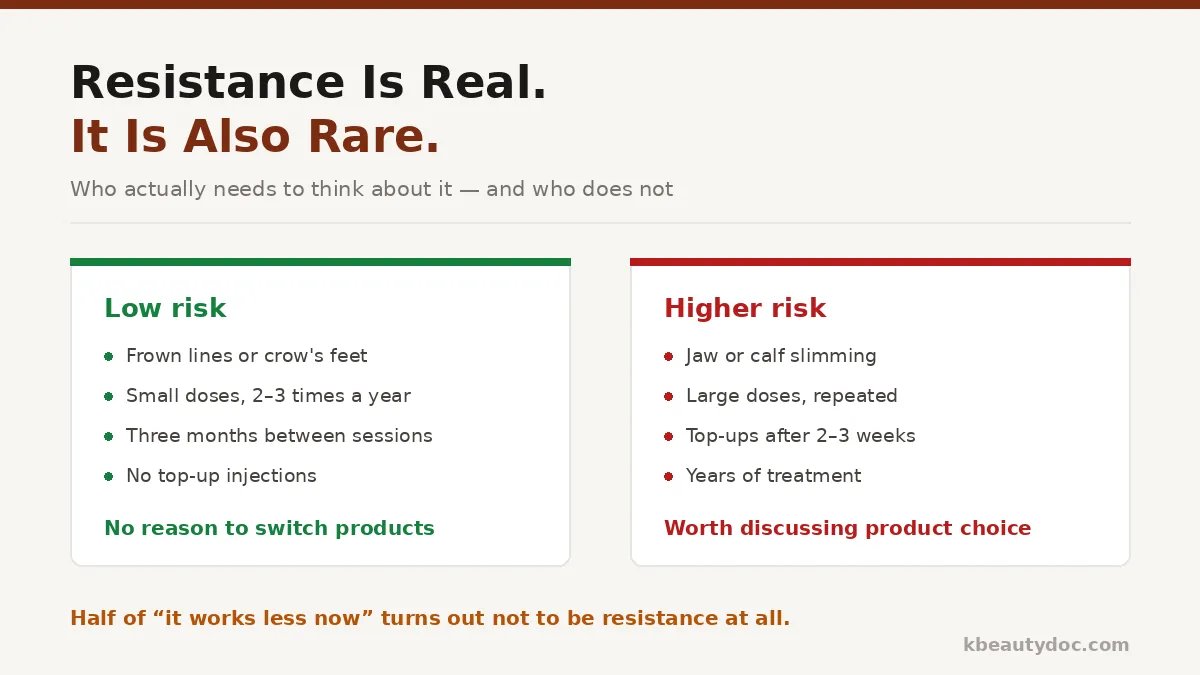
If you get your frown lines or crow’s feet done two or three times a year — you barely need to think about this. In the pooled registration data, about 5 in 1,000 developed antibodies [1]. Not a reason to switch to a pricier product.
If you have had large doses in your jaw or calves over years — risk rises with dose and repetition, so product choice is worth discussing.
If you have gone back for a top-up two or three weeks later, more than once — that is the habit that raises risk.
If you feel it is “not what it used to be” — do not assume resistance. More than half the time it is something else.
That is the practical answer. If you want to know why, keep reading.
What resistance actually is
In the second article I described the “wrapper” around the drug. If your immune system decides that wrapper — or the drug itself — is foreign, it makes antibodies, which can catch the drug before it reaches the muscle. The medical term is secondary non-response: it worked at first, then stopped.
One important detail. Having antibodies does not always mean losing the effect. Some people test positive for antibodies and continue to respond normally.
How common is it, in numbers
This is where the figures split dramatically depending on who is being studied.
Cosmetic use
Pooled data from the large registration studies of Botox, covering 5,876 people, found antibodies in about 0.5% — and only five were judged to have actually lost their response [1], fewer than 1 in 1,000.
Medical use with large doses
The numbers rise sharply. Among 568 patients treated long-term for a neck muscle disorder, 14.5% developed a reduced response over nine years — about 1.6% a year [2]. Across the wider literature, therapeutic rates range from 0.3% to 27.6% depending on design and condition [3].
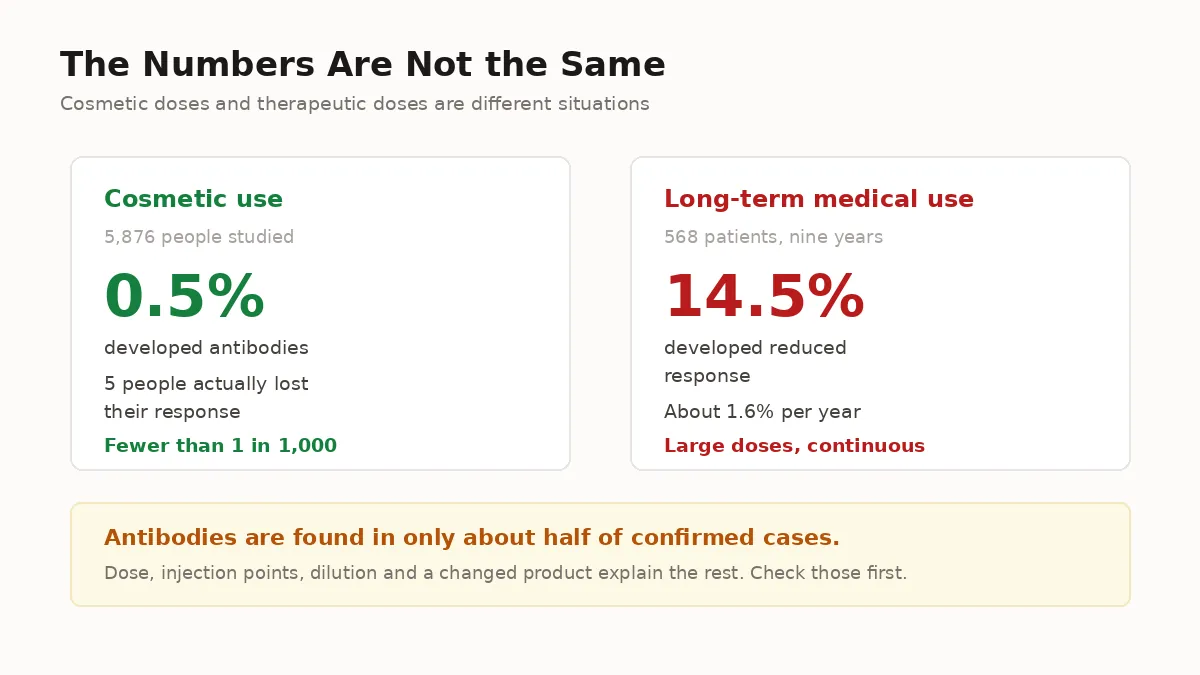
So the pattern is clear. More units, more often, for longer means higher risk — small cosmetic doses a few times a year are a different situation from large therapeutic doses on a continuous schedule. That said, cosmetic cases do exist. Rare is not the same as impossible.
Half of “it works less now” is not resistance
This is the most useful part of this article.
When patients with confirmed reduced response were tested, antibodies were found in only about half of them — the rest lost response with no detectable antibodies at all. So if treatment feels weaker than before, resistance is not the first explanation. Here are the others.
The first treatment always feels the most dramatic. It starts from your untreated baseline; every session after starts from an already-improved face. The effect has not shrunk — your starting point moved.
The dose may have been lower. Muscle bulk changes, injectors change, and judgement about how much an area needs varies.
The injection points may have been different. Within the glabella, which muscle gets how much changes the outcome — one reason injectors moved from a fixed grid to a tailored plan.
The dilution may have been different. The same units diluted differently spread differently, and can turn a day 3 result into a day 10 one.
The product may have changed without the units being converted. This is the problem from the second article. Moving from Dysport to another product while keeping the same number means receiving roughly a third of the dose.
So before concluding “I’ve become resistant,” these are the things to check.
Who is genuinely at higher risk
Research points to a few consistent factors.
Large doses. Jaw slimming, calf slimming, excessive sweating and muscle spasticity use many times the units of a cosmetic frown-line treatment.
Short intervals. Particularly top-up injections given two or three weeks later because the result felt insufficient. This is why a minimum interval of around three months is generally recommended.
Length of treatment history. In reported cases, loss of response appeared anywhere from two months to six years into treatment.
How to lower the risk
Keep at least three months between treatments. If the result was not enough, adjusting the dose at the next session is better than adding a top-up two weeks later.
Only as much as you need. More units does not mean longer duration. It means more exposure.
Record the product and the units. I have said this in every article in this series because it is genuinely the most useful thing you can do.
The ordinary risks, which are not this
Resistance is the rare problem. The common ones are short-lived: small bruises at the needle points, a headache for a day or two, and — if toxin reaches a muscle that was not the target — a heavy brow, an uneven brow, or a drooping upper eyelid, appearing in the first one to two weeks and easing as the effect fades. None of that is an immune reaction, and none of it predicts one.
Separately from resistance, botulinum toxin is generally not used in pregnancy or breastfeeding, in people with a neuromuscular disorder such as myasthenia gravis, or where there is infection at the injection site. A doctor who examines you decides.
If it really is resistance
Switching to another type A product usually will not help. Antibodies often react to the type A toxin itself rather than to a brand, so moving between type A products can produce the same result. (Partial exception: where antibodies formed against the wrapper proteins rather than the toxin, some patients regained response with a wrapper-free product — reported, but not reliable.)
There is also no simple test. Antibody assays exist but are not readily available in routine practice and are hard to interpret; antibodies are found in only half of confirmed cases.
In practice, taking an extended break is what is usually suggested, since antibody levels can decline over time.
What to ask at the clinic
Watch how they respond when you say you are worried about resistance. If the answer is immediately a more expensive product, pause. The first questions should be how often, how much, and for how long you have been treated.
If your result felt weaker, ask them to check the other explanations first — dose, injection points, dilution and any change of product, before resistance is assumed.
If a clinic offers a top-up, check the interval. A follow-up two or three weeks later may be offered as a convenience, but it is also a risk factor.
Frequently asked questions
If I develop resistance, can I never have treatment again?
Antibody levels can decline over time, and taking an extended break before trying again is a common approach. It cannot be predicted reliably.
Can I be tested for resistance?
Antibody tests exist but are not practical in routine care and are hard to interpret. The fact that antibodies appear in only about half of confirmed cases shows the limitation.
Would switching to Coretox or Xeomin solve it?
If antibodies have already formed, switching to another type A product may not restore the effect. Some patients whose antibodies targeted the wrapper proteins did respond again to a wrapper-free product, but that is not dependable. Prevention is more reliable than switching.
I only get cosmetic treatment. Should I worry?
In a large study the antibody rate was around 0.5%, and far fewer actually lost their response. Cases have been reported, so keep three months between treatments and avoid top-ups.
My results feel weaker than before. Is that resistance?
About half the time it is not. Check the first-treatment effect, dose, injection points, dilution, and whether the product changed.
So I don’t need an expensive product?
It depends. After large doses over a long period, there is a reason to consider it. If you are treated occasionally with small doses, switching purely out of concern about resistance is usually unnecessary.
References
- Jankovic J, Carruthers J, Naumann M, et al. Neutralising antibody formation with onabotulinumtoxinA treatment from global registration studies. Toxins 2023;15(5):342. PMID 37235376
- Hefter H, Hartmann C, Kahlen U, Moll M, Moldovan AS. Prospective analysis of secondary non-response to botulinum toxin therapy in cervical dystonia. Journal of Neural Transmission 2014;121(5):513-9. PMID 24311063
- Ho WWS, Albrecht P, Calderon PE, et al. Emerging trends in botulinum neurotoxin A resistance: an international multidisciplinary review. Plastic and Reconstructive Surgery Global Open 2022;10(6):e4407. DOI 10.1097/GOX.0000000000004407
Disclaimer: This is general information, not a diagnosis or a treatment plan. Brand names are discussed for information only and are not endorsements. Injections and prescription medicines should be chosen and given only by a licensed professional who has examined you, and what suits another person may not suit you.

Physician in non-surgical aesthetic medicine, practising in Ansan, South Korea. Every article here is written from clinical practice and the published literature.
About the author · Contact