Three things to know first
- All four are the same drug, working the same way.
- Units are set differently by each maker. Never compare the numbers directly.
- Nobody knows which lasts longest. Studies disagree.
So what should you choose?
Do not start with a product name; start with your situation.
You have an event coming up. A faster product helps, but all of them take one to two weeks to reach full effect. Get treated two weeks before, not two days before.
You have been treated often, for a long time. There is a reason to consider products designed to lower the chance of an immune reaction — Xeomin and Coretox.
You get large doses repeatedly for a medical reason — jaw slimming, excessive sweating, muscle spasticity. Then the point above matters much more.
You have your frown lines or crow’s feet done occasionally. Then how much, where, and who injects it matters far more than the brand — and injectors now work from your own muscle pattern rather than a fixed grid.
That is the practical answer. If you want to know why, keep reading.
In the first article I explained that Botox is a company’s brand name, not the name of the drug. Here is what actually differs between the products.
The drug and the wrapper
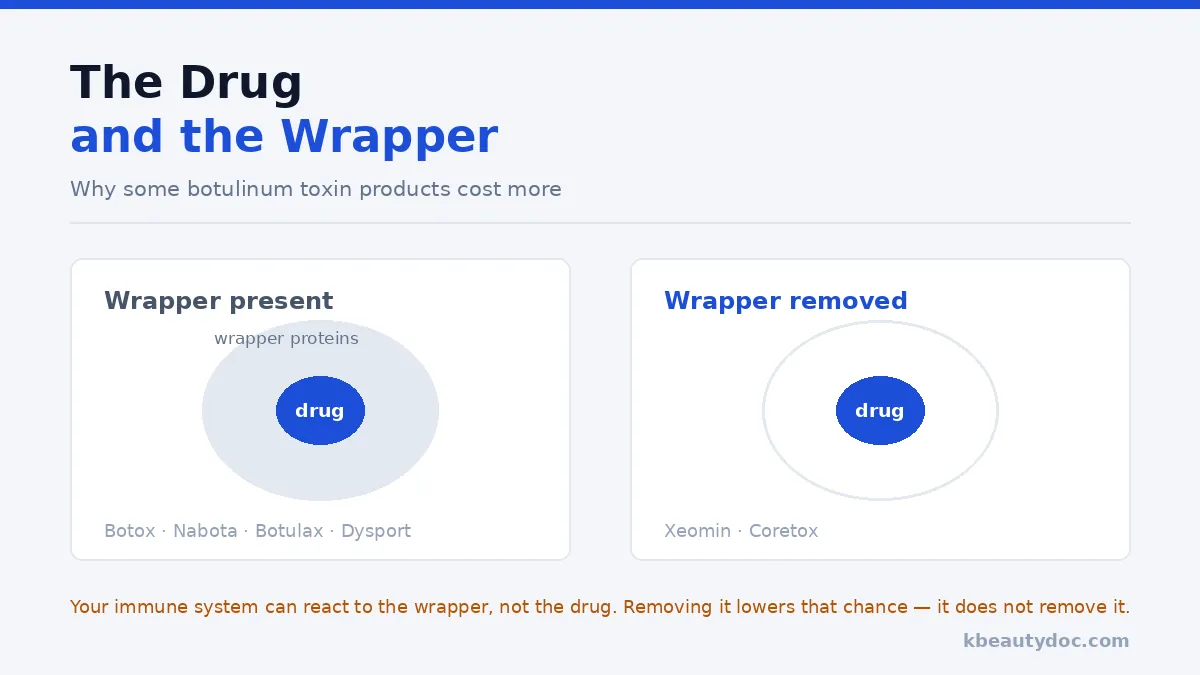
Botulinum toxin has two parts.
The part that does the work. Very small, and it is what relaxes the muscle.
The proteins wrapped around it. In nature these act like a shell, and they are about five times bigger than the drug itself.
The drug does its job, but the wrapper goes in too — and the immune system can decide something unfamiliar has arrived and make antibodies against it. If antibodies form, the same drug may work less well next time. That is what people mean by resistance, and it is why some companies strip the wrapper off.
Wrapper removed: Xeomin, Coretox Wrapper present: Botox, Nabota, Botulax, Dysport
(Technically the wrapper is complexing protein, and the two forms are described as 900 kDa and 150 kDa.)
One important point. No wrapper does not mean no resistance — these products were made to lower the chance, not remove it. And whether resistance genuinely matters for most cosmetic patients is a separate question.
Xeomin — the first to strip the wrapper
Made by Merz in Germany, launched in 2005 — the first product in the world with the wrapper removed. It tends to be chosen for people treated often over a long period, and is widely used for medical indications. Being imported, it costs roughly twice as much in Korea as Coretox.
Coretox — the first Korean product to strip the wrapper
Made by Medytox in Korea, launched in 2016 — second in the world, first here. The company also highlights that the stabiliser was removed: most toxin products add albumin, a protein from human blood, to keep the drug stable, and Coretox does not. Being domestic, it costs less than Xeomin.
One thing to know. An animal study reports an advantage for Coretox with repeated dosing [1] — but it was run by the company that makes Coretox.
Nabota — the Korean product that reached the US
Made by Daewoong Pharmaceutical in Korea, launched in 2014, in the wrapper-present group. It was the first Korean botulinum toxin approved by the US FDA, cleared in 2019 for frown lines, and is sold in the United States as Jeuveau. It holds about 13% of the US market.
Dysport — the one with different numbers
Made by Ipsen in France, used worldwide for a long time alongside Botox.
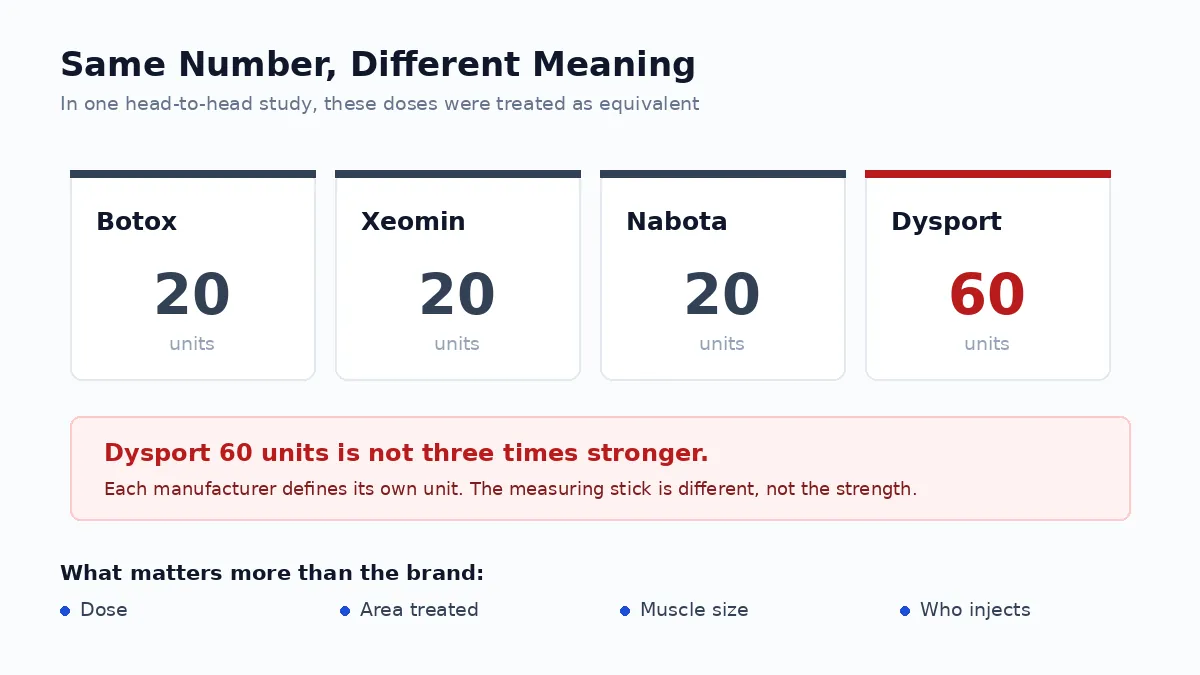
The important thing is that its units are counted differently.
In the trial below, three products were given at 20 units and Dysport at 60 — roughly three times the number. So “Dysport 60 units” is not three times stronger than 60 of another product; the measuring stick is different.
Dysport also spreads a little more widely from the injection point. Over a broad forehead that reach is useful; near small, precise muscles it is the thing to weigh, because unintended spread is what produces a heavy or uneven brow.
What can go wrong, and who should wait
The common complaints after any of the four are short-lived: a headache for a day or two, small bruises at the needle points. The one worth recognising is spread into a muscle that was not the target — a heavy or uneven brow, or a drooping upper eyelid, usually appearing in the first one to two weeks and easing as the effect fades. Bruises also mark more stubbornly in strong sun while healing, one more reason to know how to read a Korean sunscreen label before a trip.
None of the four is generally given during pregnancy or breastfeeding, to people with a neuromuscular disorder such as myasthenia gravis, or to anyone with an infection at the injection site or a past reaction to a toxin product. A doctor who examines you decides.
A study that compared all four directly
In a randomised trial, 143 women each received one of the four products for their frown lines and were followed for six months [2].
Peak effect was similar across all four. That is the important finding. Nabota and Dysport changed soonest, by day three — although day 3 versus day 10 depends on more than the brand. At six months Nabota and Xeomin were reported still holding, but other studies found the opposite.
Which lasts longest — there is no answer yet
Studies suggesting Xeomin is shorter
Patients treated for eyelid spasm were asked which product they preferred. Those preferring Xeomin returned for retreatment sooner than those preferring Botox — about 10 weeks against 13 — and the reason most often given for Botox was that it lasted longer [5]. In short: works well, wears off sooner.
A laboratory potency measurement found Xeomin vials assaying below their labelled unit content — work run by the company that makes Botox.
Studies finding no difference
An analysis of 1,101 treatment cycles in a neck muscle disorder found essentially the same duration for Botox and Xeomin, 11.2 against 11.4 weeks [3].
A randomised trial of 250 women compared the two head to head at the same 20-unit dose and found the effect equivalent at one month and similar through four months [4].
So the conclusion is
We do not know yet. Results shift with study design, area, dose and timing of measurement — which is why a clinic can say Xeomin seems to wear off sooner and still not be stating a fact about everyone. Duration is shaped far more by dose, area, muscle size and individual variation than by brand, so write down the product name and the number of units that worked well for you.
What to ask at the clinic
Which product, and how many units. Write it down; it becomes your reference anywhere else you go.
Why that product. You want to hear “this suits your situation because…”, not “this one is good.”
How they answer when you mention resistance. If the reply is immediately a pricier product, pause.
Frequently asked questions
Is a wrapper-free product better?
It was made to lower the chance of antibodies forming, not to rule it out. It matters more if you receive large doses often; treated occasionally, you may notice no difference.
Is Dysport 60 units stronger than Botox 60 units?
No. They are measured on different scales — in the study above, 60 units of Dysport corresponded to 20 of the others.
Are Korean products inferior to imported ones?
Nabota was the first Korean botulinum toxin approved by the US FDA and holds about 13% of that market; Coretox was the second product in the world to remove the wrapper. Country of origin is not a useful ranking.
Which one lasts the longest?
Studies disagree. One found Nabota and Xeomin still holding at six months; others found Botox lasted longer. Dose and individual variation matter more.
When does it start working?
As early as day three for some products, but full effect takes one to two weeks. For an event, get treated two weeks ahead.
Can I switch products?
Yes — but because units are not interchangeable, tell your injector what you had, how many units, and how it went. The number alone can lead to the wrong dose.
References
- Byun J, Lee SH, Jeon H, et al. Repeated administration of a botulinum toxin type A preparation without complexing proteins in an animal model. Toxins 2022;14(6):365. DOI 10.3390/toxins14060365
- Lemdani MS, et al. Comparative onset and duration of four botulinum toxin type A products for glabellar lines: a randomised clinical trial. JAMA Dermatology 2025;161(7):723-730. PMID 40434770
- Dressler D, Tacik P, Adib Saberi F. Botulinum toxin therapy of cervical dystonia: duration of therapeutic effects. Journal of Neural Transmission 2014;121(1):29-31. PMID 23913131
- Kane MAC, Gold MH, Coleman WP, et al. A randomized, double-blind trial to investigate the equivalence of incobotulinumtoxinA and onabotulinumtoxinA for glabellar frown lines. Dermatologic Surgery 2015;41(11):1310-9. DOI 10.1097/DSS.0000000000000531
- Chundury RV, Couch SM, Holds JB. Comparison of preferences between onabotulinumtoxinA and incobotulinumtoxinA in the treatment of benign essential blepharospasm. Ophthalmic Plastic and Reconstructive Surgery 2013;29(3):205-7. PMID 23552607
Disclaimer: This is general information, not a diagnosis or a treatment plan. Brand names are discussed for information only and are not endorsements. Injections and prescription medicines should be chosen and given only by a licensed professional who has examined you, and what suits another person may not suit you.

Physician in non-surgical aesthetic medicine, practising in Ansan, South Korea. Every article here is written from clinical practice and the published literature.
About the author · Contact