
What’s Innotox?

Like Botox, but Korean, and it comes already liquid.
Is it stronger than Botox?
No proof of that. One trial found similar results.
So why liquid?
No mixing at the clinic. That’s the main difference.
Every vial of Botox arrives as a dry speck of powder that someone at the clinic must mix with salt water. Innotox arrives already mixed.
Short answer:
- Innotox is a Korean botulinum toxin type A from Medytox, licensed in Korea since December 2013 and described as the world’s first ready-to-use liquid one [1, 2].
- Same drug class as Botox, different product. It is liquid, not powder, has no human albumin, and its units do not convert to Botox units.
- One Korean trial found it about as good as Botox for frown lines. I found no US approval; it is still being studied there.
What is Innotox?
Innotox is made by Medytox, the Korean company behind Meditoxin. Korea’s drug regulator licensed it on 11 December 2013 for the temporary improvement of frown lines between the brows [1]. A 2026 review calls it the world’s first liquid botulinum toxin type A [2].
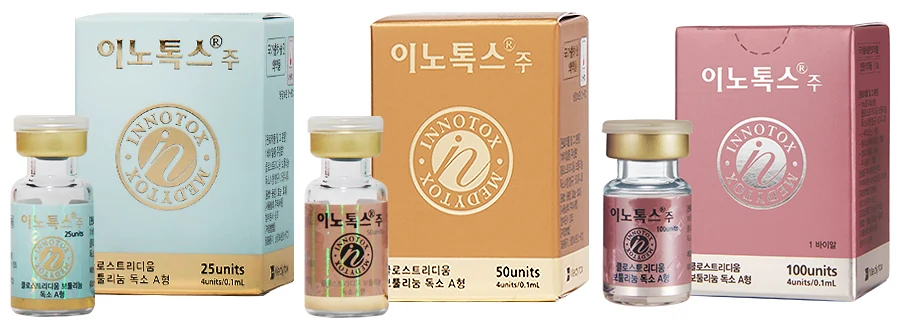
Photo: the manufacturer’s official site.
The toxin is close kin to Botox: both come from the Hall strain of the bacterium, in the large 900 kDa complex form [1, 3, 4]. Allergan, Botox’s own maker, once licensed this liquid and ran phase 3 trials before the deal ended [5].
How is Innotox different from Botox?
Powder versus liquid. Botox is a vacuum-dried powder. The clinic adds sterile saline, then must use it within 24 hours [3]. Innotox is a clear liquid already in the vial, so that step is gone [1].
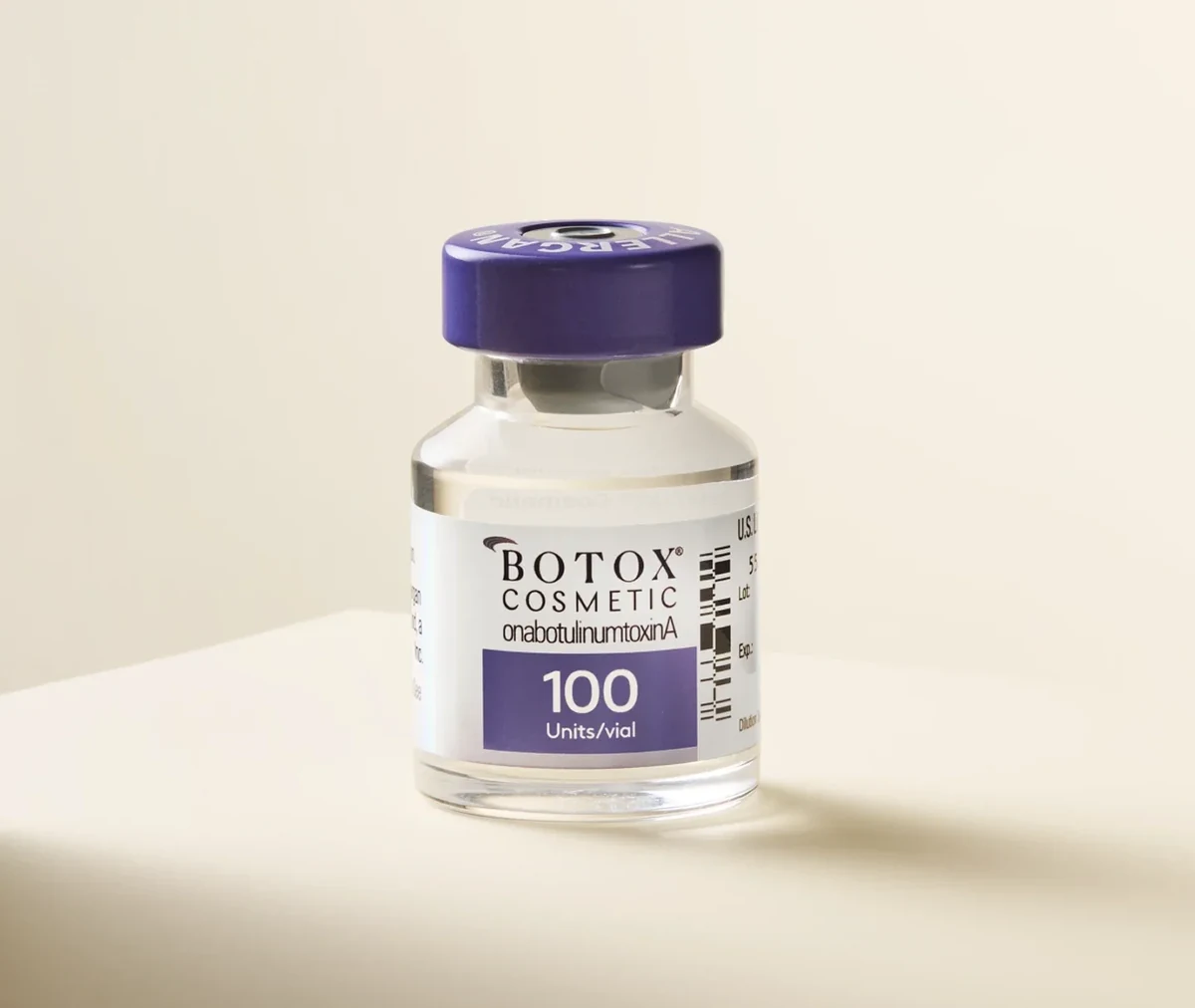
Photo: the manufacturer’s official site.
What keeps it stable. Botox contains human albumin, a protein from donated blood [3]. Innotox’s Korean label lists salt, polysorbate 20, water and L-methionine instead, with no albumin [1].
Storage. Both stay in the fridge, at 2 to 8 °C, before opening [1, 3].
So the real difference happens before the needle, not in the muscle. Why does that matter? Clinics add different amounts of saline, one reason results show on day 3 for one person and day 10 for another. A liquid fixes the strength at the factory. Handy, but it does not make the drug stronger.
Are Innotox units the same as Botox units?
No, and this matters most. Botox’s US label says its units cannot be compared to, or converted into, units of any other toxin [3, 6].
Innotox’s label uses Botox’s standard strength too, 4 units in 0.1 mL for frown lines [1, 3], but the same number on paper does not prove the same dose.
Does Innotox work as well as Botox, or last longer?
In the Korean trial behind its licence, 168 adults with frown lines got Innotox or Botox without knowing which. At four weeks the improvement was not significantly different [7]. At 16 weeks one measure favoured Innotox: one secondary result from one trial, so I do not tell patients it lasts longer.
Korea’s label puts the effect at about three to four months for frown lines, and says doses should not be repeated more often than every three months [1].
Medytox-funded trials in North America and Europe compared it with a placebo, not Botox [8]. A 2026 review says it is still in US studies [2]; I found no US approval.
Was Innotox ever banned in Korea?
Briefly. In January 2021 Korea’s regulator cancelled its licence over stability test documents that prosecutors said were falsified [9]. A court suspended the order a month later while Medytox sued, and sales resumed [10]. Korea’s drug database listed the licence as active when I checked on 6 October 2026 [1]. I could not confirm the final ruling.
What are the side effects, and who should wait?
In the North American and European trials, headache was the most common complaint, and a drooping eyelid affected roughly 1 in 100 treated people or fewer [8].
The Korean label advises against it in pregnancy or breastfeeding, asks for care with nerve-muscle diseases such as myasthenia gravis, and rules out ongoing use with aminoglycoside antibiotics [1]. An infected injection site means waiting.
What I tell my patients about Innotox
- Write down the name and the units. “Innotox, 20 units” is useful later; “Korean Botox” is not.
- Liquid is a convenience, not an upgrade. How the injector plans for your muscles matters more.
- Keep at least three months between sessions, whatever the brand. Frequent top-ups are the pattern linked to toxin resistance.
Every Korean option is lined up in Is there a Korean alternative to Botox?
Have a question about your own case? Ask me on LINE or by email — details on the Contact page.
Read next
- Botulax vs Botox: Is Korean Botox Safe?
- Dysport vs Xeomin vs Nabota: Is One Better? Plus Coretox
- Korean clinics, honestly: every comparison in one place
FAQ
Is Innotox better than Botox?
Not on the evidence I found. In one Korean trial of 168 people, frown-line improvement at four weeks was not significantly different. Its advantage is practical: it comes as a ready-to-use liquid, so there is no mixing step at the clinic.
Is Innotox FDA approved?
I found no US approval. Medytox has run phase 3 trials in North America and Europe, and a 2026 review describes it as still being studied in the US.
How long does Innotox last?
Korea’s label says about three to four months for frown lines, and repeat doses should be at least three months apart. Dose, muscle strength and the area treated all change this.
References
- Ministry of Food and Drug Safety (Korea). Innotox Inj. licence and label, item 201310633 (licensed 2013-12-11; additives; storage; dosage; precautions). nedrug.mfds.go.kr. Accessed 2026-10-06.
- Dressler D, Kim N, Johnson EA, Adib Saberi F. Korean botulinum toxins. J Neural Transm 2026;133(6):971-975. 10.1007/s00702-025-03076-x
- AbbVie. BOTOX Cosmetic (onabotulinumtoxinA) US prescribing information, revised October 2024. DailyMed
- Kim HM, Kwak S, Choi YS, Lee D, Kwon JH, Jung H. Thermal stability of botulinum toxin type A formulations exposed to heat in vitro, assessed by an in vivo mouse potency bioassay. Aesthet Surg J Open Forum 2026;8:ojag025. 10.1093/asjof/ojag025 (funded by Medytox; five authors are Medytox employees)
- Medytox. Company brochure 2024 (published January 2025), group history. Accessed 2026-10-06.
- Brin MF, Nelson M, Ashourian N, Brideau-Andersen A, Maltman J. Update on non-interchangeability of botulinum neurotoxin products. Toxins 2024;16(6):266. 10.3390/toxins16060266
- Kim JE, Song EJ, Choi GS, Lew BL, Sim WY, Kang H. The efficacy and safety of liquid-type botulinum toxin type A for the management of moderate to severe glabellar frown lines. Plast Reconstr Surg 2015;135(3):732-741. PMID 25719692
- Coleman W, Bertucci V, Humphrey S, et al. NivobotulinumtoxinA in the treatment of glabellar lines with or without concurrent treatment of lateral canthal lines in two phase 3 clinical trials. Aesthet Surg J 2025;45(4):404-413. 10.1093/asj/sjae233 (funded by Medytox)
- Korea Biomedical Review. Regulator cancels permit for Medytox’s wrinkle remover, 18 January 2021. koreabiomed.com
- Edaily. Court suspends cancellation of Innotox licence; Medytox resumes sales, 8 February 2021 (in Korean). edaily.co.kr
Disclaimer: This is general information, not a diagnosis or a treatment plan. Brand names are discussed for information only and are not endorsements. Injections and prescription medicines should be chosen and given only by a licensed professional who has examined you, and what suits another person may not suit you.
14 years in practice · replies to messages herselfA doctor in Korea, in practice since 2012 — your K-Beauty Doc. Physician in non-surgical aesthetic medicine, practising in Ansan, South Korea. Every article here is written from clinical practice and the published literature. Not medical advice.
About the author · Contact