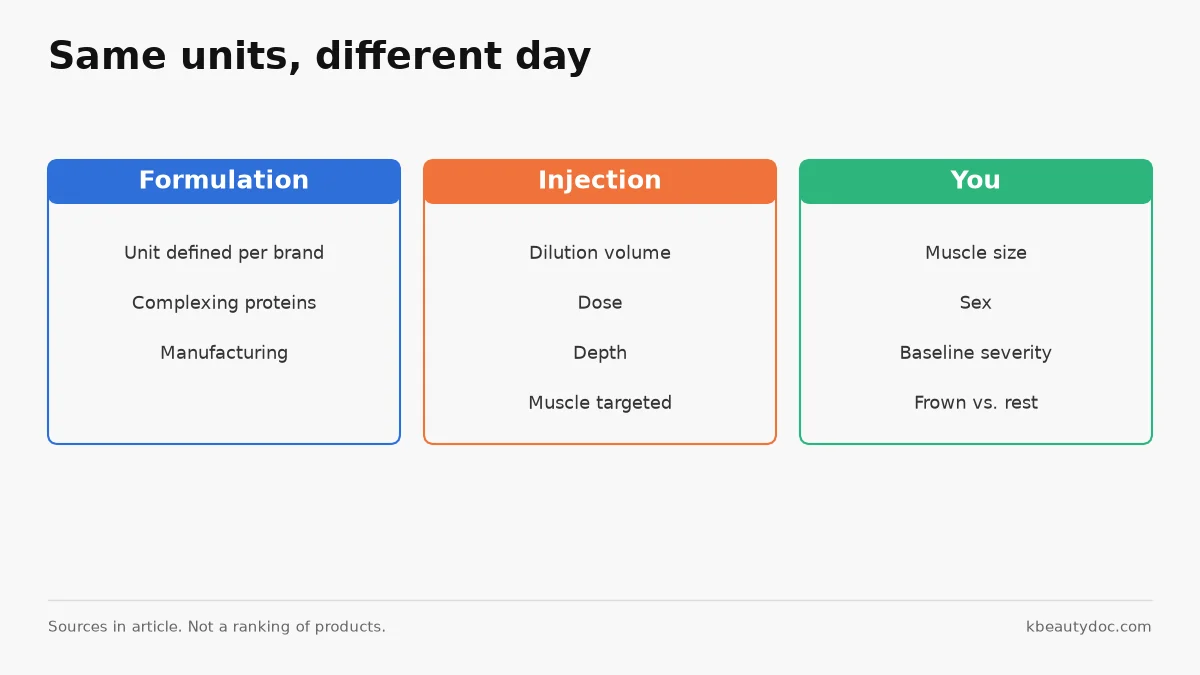
Two people are injected the same afternoon, in the same frown lines, with the same number on the chart — and one cannot frown by Wednesday while the other is still waiting the following Monday.
The short answer. A “unit” is not a shared measurement. Each maker defines its own by its own in-house potency test, so the number on your chart means something only inside that brand. Beyond the vial, speed depends on dilution, placement and muscle size. Published onset for frown lines sits roughly between 2 and 5 days, with the fuller effect around two weeks — but trials disagree, and none of them measured you.
Why it is never instant
Botulinum toxin does not switch a muscle off on contact. The protein binds to the nerve ending, is carried inside, and cuts a docking protein the nerve uses to release its signal. Endings that already loaded their signal still fire, so the muscle works until enough of that machinery turns over — hours to days, not minutes. “It did nothing” on day 2 is not a verdict.
Factor 1 — the formulation
I have covered what differs between the brands and why Botox is one company’s brand name, not the drug’s elsewhere. Here, only the part that touches timing.
The unit is the biggest trap
Every manufacturer sets potency against its own reference standard with its own in-house assay, so units cannot be converted between brands by a dose ratio [1]. Dysport makes this visible — trials using 20 units of the others use 60 of Dysport for the same area. The rest hide it better, their numbers happening to look similar. So “same units, different speed” is the wrong question: it was often not the same amount.
What the trials actually report
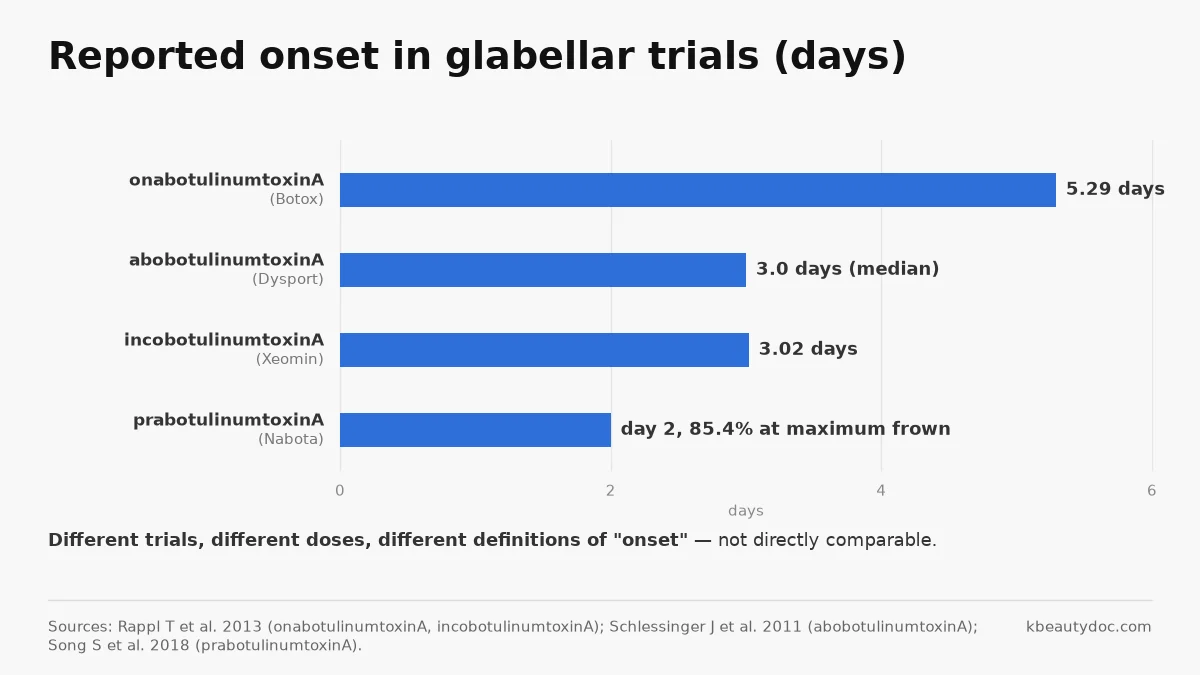
| Product (generic name) | Complexing proteins | Onset reported in published trials |
|---|---|---|
| Botox (onabotulinumtoxinA) | present | 5.29 days in women in a 3-arm trial of 180 people [2]; measurable change at day 2 for crow’s feet [4] |
| Dysport (abobotulinumtoxinA) | present | Median 3 days in pooled phase 3 data (n=1,160); 19.7% by day 1 [3] |
| Xeomin (incobotulinumtoxinA) | absent | 3.02 days in women in the same trial [2]; 84% of peak effect by days 2–4 in 23 patients [5] |
| Nabota / Jeuveau (prabotulinumtoxinA) | present | 85.4% improved at maximum frown by day 2 (n=41); 97.6% by day 14 [6] |
| Botulax / Letybo (letibotulinumtoxinA) | present | Week-4 responder rate only; no day-level figure I could confirm [7] |
| Meditoxin, Coretox, others | Meditoxin present, Coretox absent | No published day-level figure I could find |
That table is not a ranking. Those studies used different doses, muscles, raters and definitions of “onset”, and they disagree: a 2025 head-to-head in 143 women found two of four arms changed earliest at day 3 [8], while a split-face study found no difference between two of the same products [9]. Formulation moves onset by a day or two, not a week.
The “wrapper” does not explain speed
Some products carry the accessory proteins that surround the toxin in nature; Xeomin and Coretox do not, so it is tempting to assume the stripped version acts sooner. Laboratory work argues otherwise: those complexes fall apart within about a minute above pH 7, and most free neurotoxin is released during manufacturing anyway [10].
Factor 2 — the injection
The part patients rarely think about, and the part I think matters more.
Dilution. The same units in more saline cover a wider area — in a randomised forehead study, 5 units in five times more saline spread across roughly 50% more area [11]. A wider, thinner spread reaches more fibres of a broad muscle early; a concentrated bolus does more at one point. Both change what day 3 looks like.
Dose. In a dose-ranging study in 80 men, 40, 60 and 80 units beat 20 units on peak response and duration [12]. Undershooting a strong muscle looks exactly like slow onset.
Depth and placement. Toxin in the belly of the target muscle acts sooner than toxin sitting above it in fat — clinical judgement, not something a trial has cleanly isolated.
Time since the vial was mixed. Largely a myth. Potency-tested after reconstitution, one Korean product held an estimated 16 weeks at room temperature and 74 weeks refrigerated [13]. A vial mixed that morning is not a weaker vial.
Factor 3 — you
Sex and muscle mass. In the 180-person trial, onset was earlier in women than in men for all three products. Pooled Dysport data showed the same shape: men responded less often on a fixed dose than on one adjusted for muscle mass [3]. A bigger muscle needs more drug, and until it gets it the effect looks late.
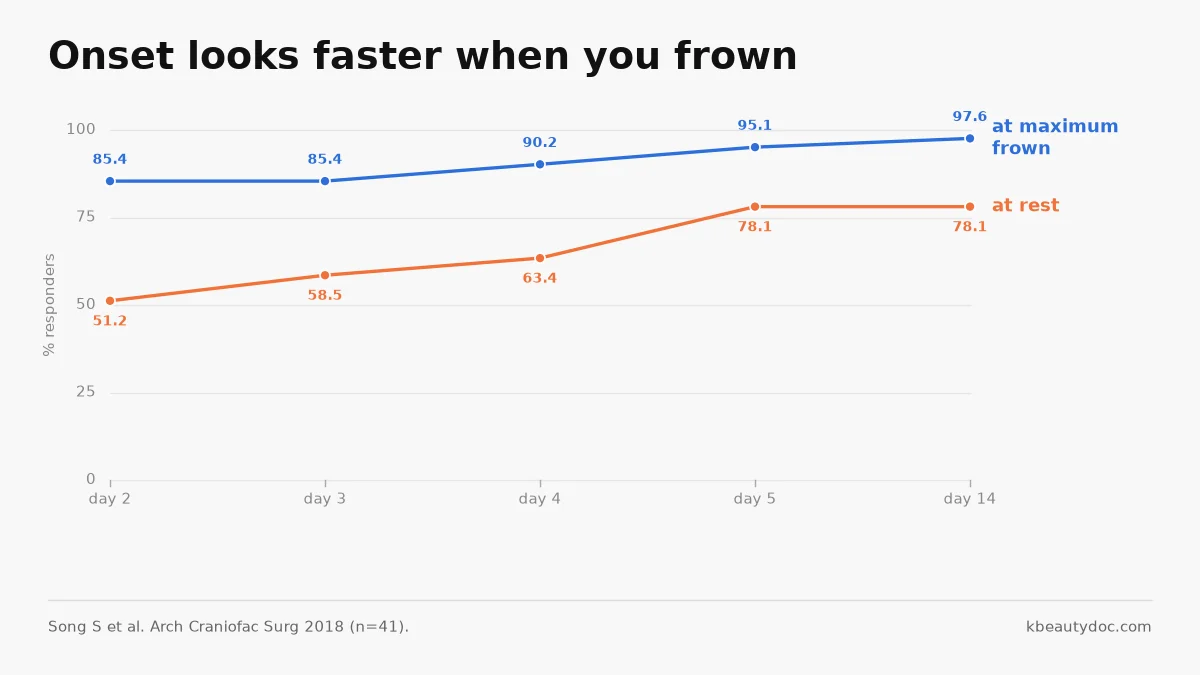
Frowning versus resting. Two clocks. In the Nabota study, at day 2, 85.4% had improved at maximum frown but only 51.2% at rest; by day 14, 97.6% and 78.1%. Movement settles first, because skin has to stop being folded before the crease softens.
Where you started. In the 143-woman trial, more severe baseline movement produced more measurable improvement — mild lines leave less to see.
Treatment history. True antibody-driven resistance is uncommon in occasional cosmetic use and is not the first explanation to reach for when one round feels slow. The same frown-line site is the one used in the mood research, where trial evidence and online claims diverge.
Late is not the same as spread
Waiting is normal. A different pattern is not. A heavy brow, an uneven brow, or a drooping upper eyelid usually appears between days 3 and 10 — the same window in which people are still hoping for an effect. That is toxin acting where it was not wanted rather than a slow start, and it eases as the effect wears off. Headache and small bruises at the injection points are the common, short-lived complaints.
Botulinum toxin is generally not given to people who are pregnant or breastfeeding, who have a neuromuscular disorder such as myasthenia gravis, who have an infection at the injection site, or who have reacted badly to a toxin product before. A doctor who examines you decides.
If a week has gone by and nothing has changed
General guidance, not advice for any one person. Wait until day 14 to judge; most protocols assess at two weeks, when the picture is stable. If movement still has not changed, raise it with the doctor who treated you and bring the product name, units, areas injected, and what you noticed on which day. That record is worth more next time than the number alone.
FAQ
How long until botulinum toxin starts working?
Trials on frown lines most often report first visible change between day 2 and day 5, with the effect building to around two weeks. They disagree on exact days because each defines “onset” differently.
Does a higher unit number mean faster onset?
Within one product, higher doses have been linked to higher peak response and longer duration. Across brands the comparison does not hold, because each maker defines its unit differently.
Is 20 units of one brand the same as 20 units of another?
No. A 2024 review states these units are not interchangeable and cannot be converted with a dose ratio. Dysport is the clearest example, dosed at roughly three times the number for the same area.
Do the brands without complexing proteins work faster?
Not for that reason. Those accessory proteins separate from the active toxin within about a minute at body pH, and mostly separate during manufacturing anyway.
Why did it work faster on my forehead than on my frown lines?
Different muscle, size, dose and dilution. A thin broad muscle and a thick deep one do not follow one schedule, even in the same session.
My lines are still visible at rest after a week. Is the treatment failing?
In one study, improvement at maximum frown reached 85.4% by day 2 while at rest it was 51.2%, rising to 78.1% by day 14. Movement settles before the resting crease does.
Should I ask for a different brand next time if mine felt slow?
Bringing the details — product, units, areas and when you noticed the change — beats switching on one impression. Timing is shaped by dose, dilution, muscle and technique as much as by the name on the vial.
References
- Brin MF, Nelson M, Ashourian N, Brideau-Andersen A, Maltman J. Update on non-interchangeability of botulinum neurotoxin products. Toxins 2024;16(6):266. PMID 38922160
- Rappl T, Parvizi D, Friedl H, et al. Onset and duration of effect of incobotulinumtoxinA, onabotulinumtoxinA and abobotulinumtoxinA in the treatment of glabellar frown lines. Clinical, Cosmetic and Investigational Dermatology 2013;6:211-219. PMID 24098087
- Schlessinger J, Monheit G, Kane MAC, Mendelsohn N. Time to onset of response to abobotulinumtoxinA for glabellar lines: a pooled analysis of phase 3 trials. Dermatologic Surgery 2011;37(10):1434-1442. PMID 21745254
- Yu KC, Nettar KD, Bapna S, et al. Split-face double-blind study comparing the onset of action of onabotulinumtoxinA and abobotulinumtoxinA. Archives of Facial Plastic Surgery 2012;14(3):198-204. PMID 22183059
- Prager W, Bee EK, Havermann I, Zschocke I. Onset, longevity and patient satisfaction with incobotulinumtoxinA for glabellar frown lines. Clinical Interventions in Aging 2013;8:449-456. PMID 23650444
- Song S, Lee YH, Hong JP, Oh TS. Onset of prabotulinumtoxinA for glabellar lines: a phase 4 study. Archives of Craniofacial Surgery 2018;19(3):168-174. PMID 30282425
- Masood M, et al. Efficacy and safety of letibotulinumtoxinA for glabellar lines: a systematic review and meta-analysis. Aesthetic Plastic Surgery 2026;50:3427-3437. PMID 41501424
- Lemdani MS, et al. Comparative onset and duration of four botulinum toxin type A products for glabellar lines: a randomised clinical trial. JAMA Dermatology 2025;161(7):723-730. PMID 40434770
- Vasile G, et al. Split-face comparison of onabotulinumtoxinA and prabotulinumtoxinA. Journal of Clinical and Aesthetic Dermatology 2023;16(5). PMID 37288279
- Eisele KH, Fink K, Vey M, Taylor HV. Studies on the dissociation of botulinum neurotoxin type A complexes. Toxicon 2011;57(4):555-565. PMID 21195107
- Hsu TS, Dover JS, Arndt KA. Effect of volume and concentration on the diffusion of botulinum exotoxin A. Archives of Dermatology 2004;140(11):1351-1354. PMID 15545544
- Carruthers A, Carruthers J. Prospective, double-blind, randomized, parallel-group, dose-ranging study of botulinum toxin type A in men with glabellar rhytids. Dermatologic Surgery 2005;31(10):1297-1303. PMID 16188182
- Park KY, Han HS, Kim JH, Kim HB, Seo SJ. Real-time stability of prabotulinumtoxinA after reconstitution. Dermatologic Surgery 2020;46(12):1657-1660. PMID 33252895
Disclaimer: This is general information, not a diagnosis or a treatment plan. Brand names are discussed for information only and are not endorsements. Injections and prescription medicines should be chosen and given only by a licensed professional who has examined you, and what suits another person may not suit you.

Physician in non-surgical aesthetic medicine, practising in Ansan, South Korea. Every article here is written from clinical practice and the published literature.
About the author · Contact