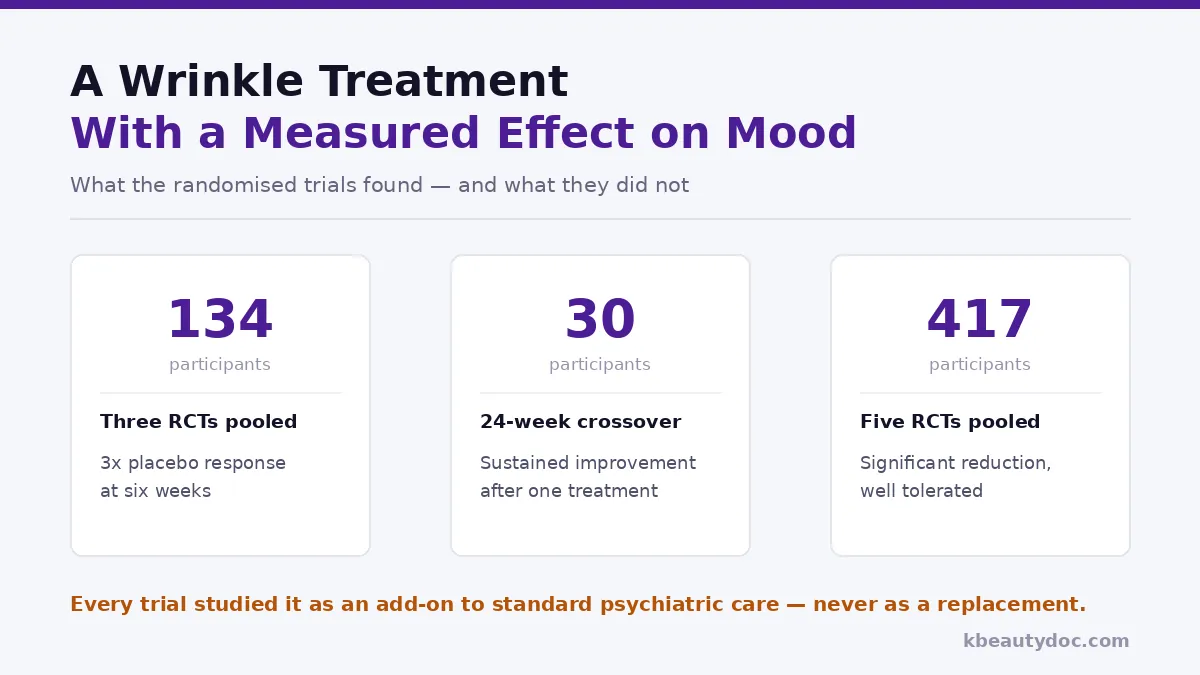
Three things to know first
- The research is real. Several randomised controlled trials, not one small study.
- It is an add-on, not a treatment. Every trial studied it alongside standard psychiatric care.
- The site matters. Only the frown-line area produced the effect.
So what does this mean for you?
Here is the short version.
If you are dealing with depression — the first step is a physician or mental health professional, not a cosmetic appointment. Everything below was studied as an addition to proper care, never as a replacement for it.
If you are already receiving treatment for depression and are curious about this — it is a reasonable thing to raise with your doctor. The evidence exists and the safety profile in these trials was good.
If you are getting frown-line treatment anyway — you do not need to do anything differently. This research does not change how a cosmetic treatment is performed.
If you saw this on social media as a “mood hack” — the trials are more modest than the headlines.
Botulinum toxin — the drug sold as Botox, Botulax and Meditoxin — is best known as a wrinkle treatment. But there is a growing body of clinical research examining it as an adjunctive treatment for major depressive disorder — not as a replacement for antidepressants or therapy, but as an add-on with its own measurable effect.
Here is where the evidence actually stands.
The idea behind it: facial feedback
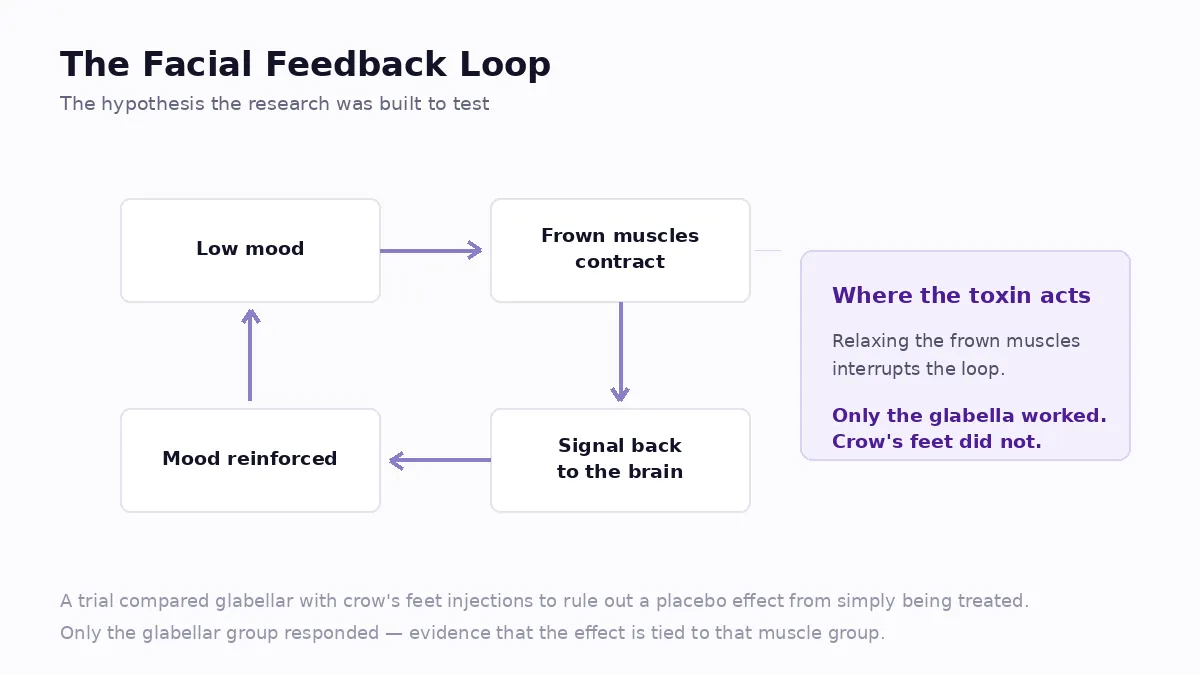
The theory driving this research is the facial feedback hypothesis — the idea that facial expressions do not merely reflect emotion, they help reinforce it.
The corrugator and procerus muscles, the frown muscles between the eyebrows, are chronically active in many people with depression. The hypothesis is that relaxing them interrupts a feedback loop that keeps reinforcing negative mood, independently of any cosmetic effect.
It sounds implausible until you see how carefully the trials were built to separate a real effect from the pleasure of a cosmetic appointment.
What the studies found
| Study | Design | Participants | Finding |
|---|---|---|---|
| Pooled analysis (2015) | Three placebo-controlled RCTs combined | 134 | Response rate roughly three times placebo at six weeks |
| Magid et al. (2014) | 24-week randomised, double-blind, crossover | 30 | Significantly greater symptom reduction than placebo |
| Systematic review (2020) | Five RCTs pooled | 417 | Statistically significant, large-effect reduction; well tolerated |
| Site comparison trial (2024) | Glabella vs crow’s feet | — | Effect only in the glabella group |
Read together, the conclusion is simple. When patient-level data from three placebo-controlled trials of frown-line injections were pooled, improvement on depression rating scales at six weeks was several times more common in the treated group than in the placebo group [1]. A six-month crossover trial, in which every participant eventually received the active drug, found significantly greater symptom reduction than placebo after a single frown-line treatment [2]. A systematic review pooling five randomised trials reported the same direction of effect, with side effects that were mild and temporary [3].
None of these were large trials, which is the honest caveat — but they point the same way, which is unusual in early psychiatric research.
The detail that makes this convincing
Across the research, the effect is consistently tied to one specific area — the glabellar region, the corrugator and procerus muscles between and above the eyebrows. It is the same area where cosmetic injectors moved from a fixed grid to a muscle-by-muscle plan.
This matters because of one particular trial design. Researchers directly compared [4] glabellar injections against crow’s feet injections in patients with treatment-resistant depression, specifically to rule out a placebo effect from simply receiving a cosmetic treatment.
The glabellar group showed the antidepressant response. The crow’s feet group — same product, same session, same expectation of benefit — did not.
That is meaningful evidence that the mood effect is tied to that specific muscle group rather than to the experience of being injected.
What this does not mean
This is not a stand-alone treatment for depression, and it is not a substitute for psychiatric evaluation, medication, or therapy where those are indicated.
Every trial in this body of research studied it as an adjunctive treatment — layered on top of standard psychiatric care, not instead of it. That distinction is not a legal disclaimer; it is what was actually tested.
If you are dealing with depressive symptoms, the appropriate first step is a conversation with a physician or mental health provider who can evaluate the full clinical picture. Not a cosmetic injection appointment.
Two further limitations worth stating plainly. The trials are small — 30 participants here, 134 there, 417 pooled. In psychiatric research these are early-stage numbers, not definitive ones. And most participants were women receiving glabellar treatment, which leaves open how much of the effect comes from appearance change rather than facial feedback. The crow’s feet comparison argues against that explanation, but one trial does not settle it.
The published trials also used onabotulinumtoxinA, and because units are counted differently by each manufacturer, those doses do not transfer to another vial.
Dr. Yoo’s note
What I find genuinely interesting here is not that “Botox cures depression” — it does not, and no serious study claims that.
It is that a treatment developed for wrinkles turned out to have a measurable, replicated effect on mood through an entirely different mechanism: interrupting facial feedback rather than any pharmacological action on the brain.
That is a useful reminder that the line between cosmetic and medical is often blurrier than marketing makes it look. And it is also why something like this belongs with a qualified provider who understands both sides of it, rather than being chased as a mood hack on your own.
FAQ
Would a normal cosmetic Botox treatment help my mood?
The trials used glabellar injections at doses in the cosmetic range, so the overlap is real. But mood outcomes were measured in patients diagnosed with major depressive disorder receiving standard care alongside. It is not something to rely on.
Why only the frown lines?
The corrugator and procerus muscles are the ones chronically active in depression, and they are what the facial feedback hypothesis concerns. A trial comparing glabellar with crow’s feet injections found the response only in the glabellar group.
How long did the effect last in the studies?
The 24-week trial tracked participants over six months and reported sustained improvement after a single treatment. Duration varied between studies.
Is this an approved treatment for depression?
No. This is research into an adjunctive use, not an approved indication. Any use for this purpose would be outside labelled indications and belongs in a supervised clinical setting.
Can I ask my dermatologist about this?
You can, but the more useful conversation is with whoever manages your mental health care. They can judge whether it fits your overall treatment plan.
Are the studies large enough to be sure?
Not yet. The individual trials involve tens of participants and the pooled analyses a few hundred. The consistency across trials is encouraging; the scale is still modest.
This post is for general informational purposes only, summarises published clinical research, and does not constitute a diagnosis or treatment recommendation for any individual reader. If you are experiencing symptoms of depression, please consult a licensed physician or mental health professional.
References
- Magid M, Finzi E, Kruger THC, et al. Treating depression with botulinum toxin: a pooled analysis of randomized controlled trials. Pharmacopsychiatry 2015;48(6):205-10. PMID 26252721
- Magid M, Reichenberg JS, Poth PE, et al. Treatment of major depressive disorder using botulinum toxin A: a 24-week randomized, double-blind, placebo-controlled study. Journal of Clinical Psychiatry 2014;75(8):837-44. PMID 24910934
- Qian H, Shao F, Lenahan C, et al. Efficacy and safety of botulinum toxin A for depression: a systematic review and meta-analysis. Frontiers in Psychiatry 2020;11:603087. PMID 33343429
- Ceolato-Martin C, et al. Injection site matters: a randomized study of botulinum toxin for treatment-resistant depression (OnaDEP). Depression and Anxiety 2024;2024:1177925. PMID 40226647
Disclaimer: This article summarises published research for general interest. A study finding is not a treatment recommendation, and evidence at this stage cannot tell you what will happen in your own case. Please bring medical questions, including anything affecting your mental health, to a licensed clinician who can examine you.

Physician in non-surgical aesthetic medicine, practising in Ansan, South Korea. Every article here is written from clinical practice and the published literature.
About the author · Contact