Three things to know first
- Not all dark spots are the same problem. Melasma and sun spots do not answer to the same cream.
- The ingredient list is genuinely reasonable. That is why it travelled.
- Sunscreen matters more than the cream. Every time.
So should you buy it?
Here is the short answer.
If you have post-acne marks or general unevenness — yes, this is a sensible product to try. The actives are well-chosen and it doubles as a moisturiser.
If you think you have melasma — treat it as one supporting piece, not the plan. Melasma behaves differently and responds unpredictably. Get it looked at properly.
If you are not using sunscreen daily — buy sunscreen first. A brightening cream without sun protection is emptying a bath with the tap running.
If you expect the seven-day results in the videos — adjust the timeline. This category works over weeks to months, not days.
That is the practical answer. The rest explains why.
If you have spent time on Malaysian or Singaporean TikTok, you have met Medipeel’s Melanon X line — cream, ampoule, eye cream, all built around fading dark spots. It began as a Korean drugstore staple and picked up a following across Southeast Asia, with creators posting before-and-afters in Malay, English and Mandarin.
Here is what is actually in it, and where it fits.
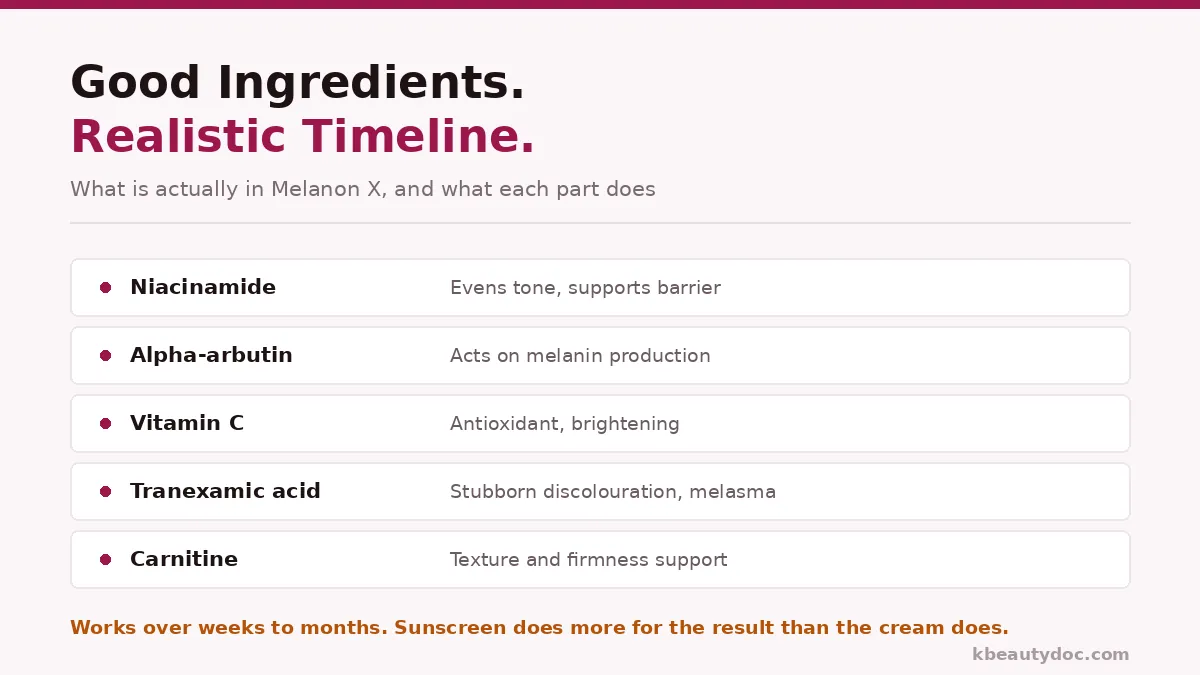
What is in the formula
| Ingredient | What it does | Evidence |
|---|---|---|
| Niacinamide | Evens tone over time, supports the skin barrier | Well established, widely tolerated |
| Alpha-arbutin | Acts on melanin production; gentler than hydroquinone | Reasonable, works gradually |
| Vitamin C | Antioxidant support, contributes to brightening | Established, stability varies by formulation |
| Tranexamic acid | Used for stubborn discolouration including melasma | Good support topically and orally |
| Carnitine | Supports texture and firmness | Supporting role rather than a main active |
This is a reasonable, evidence-informed combination for gradual tone correction, not a dramatic overnight fix. Vitamin C also shows up in home devices, where the electrode polarity decides whether anything is delivered.
Who it tends to suit
Post-acne marks, sun-related dark spots, general unevenness. Anyone wanting a home-care layer alongside sun protection rather than instead of it. Dry-to-normal skin, since the cream doubles as a moisturiser.
First, work out which pigmentation you actually have
This is the part that decides whether the product will do anything for you, and it is skipped in almost every review.
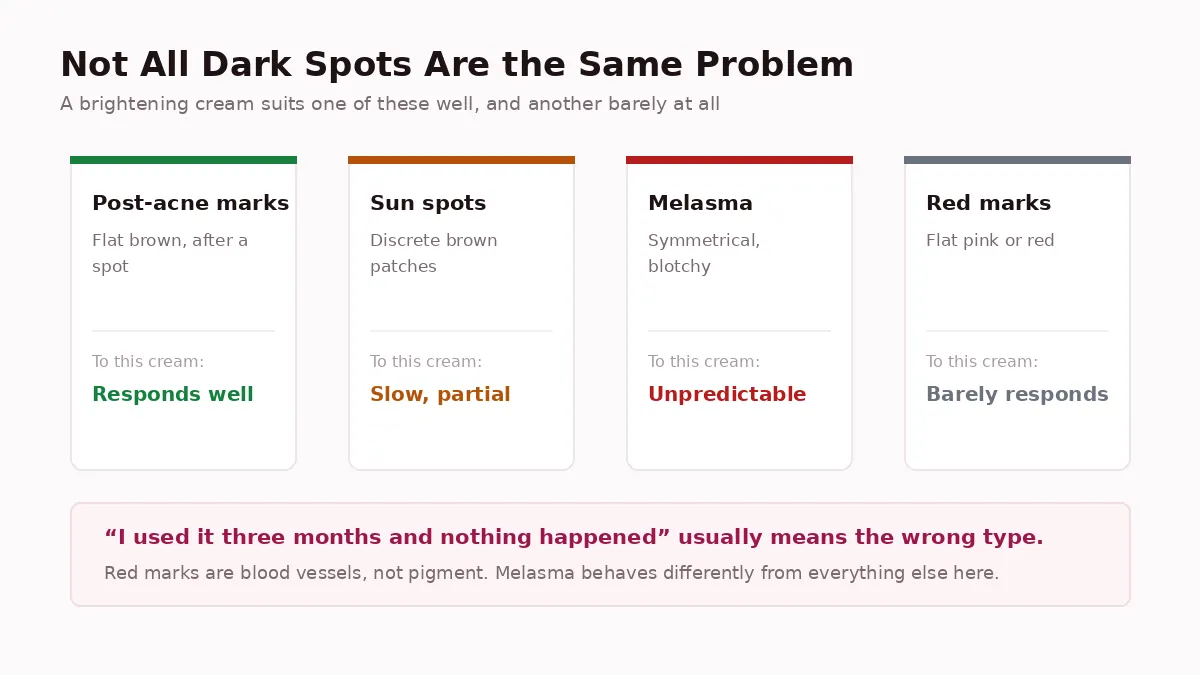
Post-inflammatory hyperpigmentation. Flat brown marks left behind after acne or injury. This is pigment sitting where inflammation happened. It fades on its own over months, and topical brightening agents genuinely speed that up. This is the type a product like this suits best.
Sun-related spots. Discrete brown patches from cumulative UV exposure, usually on the cheeks, forehead and hands. Responds to topical treatment slowly, and to laser more decisively.
Melasma. Symmetrical, blotchy patches, usually on the cheeks and upper lip, more common in women. Driven by hormones and UV together. This behaves differently from everything above and is covered separately below.
Post-inflammatory erythema. Flat red or pink marks rather than brown. This is dilated blood vessels, not pigment. Brightening agents do very little for it.
Getting this wrong is the usual reason someone says “I used it for three months and nothing happened.”
A note on melasma specifically
Melasma is a different mechanism from ordinary sun spots or acne marks. It is more hormonally and UV-driven, and it responds unpredictably to both actives and physical irritation.
Tranexamic acid is genuinely useful here — but consistency and sun protection matter more than the product itself.
Avoid friction. Skip anything involving rubbing, aggressive patting, or layering several actives at once over melasma-prone areas. Added irritation can worsen pigmentation rather than fade it. This applies to cleansing brushes, exfoliating pads, and enthusiastic application technique.
Treat a product like this as supporting, not central. If you have diagnosed melasma or a family history of it, it belongs inside a plan supervised by a provider, not as the plan itself.
Where oral tranexamic acid fits in
Since tranexamic acid comes up so often in melasma conversations, it is worth explaining how the topical version differs from what is used in clinic.
In practice, tranexamic acid is also prescribed orally for stubborn melasma — stronger than any cream, and one reason a Korean visit often ends with a prescription cream rather than a shelf one. A large Asian case series found most patients with refractory melasma improved on it, usually within the first two months, with relapse common afterwards and one patient developing a deep vein thrombosis traced to an inherited clotting disorder [1]. It is typically taken twice daily over a course of weeks alongside topical agents and strict sun protection.
It is prescription-only for good reason. Tranexamic acid affects blood clotting, so it is not appropriate for anyone with a personal or family history of clots, stroke or clotting disorders, and those authors conclude that careful screening should come first. Combined oral contraceptives and smoking raise that risk further. It is not used in pregnancy or breastfeeding, and side effects are monitored rather than self-managed.
I include this for context, not as a suggestion to source it yourself. If oral tranexamic acid seems relevant to your melasma, that conversation belongs with a physician who can screen you properly.
What this product will not do
No cream — Korean, viral, or otherwise — replaces daily sunscreen, and Korean and Western labels do not say the same things. Brightening ingredients soften pigmentation over weeks to months. They do not erase established melasma or deep marks on their own.
UV exposure undoes the work faster than any active can do it. If you are treating pigmentation without sun protection, you are working against yourself every day you go outside.
Treat the online before-and-afters with healthy scepticism about timeline. Lighting, angle and camera processing account for a good portion of what you are seeing.
How to use it sensibly
Start with one product, not the line. The cream is the reasonable entry point. Adding the ampoule and eye cream simultaneously means you cannot tell what caused a reaction.
Give it eight to twelve weeks. This category works slowly. Judging it at two weeks tells you nothing.
Do not layer it with a strong exfoliating acid or retinoid on the same night when you first start. Introduce one thing at a time.
Photograph your skin at the start, in the same light, without makeup. Gradual change is genuinely hard to perceive day to day, and this is the only reliable way to know whether it is working.
Dr. Yoo’s note
The ingredient list here is genuinely reasonable, which is part of why it has travelled so well outside Korea. But “viral” and “clinically indicated for your skin” are not the same thing.
If your dark spots are not budging after consistent use, or if you suspect melasma rather than ordinary pigmentation, that is a sign to get an in-person opinion rather than add another product to the stack.
FAQ
How long before I see a difference?
Eight to twelve weeks of consistent use is a fair assessment window. Anything faster than that in a video is likely lighting rather than pigment.
Can I use it with vitamin C or retinol?
Not all on the same night when you are starting out. Introduce one product at a time so you can identify what causes irritation.
Is it safe during pregnancy?
Ask your doctor about the specific formulation. Separately, oral tranexamic acid is not used during pregnancy or breastfeeding — that is a different question from the topical product.
Will it work on melasma?
It may help as part of a broader plan, but melasma responds unpredictably and often needs supervised treatment. Sun protection and avoiding friction matter more than the cream.
Do I still need sunscreen if I am using this?
Yes, and more than ever. UV undoes pigment correction faster than any topical can achieve it. Sunscreen is the treatment; the cream is the support.
What if nothing happens after three months?
Reconsider what you are treating. Flat red marks, melasma and post-acne brown marks are different problems, and one of them may not respond to this category at all.
References
- Lee HC, Thng TGS, Goh CL. Oral tranexamic acid (TA) in the treatment of melasma: a retrospective analysis. J Am Acad Dermatol 2016;75(2):385-392. DOI: 10.1016/j.jaad.2016.03.001
Disclaimer: I write about cosmetics and shops as general information, not as a recommendation of any particular product or retailer. I receive no sponsorship, samples or payment from the brands mentioned. Skin responds differently from person to person, so patch test anything new, and see a doctor about a skin condition.

Physician in non-surgical aesthetic medicine, practising in Ansan, South Korea. Every article here is written from clinical practice and the published literature.
About the author · Contact