
What to know first
- Laser toning does not work as a one-off. It is designed as a course.
- Picosecond is stronger for tattoos, dermal pigment and lentigines. For melasma, it does not clearly beat conventional Nd:YAG.
- Lentigines get darker before they clear. That is the pigment leaving.
- Some things do work in one visit — spot removal, and above all an accurate diagnosis.
- What you take home matters more. Pigmentation is won or lost at home.
If your trip is this long
Three days or less — I would not have a treatment. Have a consultation, find out what your pigmentation actually is, buy home care and fly home.
Four to seven days — Individual spot removal is possible. Schedule it at least five days before you fly.
Two weeks or more — Two or three toning sessions are possible, but that is not a completed course. You would be starting and leaving.
If you visit Korea often — Different situation entirely. You can plan a course that continues across visits.
That is the practical answer. If you want to know why, keep reading.
Why toning cannot work in one session
Laser toning uses low energy delivered across many sessions. That is the design, not a limitation.
Breaking the pigment aggressively in one go would seem faster. But it causes inflammation, and inflammation produces more pigment — a risk that is particularly high in Asian and darker skin. What you tried to remove comes back darker.
So the approach became low energy, repeated. A single session is one of many.
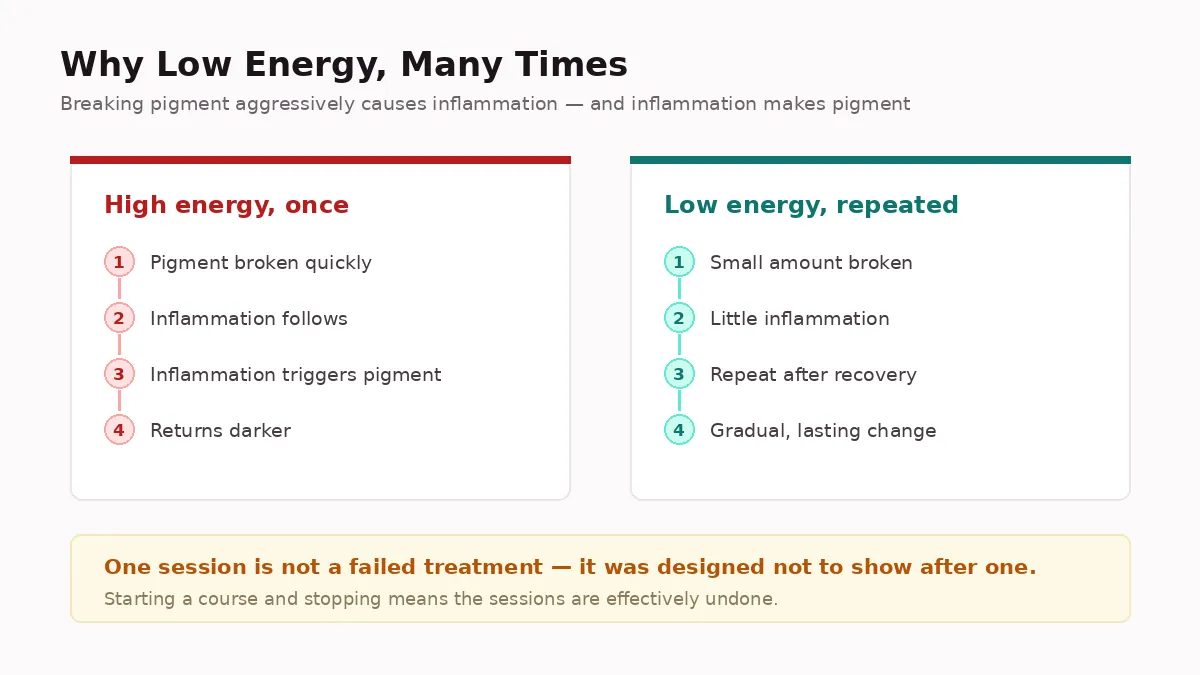
And there is a bigger problem. Starting toning and then stopping means the effect regresses. Two sessions on holiday, then a return visit six months later, and those two have effectively been undone.
So what does work in one visit?
Individual spot removal. Discrete, well-defined lesions are a different matter — seborrheic keratoses, freckles, small long-standing moles. Energy is concentrated on each lesion and one session finishes it. But a crust forms over each spot, takes five to seven days to separate, is hard to conceal, and risks scarring if picked off.
An accurate diagnosis — probably the most valuable thing available on a short trip. Pigmentation treatment usually fails not because the treatment was poor, but because the wrong type was assumed. Several kinds look similar on the surface, are treated completely differently, and cannot be told apart by looking. Some also worsen with aggressive laser, so the diagnosis is not a formality.
Picosecond or conventional toning: where each is stronger
Clinics will tell you they have a picosecond device. It is newer, and that is true. But where it is actually stronger is more specific than the marketing suggests.
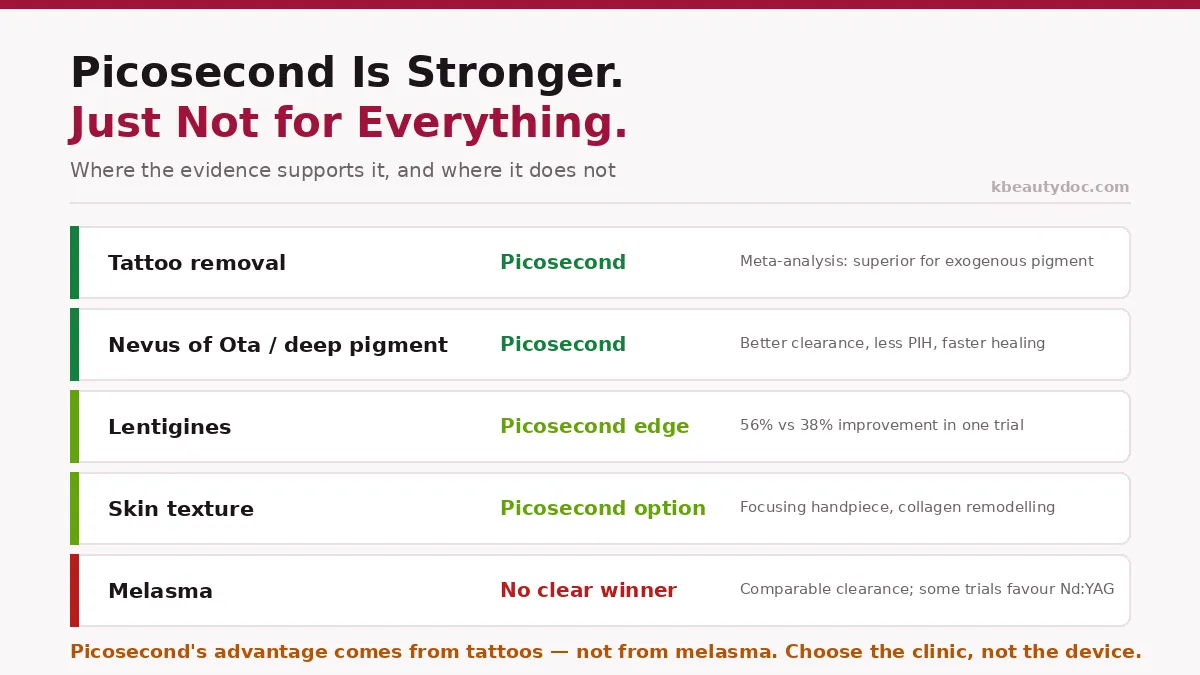
Where picosecond is clearly better
Tattoo removal. Pooling the randomised trials, picosecond lasers come out ahead of nanosecond lasers for pigment that came from outside the body [1]. Tattoo ink is a hard foreign particle, and breaking it apart benefits from the stronger shock a shorter pulse produces.
Dermal pigment, where melanin sits deep. In a split-face randomised comparison in acquired bilateral nevus of Ota-like macules, a 755 nm picosecond laser came out ahead of a nanosecond laser on clearance, pain and healing time [2].
Lentigines. Well-defined epidermal spots fragment readily; a retrospective comparison of a 730 nm picosecond with a 532 nm Q-switched laser reported a higher improvement rate [3].
But melasma is different
In that same pooled analysis, for pigment your own body produced — which includes melasma — picosecond and nanosecond lasers cleared it comparably, with no statistically significant difference [1]. Picosecond’s advantage comes from tattoos, not melasma.
Melasma trials sometimes point the other way. In a randomised, evaluator-blinded trial, a conventional combination of Q-switched and long-pulse Nd:YAG outperformed a picosecond alexandrite laser on melasma severity [4]. In another, picosecond alexandrite performed comparably to 2% hydroquinone cream [5].
Why this happens. Hormones, UV, vessels and dermal inflammation act together in melasma, and breaking up pigment alone does not resolve it. So how gently you can repeat matters more than how forcefully you can fragment.
The practical conclusion
For tattoos, nevus of Ota and other deep pigment, picosecond has the advantage; for lentigines it helps, though conventional devices also work well. For melasma, do not choose a clinic by which device it owns — the diagnosis they make and how they manage irritation matter more.
Why lentigines get darker before they clear
This is what surprises patients most, and it is the expected course. When the laser fragments the pigment, the shattered melanin and damaged epidermal cells migrate upward, so the area darkens and crusts before the crust separates, carrying the pigment with it.
The timeline. The spot whitens immediately and settles within about half an hour. Days 1–3 it darkens, which is when people worry. Days 3–7 a crust forms and lifts at the edges. Days 7–14 most crusts separate and the area may look pink, which then fades.
The one rule: do not pick the crusts. Removing them early risks post-inflammatory hyperpigmentation or scarring — a mark that outlasts the one you were treating.
Aftercare
While the crusts are present. No rubbing, no exfoliation, no sheet masks. Cleanse with your hands and rinse rather than scrub. Moisturise lightly so the crusts do not dry too hard. Skip makeup — the risk is less the makeup than rubbing it off. Avoid saunas, intense exercise, pools and the sea.
Once the crusts have gone. Pink is normal; it is new skin, and it fades over several weeks. Sun protection becomes decisive here, because freshly resurfaced skin is vulnerable and most post-treatment pigmentation is determined in this window. Acids, retinoids, vitamin C and spicule products wait until the skin has recovered.
What to take home
Honestly: pigmentation is not a battle you win at the clinic. It is one you avoid losing at home.
Sunscreen. Nothing matters more. You can break pigment with a laser, but UV rebuilds it. Check the UVA rating — Korean products state it as a PA grade, so choose PA++++.
Ingredients. Niacinamide is well tolerated and a sensible starting point. Tranexamic acid is used for stubborn pigmentation, particularly melasma. Vitamin C adds antioxidant support. The strongest options are not on the shelf: ask whether a prescription cream fits your case before you fly home. Start one at a time — several actives at once make irritation impossible to trace, and irritation worsens pigmentation.
And do not expect short-term results. This moves in months; eight to twelve weeks is a fair assessment window.
What to ask at consultation
“What type of pigmentation do I have?” The answer determines everything else.
“Is there anything worth doing in my time frame?” Say how many days you have. A good clinic will also tell you when the answer is nothing on this trip — one of several ways a Korean consultation runs differently from a Western one.
“How many days will the crusts last?” Essential for spot removal. And “what should I do at home?” — a clinic that never discusses home care is not focused on your result.
FAQ
Is one toning session worth having?
Very little. It is designed as low energy across many sessions, and one is only the beginning.
How long after spot removal can I fly?
Crusts usually take five to seven days to fall away. Have it at least five days before departure.
I have melasma and was offered an aggressive laser.
Discuss it further. Melasma can worsen with high energy, so lower-intensity approaches across multiple sessions are more usual.
Can I continue treatment after I get home?
Yes, locally. Take a record of the diagnosis and what was done — that is the starting point for the next provider.
Is a picosecond laser better for melasma?
The evidence does not show that. Pooled trials found picosecond and nanosecond lasers cleared endogenous pigment comparably.
My spot got darker after treatment. Did it fail?
No — that is the expected course for lentigines. Fragmented pigment migrates upward, darkens, crusts and separates over one to two weeks.
Can home care alone clear pigmentation?
It is closer to lightening it and preventing more. But no treatment holds without sun protection, so home care is not secondary.
References
- Wu W, Du Y, Zhang Y, et al. Comparative appraisal with meta-analysis of picosecond versus nanosecond lasers for hyperpigmented disorders and tattoos. Lasers Med Sci 2025;40(1):465. DOI: 10.1007/s10103-025-04721-3
- Yu W, Zhu J, Yu W, et al. A split-face, single-blinded, randomized controlled comparison of alexandrite 755-nm picosecond laser versus alexandrite 755-nm nanosecond laser in the treatment of acquired bilateral nevus of Ota-like macules. J Am Acad Dermatol 2018;79(3):479-486. DOI: 10.1016/j.jaad.2017.12.053
- Lin G, Zhao R, Guo C, et al. Comparing the efficacy and safety of a 730-nm picosecond laser with a 532-nm Q-switched Nd:YAG laser for facial pigmented disorders: a retrospective comparative study. Eur J Med Res 2026;31(1). DOI: 10.1186/s40001-026-04099-0
- Liang S, Shang S, Tan A, et al. Comparative efficacy and safety of the novel picosecond alexandrite laser and the traditional combined Q-switched and long-pulse Nd:YAG lasers in melasma treatment: a randomized evaluator-blinded trial. Lasers Med Sci 2025;40(1):29. DOI: 10.1007/s10103-025-04286-1
- Liang S, Shang S, Zhang W, et al. Comparison of the efficacy and safety of picosecond Nd:YAG laser (1,064 nm), picosecond alexandrite laser (755 nm) and 2% hydroquinone cream in the treatment of melasma: a randomized, controlled, assessor-blinded trial. Front Med 2023;10:1132823. DOI: 10.3389/fmed.2023.1132823
Disclaimer: This article explains treatments in general terms and is not a diagnosis or a treatment plan. What happens varies from person to person, and no article can tell you what to expect. Please discuss your own case with a licensed medical professional where you live. I do not endorse specific clinics or device brands.

Physician in non-surgical aesthetic medicine, practising in Ansan, South Korea. Every article here is written from clinical practice and the published literature.
About the author · Contact