Three things to know first
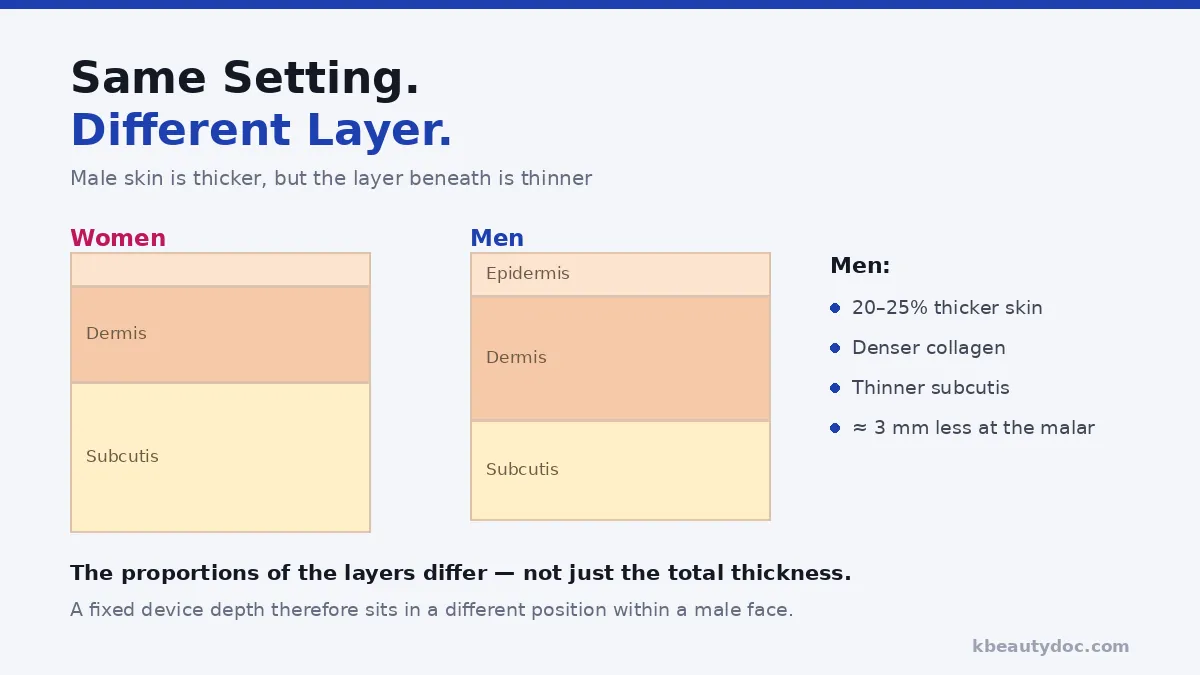
- Men’s skin is thicker with denser collagen. A bigger denominator makes the same change look smaller.
- That is why surface energy treatments often produce “I can’t tell what changed.”
- Hair removal and RF microneedling are the exceptions — for different reasons, both are noticeable.
So what should men be offered?
If you want to feel something change — laser hair removal is the most reliable, because it removes daily shaving trauma.
If pores, oil and rough texture bother you — RF microneedling suits men well, because the needles reach the target depth instead of crossing thick skin.
If sagging is the problem — in men this is usually structural, and tightening the dermis alone will not solve it.
If you are considering RF tightening or ultrasound lifting — take before photographs. Both work in men, but the change is perceived as smaller.
That is the practical answer. If you want to know why, keep reading.
What is actually different about male skin
Most of these differences are driven by androgens.
It is thicker. A review of 57 studies comparing male and female skin concludes that thickness and pigmentation are significantly higher in men; the facial measurements it summarises put men roughly 10–20% thicker at the forehead, mid-cheek, jowl and neck [1].
Collagen is denser, while the same review finds no significant difference in skin elasticity between the sexes [1].
Sebaceous glands are larger and more active, which produces larger pores and a rougher surface, and dense terminal beard follicles cover the male face.
But subcutaneous fat is thinner, particularly over the medial cheek, which is why male faces read flatter. So the proportions of the layers differ, not just the thickness — and that one fact explains most of what follows.
Why RF tightening often produces “I can’t tell”
The same depth lands in a different layer
Energy treatments deliver heat to a set depth. If the dermis is thicker, that fixed depth sits in a different position within it — a setting that reaches mid-dermis in a woman may only engage upper dermis in a man.
A bigger denominator makes the change look smaller
This is the main reason. The absolute amount of new collagen may not differ much between the sexes, but men start with denser collagen, so the same gain is a smaller proportional change — and proportion is what people perceive. The treatment works; the perception is swallowed.
The scorecard is different
Men rarely come in about texture. They come in about the jawline, looking tired, or a double chin. Korean doctors writing a lifting protocol for Asian men report the same split: jawline definition over skin rejuvenation, with high demand for double-chin work [2].
So a treatment can improve skin quality and a male patient will not count it. Same treatment, different scorecard.
What I notice in the room
Women usually see the change first. Putting on makeup means looking closely in a mirror every morning, and that habit builds an eye for detail: patients tell me the texture looks more even, or that their pores look smaller, before I have said anything. Men often have no comparable routine, so a change of the same size goes unremarked — and because male skin is thicker, it is genuinely less dramatic to begin with. Those two things together are why the same treatment can produce two very different verdicts. It is an observation about habit and skin thickness, not about who cares more.
So why is hair removal noticeable?
The same man who says he cannot tell what RF did will say his skin improved after laser hair removal, because the two work in opposite directions. RF adds something that was not there, and new collagen against a dense baseline gets lost in the noise. Hair removal takes away something that was happening every day, and removal is a much larger signal than addition. Whether it also changes oil output is a separate question, where the mechanism runs ahead of the trials.
What disappears: daily shaving trauma, since a blade scrapes the stratum corneum every morning; ingrown hairs; the pigmentation left by repeated irritation; and, as beard follicles miniaturise, pores look smaller and texture genuinely changes. He is not imagining it — a source of ongoing damage was removed and the surface structure changed. If you are thinking of trying a home device on the beard first, the manuals themselves are blunt about who they are not for.
What goes wrong more often in men
Thick skin and dense beard follicles change the risks, not only the results.
- Burns and blisters in the beard zone. Dark terminal hair absorbs far more energy per pulse than fine hair, so a setting that is comfortable elsewhere can overheat the skin around a beard.
- Folliculitis — small tender spots in the treated area for a few days.
- Paradoxical hypertrichosis: hair thickening at the border of a treated area instead of thinning, reported most often around the jaw and neck.
- Marks left by years of shaving irritation, which fade more slowly on deeper skin tones.
Beard sessions are usually spaced 3–4 weeks apart, and most men are judged over a course rather than after one visit. People who are pregnant, have an active infection or broken skin in the area, take a medicine that raises light sensitivity, or arrive with a fresh tan are generally not candidates that day; a doctor who examines you decides.
Why Ulthera, Shurink, Liftera and Coolsonic feel ambiguous
The same principle, amplified. Focused ultrasound targets the SMAS with cartridges of fixed depth — 1.5, 3.0 and 4.5 mm — while monopolar radiofrequency heats the dermis in bulk.
But the depth of the tissue layers, including the SMAS, varies by sex and by region of the face. Cartridge depth is fixed; tissue depth is not. The Korean protocol paper starts from that premise and frames treatment around the lower face rather than skin quality [2]. So the operator’s experience with male patients matters — settings carried over from female patients may not land where intended.
So why does RF microneedling suit men?
The difficulty with surface-delivered energy is that it has to travel through thick skin. RF microneedling skips the path entirely: needles reach the chosen depth and emit radiofrequency from the tip, so depth is set mechanically, independent of thickness or impedance. Thick skin or thin, 1.5 mm means 1.5 mm.
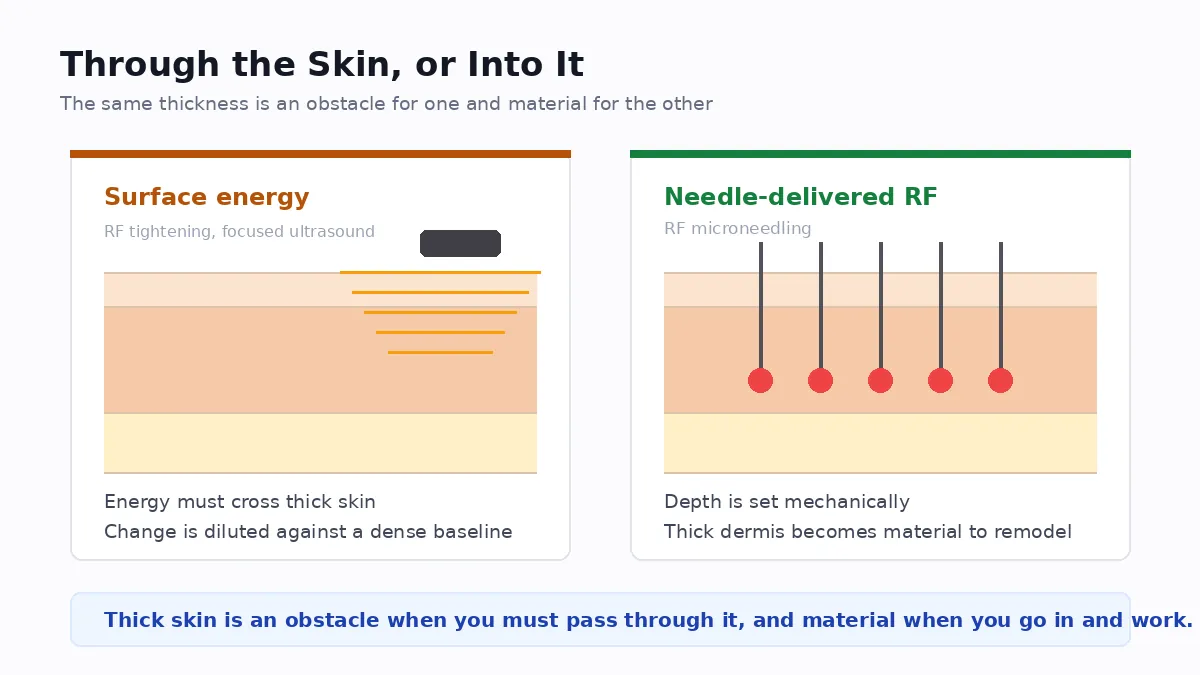
And male skin now works in favour rather than against. A thick dermis with dense collagen becomes more material to remodel when stimulated directly, and tolerates deeper settings. It also reaches what men complain about: heat at the needle tip contracts tissue around the pores, and it treats acne scarring, which surface energy largely leaves untouched.
The summary is this. Surface energy feels underwhelming in men and needle-based RF feels substantial for the same reason — thick skin is an obstacle when you pass through it, and material when you go in and work.
Side by side
| Women | Men | |
|---|---|---|
| Skin thickness | Thinner | About 10–20% thicker |
| Sebaceous glands | Smaller | Larger, more active |
| Surface energy treatment | Change felt readily | Change felt weakly |
| Hair removal | Moderate | Strongly felt |
| Needle-based RF | Effective | Well suited |
| Main concern | Skin quality | Jawline, double chin |
FAQ
Does RF tightening simply not work on men?
It works. The perceived change is smaller because men start with denser collagen, so the same absolute gain is a smaller proportional change.
Why did my skin look better after laser hair removal?
Daily shaving trauma stopped, ingrown hairs and irritation decreased, and terminal follicles miniaturised so pores appear smaller — removing damage rather than adding collagen.
Is RF microneedling better than RF tightening for men?
For pores, oil and texture, often yes. Needles set the depth mechanically instead of relying on energy crossing thick skin.
Why do men need different settings for ultrasound lifting?
The proportions of the tissue layers differ, so a setting calibrated on female patients may not reach the intended layer.
Should men expect less from aesthetic treatment overall?
No — but the treatments that produce noticeable results differ. Structural work, hair removal and needle-based treatment tend to satisfy men more than surface tightening.
How long before I can judge whether it worked?
Collagen remodelling takes two to three months. Judge at that point, against photographs rather than memory.
References
- Rahrovan S, Fanian F, Mehryan P, Humbert P, Firooz A. Male versus female skin: what dermatologists and cosmeticians should know. Int J Womens Dermatol 2018;4(3):122-130. DOI: 10.1016/j.ijwd.2018.03.002
- Park JY, Hong W, Lee KC, Shim HC, An J, Park JH, Kim HJ. Customizing microfocused ultrasound with visualization treatment for facial lifting in Asian men: experience and practical insights from Korea. J Cosmet Dermatol 2025;24(6):e70278. DOI: 10.1111/jocd.70278
Disclaimer: This article explains treatments in general terms and is not a diagnosis or a treatment plan. What happens varies from person to person, and no article can tell you what to expect. Please discuss your own case with a licensed medical professional where you live. I do not endorse specific clinics or device brands.

Physician in non-surgical aesthetic medicine, practising in Ansan, South Korea. Every article here is written from clinical practice and the published literature.
About the author · Contact