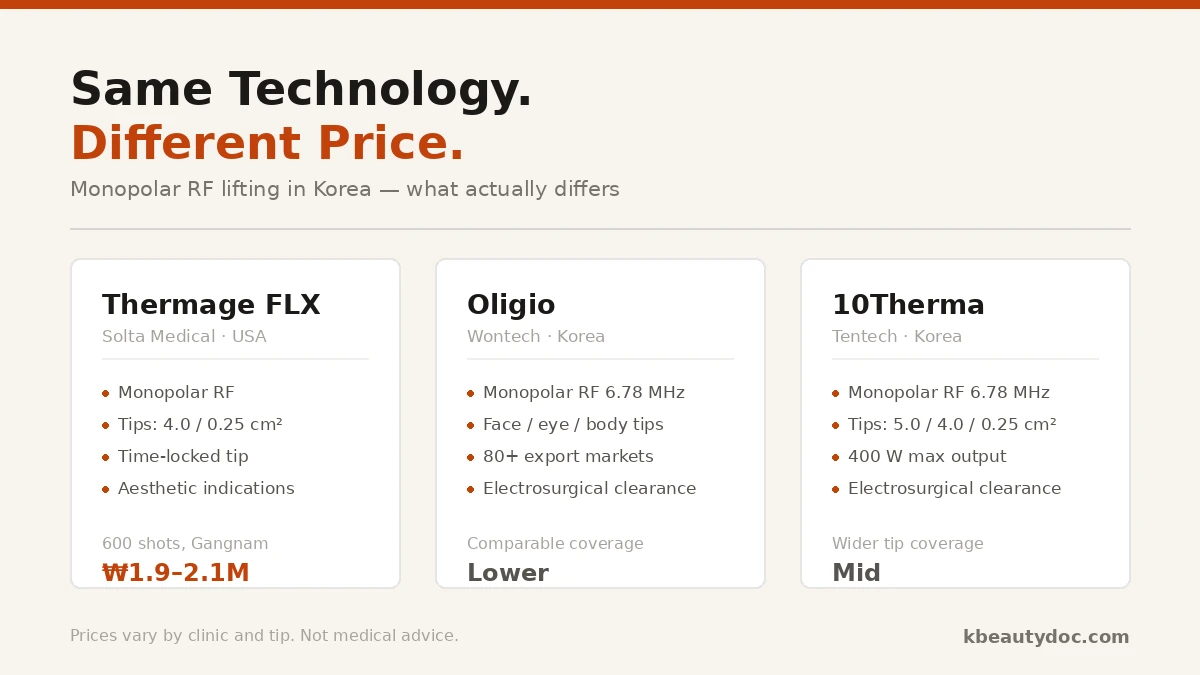
If you are comparing skin-tightening options in Korea, here is the short answer: Thermage, Oligio, and 10Therma are all monopolar radiofrequency devices. They heat the dermis through a single active electrode to contract existing collagen and stimulate new collagen over the following months. The mechanism is the same. What differs is where the device is made, how the tip system works, what the device is actually cleared for in each country, and what you pay.
Here is what I would want to know as a patient.
At a glance
| Thermage FLX | Oligio | 10Therma | |
|---|---|---|---|
| Manufacturer | Solta Medical (USA) | Wontech (Korea) | Tentech (Korea) |
| Energy type | Monopolar RF | Monopolar RF, 6.78 MHz | Monopolar RF, 6.78 MHz |
| Max output | — | 400 W (Oligio X) | 400 W |
| Face tip | 4.0 cm2 | Face tip | 5.0 cm2 and 4.0 cm2 |
| Eye tip | 0.25 cm2 | Yes | 0.25 cm2 |
| Body tip | Yes | Yes | 20 cm2 |
| Tip constraint | Time-locked once activated | – | – |
| US FDA 510(k) | Yes, aesthetic indications | Yes, electrosurgical category | Yes, electrocoagulation and hemostasis |
| Export reach | Global | 80+ countries | Brazil, India, Thailand, Philippines, Mexico, Singapore, UAE, Malaysia, Australia |
| Korea price, 600 shots | ~1.9-2.1M KRW | Lower | Between the two |
Prices exclude VAT and vary by clinic and tip.
How monopolar RF works
A handpiece delivers RF energy through the skin surface. Because it is monopolar, the current travels from the tip through the tissue to a return pad, producing bulk heating in the dermis rather than a shallow surface effect. Bipolar RF stays much shallower, which is why InMode uses suction while Onda uses microwaves to reach anything deeper.
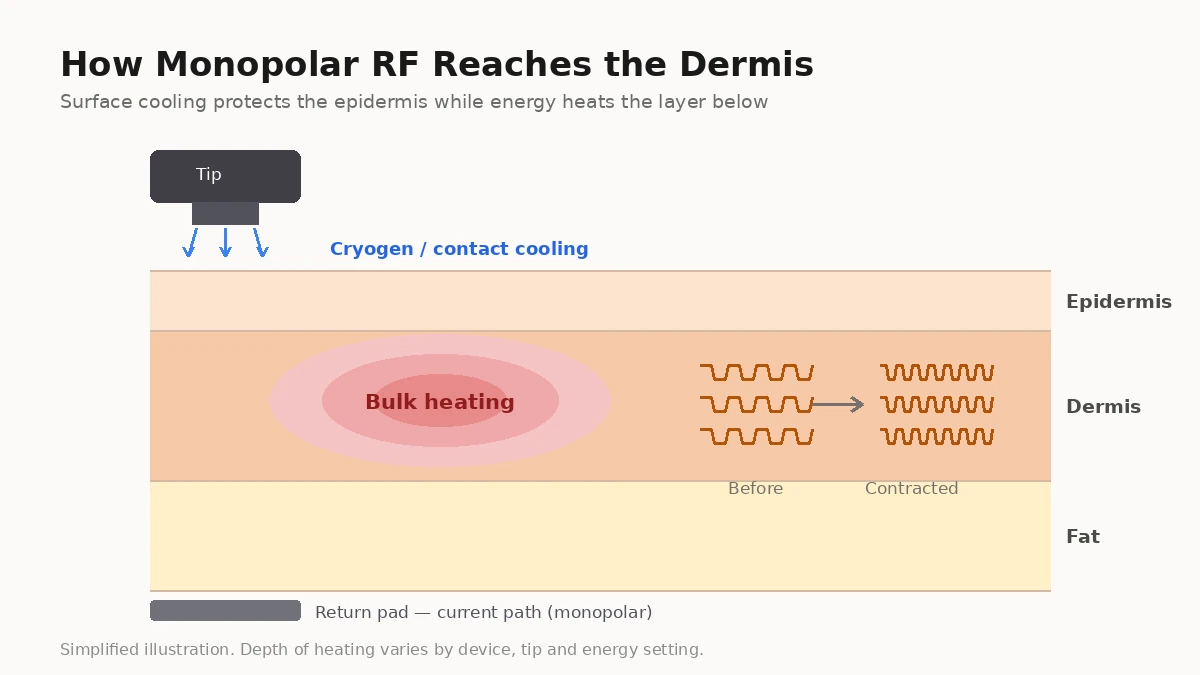
Two consequences follow, and they apply to all three devices.
The surface must be cooled while the depth is heated. These devices use cryogen spray or contact cooling for that reason. Cooling is not a comfort feature — it is what allows meaningful energy without injuring the top layer. Weaker cooling usually means lower energy.
The result is gradual. Mild tightening on the day, but the meaningful change comes from collagen remodeling over two to three months.
Thermage FLX
Made by Solta Medical in the United States. FLX is the fourth generation, and the platform the whole category was built around — which is why most patients arrive knowing the name.
Tip system and its constraint. Thermage uses single-use tips with a fixed shot count. The standard face tip is 4.0 cm² at 600 shots. There is also a 0.25 cm² eye tip — what Korean patients call Eye Thermage — priced as a separate procedure.
The practical limit is that a Thermage tip is time-locked once activated: it cannot be paused, resumed another day, or split between patients. That shapes how a clinic schedules treatments.
Cost pressure. The tip is imported and priced in dollars, so a weaker won raises the price you pay. The consumable sets the floor.
Typical Korean pricing: roughly 1.9–2.1 million KRW for 600 shots in Gangnam, before VAT.
Oligio
Made by Wontech, a Korean manufacturer. Monopolar RF at 6.78 MHz, with a tip range covering face, periorbital area, and body.
Wontech is not a domestic-only company: it holds US, European, Australian and Thai registrations, exports to over 80 countries, and runs subsidiaries abroad. The newer Oligio X platform reaches 400 W with a dual-mode delivery system meant to treat upper and deeper dermis in one session.
Positioning in Korea. Korean clinics often suggest Oligio for patients worried about losing facial volume, describing it as keeping energy in the dermis rather than reaching into fat. Fat is a separate target with its own tools — the US and Korean double chin injections work chemically, not by heat. Whether the distinction is as clean in practice as in the marketing is debatable.
Typical Korean pricing: meaningfully lower than Thermage for a comparable shot count, with wide variation by clinic and tip.
10Therma
Made by Tentech, also Korean, known previously for the 10Thera ultrasound platform. Monopolar RF at 6.78 MHz with 400 W maximum output.
Tip system. Four tips: 0.25 cm² for the eye area, 4.0 and 5.0 cm² for the face, 20 cm² for the body. The 5.0 cm² tip covers more area per shot, which matters when you compare “600 shots” across devices: a shot is not a fixed amount of treated skin.
International footprint. Tentech holds registrations in Brazil, India, Thailand, the Philippines, Mexico, Singapore, the UAE, Malaysia and Australia. In the United States the device is sold as XTHERMA.
Typical Korean pricing: positioned between Oligio and Thermage in most clinics, again with wide variation.
The FDA question, answered precisely
Patients often ask whether the Korean devices are “FDA approved.” The accurate answer needs one extra step.
All three have US FDA 510(k) clearance. But the scope of that clearance differs. Both Korean devices entered the US market through the general electrosurgical route: clearance for electrocoagulation and haemostasis.
Thermage FLX holds both. Its 510(k) lists electrocoagulation and haemostasis alongside non-invasive treatment of wrinkles around the eyes, including the eyelids. That second indication — the cosmetic one patients are actually after — is what the Korean devices’ current US clearances do not name.
This does not mean the Korean devices do nothing. Oligio has peer-reviewed clinical data on facial laxity, from one small study [1], and both are widely used by Korean doctors. If a clinic tells you a device is “FDA approved,” the useful follow-up is: cleared for what indication?
What actually determines your result
In my experience patients over-weight the device name and under-weight three things.
Shot count against your face and tip size. 600 shots is a full-face figure with a standard tip. A bigger tip covers more area per shot; a bigger face spreads the same package thinner. Compare treated area, not just the number.
Energy settings and who is operating. The same machine at low settings gives a modest result. Clinics competing hard on price sometimes compete by turning energy down, which lowers both risk and effect. That is invisible on a price list.
Your starting point. Monopolar RF works on skin quality and mild to moderate laxity, while focused ultrasound aims at the deeper SMAS layer. In advanced sagging neither substitutes for surgical lifting, because surgery, threads and energy devices meet the retaining ligaments differently.
What to expect afterward
Redness for a few hours is common, and makeup is usually possible the same day. Swelling or tenderness for a day or two happens. Blistering and pigment change are uncommon but possible, and the risk rises with aggressive settings, recent sun exposure or tanned skin — which is why the PA rating on the bottle you use afterwards matters as much as the setting on the machine, and why it pays to know how to read a Korean sunscreen label.
Results accumulate over two to three months. Annual repetition is the common recommendation, though some clinics use shorter intervals as maintenance.
If you are visiting briefly, book early in the trip rather than the day before you fly, so redness settles and you can go back with questions.
FAQ
Is Thermage better than the Korean devices?
Thermage has the longest track record and the most specific cosmetic clearances, and costs the most. The Korean devices deliver the same class of energy for less. Which fits depends on skin thickness, laxity and budget more than on brand.
Why is Thermage so expensive in Korea?
The single-use tip is imported and dollar-priced, and won weakness has pushed that cost up. The consumable, not the clinic’s time, sets the price floor.
What is Eye Thermage?
A 0.25 cm² tip used around the eye area. Oligio and 10Therma also offer eye-area tips, so periorbital treatment is not exclusive to one platform.
How many shots do I need?
600 shots is the standard full-face figure. Larger faces or added areas need more. Ask for shot count and tip size in writing.
Does it hurt?
A heat sensation with each pulse. Comfort depends on the device, the energy level and the cooling. Numbing cream is common, and you should be able to say if a setting feels too strong.
How long do results last?
Collagen remodeling continues for two to three months, and repeat treatment is typically advised after about a year.
References
- Shin J, et al. Clinical efficacy and safety of a monopolar radiofrequency device for facial laxity. Cosmetics 2024;11(3):71. doi:10.3390/cosmetics11030071
Disclaimer: This article explains treatments in general terms and is not a diagnosis or a treatment plan. What happens varies from person to person, and no article can tell you what to expect. Please discuss your own case with a licensed medical professional where you live. I do not endorse specific clinics or device brands.

Physician in non-surgical aesthetic medicine, practising in Ansan, South Korea. Every article here is written from clinical practice and the published literature.
About the author · Contact