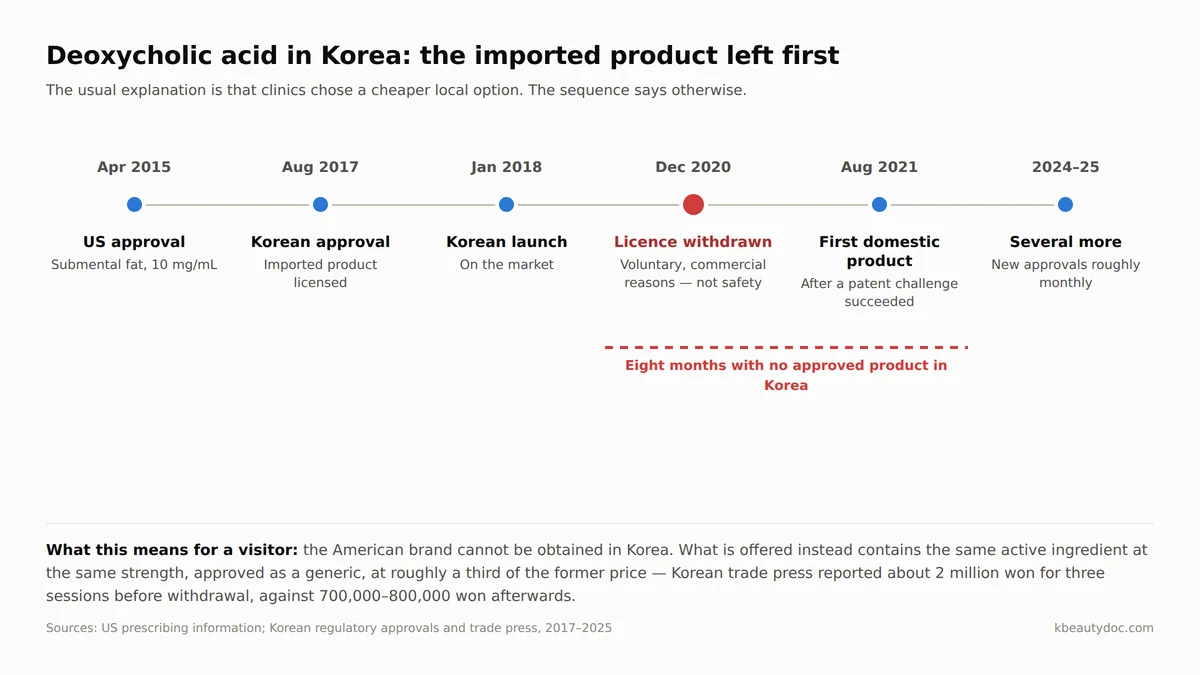
There is no point looking for the American double chin injection in Korea: the company withdrew it in December 2020, and the reason reported at the time was commercial, not safety.
The short answer. What is used in Korea now is domestically made, with the same active ingredient at the same strength — deoxycholic acid, 10 mg/mL — at roughly a third of the price. Only one area is approved, under the chin. What decides your result is not the brand on the vial but depth, spacing, dose and the number of sessions. And this is not a comfortable injection: swelling happens to the large majority and lasts days to weeks, so if your trip involves photographs, plan around it.
What the injection does
Deoxycholic acid is a bile acid your body already makes to break down fat during digestion. Injected into the fat layer under the chin, it dissolves the membrane around fat cells — breaking open the bag rather than shrinking it. The body then clears the debris through a local inflammatory response, and the tissue reorganises.
Which is why nothing happens the next morning. The change develops over weeks, and the mirror the day after tells you only how swollen you are.
What happened in Korea
The usual explanation gets it backwards: people assume Korean clinics chose the cheaper local option, but the imported product left first.
- April 2015 — the US regulator approves the original product for moderate to severe fullness under the chin, at 10 mg/mL.
- August 2017 — Korean approval. January 2018 — Korean launch.
- December 2020 — the company voluntarily cancels its Korean licence. The reason given was commercial, not safety.
- 2021 — a Korean company invalidates the composition patent and designs around the remaining formulation patents.
- August 2021 — the first domestic deoxycholic acid product is approved, launching that November.
- 2024–2025 — further approvals at roughly monthly intervals.
By the time domestic products were widely available the imported one had been gone eight months; there was no choice to make. Korean trade press reported the original at around 2 million won for three sessions, against 700,000–800,000 won for domestically approved products.
If the ingredient is the same, is the result the same?
There is a reasonable basis for saying yes, with conditions.
This is a water-based solution injected under the skin: no tablet dissolving in a stomach, no gut wall to cross — none of the steps where two versions of a drug most often diverge, which is why the later Korean products were approved as generics. What still has to match: active ingredient and strength, form and route, raw material purity, the acidity that decides how much it stings, and sterility.
And here is the part that matters more than any of it. The variables that decide your outcome are not in the vial: depth, grid spacing, volume per session, number of sessions, and how well the injector knows the anatomy of the neck.
What the side effects actually look like
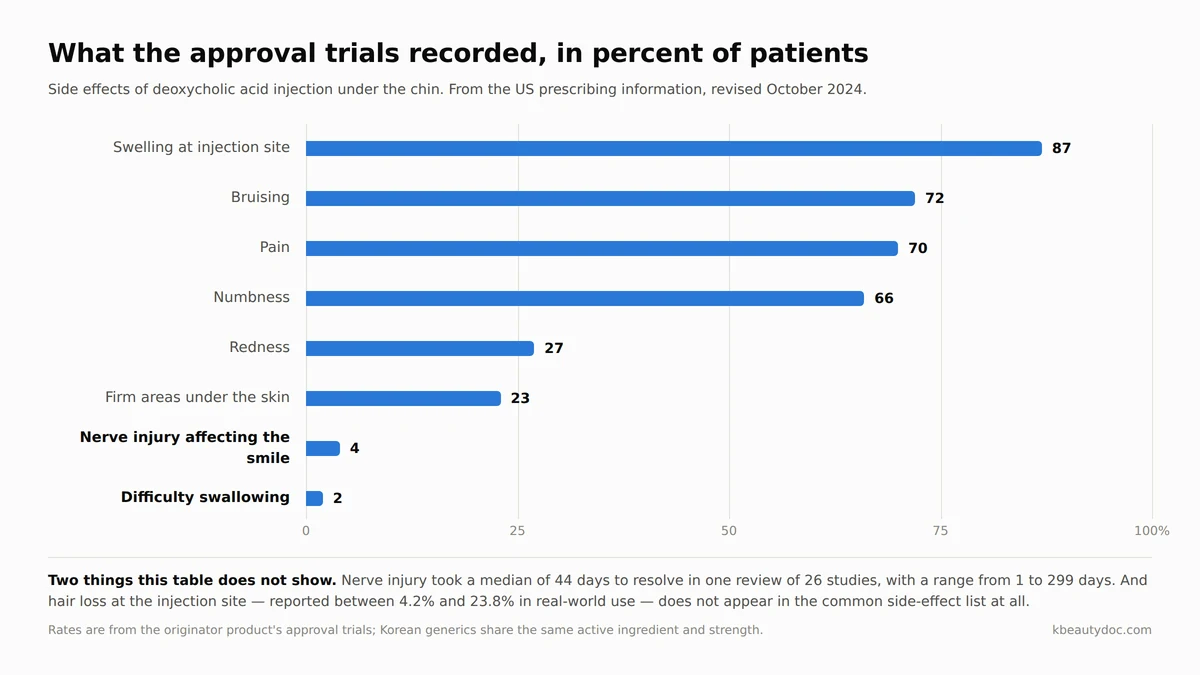
From the original product’s approval trials, via the US prescribing information revised October 2024 [1]. Higher than most clinic brochures suggest.
| Swelling at the injection site | 87% |
|---|---|
| Bruising | 72% |
| Pain | 70% |
| Numbness | 66% |
| Redness | 27% |
| Firm areas under the skin | 23% |
| Nerve injury affecting the smile | 4% |
| Difficulty swallowing | 2% |
Swelling happens to nearly everyone, for days to weeks — the first thing to plan around on a short trip, not the last.
The nerve injury is real, not theoretical. A nerve running along the jaw controls part of the smile and sits close to the treatment area. In the approval trials every case of that nerve injury recovered on its own — but the time it took ranged from a single day to most of a year, with a typical figure of about six weeks [1].
And one that rarely appears in clinic material: hair loss at the injection site. The prescribing information treats it as a reason to hold off on further sessions until the hair comes back [1]. A review of the serious events reported after these injections concluded that most of them are procedure-related and avoidable, and suggested injecting a little deeper in men for exactly that reason [2].
The label also warns that injecting too shallowly can cause ulceration and tissue death, and to keep away from nerves, vessels, salivary glands and the thyroid. Again: technique, not brand.
And who is generally left out on the day. People who are pregnant or breastfeeding, who have an infection or inflamed skin under the chin, who have a bleeding disorder or take anticoagulants, or who have had surgery or other treatment in the same area recently are usually not candidates, and a swallowing or thyroid problem changes the conversation. A doctor who examines you decides.
What this looks like from my side of the room
Clinical observation, offered as such. What patients describe to me during a deoxycholic acid session is heat, then swelling afterwards. The part they are least prepared for is a dull, blunted sensation under the chin that can outlast the swelling. I now raise it before the first injection rather than after.
There is also a newer option: in September 2025 the Korean regulator approved NUVIJU, a Medytox injectable built on cholic acid rather than deoxycholic acid for the same indication. Patients I have used it on generally describe the injection as less fierce than the older products — an impression from a small number of people, not a head-to-head trial. The trade-off is price.
What about arms, abdomen and other areas?
Not approved anywhere. The American prescribing information states that use outside the area under the chin “has not been established and is not recommended”, and every Korean product carries the same single indication: moderate to severe submental fullness in adults. An investigator-initiated study of other areas has begun in Korea, but no additional area is approved.
Separately, much of what is sold in Korea as “fat dissolving injection” is a compounded mixture rather than this product, and a Korean health technology assessment body has noted that mixing ratios in these preparations are not standardised. Asking which of the two you are being offered is a reasonable question, not a rude one — one of several things that surprise visitors in a Korean clinic.
If you are visiting Korea
- This is a course, not a single visit — sessions are spaced at least a month apart. The same multi-session constraint applies to collagen-stimulating treatments.
- Swelling and bruising last days to weeks. Schedule around anything involving photographs.
- The result develops over weeks. You will be home before you see it.
- Write down what you were given, how many millilitres and how many injection points — if you continue elsewhere, that record is the starting point.
- For how much a short trip can realistically achieve, see the pigmentation article.
Frequently asked questions
Can I get the American brand in Korea?
No. It was approved in 2017, launched in 2018, and the licence was voluntarily cancelled in December 2020. It has not returned.
Why did it leave? Was there a safety problem?
No. Korean reporting at the time gave a lack of commercial competitiveness, alongside a modest import volume.
Are the Korean products weaker?
Same active ingredient, same strength, same injectable form — they were approved as generics on that basis. What varies is technique far more than the product.
How many sessions will I need, and how long does it take?
More than one, spaced at least a month apart. The change develops over weeks after each session, so the full picture takes months.
How long will I be swollen? Can I have this on a short trip?
Swelling was reported in 87% of patients in the approval trials and lasts days to weeks. Possible on a trip, but schedule it early in the week.
Can it be used on my arms or stomach?
Not as an approved treatment. Under the chin is the only approved indication in both countries.
Is this the same as the “fat dissolving injections” I have read about?
Often not. Many injections sold under that name are compounded mixtures rather than the approved single-ingredient product.
References
- Deoxycholic acid injection (Kythera Biopharmaceuticals). US prescribing information, revised October 2024. DailyMed label
- Shridharani SM, Kennedy ML. Management of serious adverse events following deoxycholic acid injection for submental and jowl fat reduction: a systematic review and management recommendations. Aesthet Surg J Open Forum 2024;6:ojae061. 10.1093/asjof/ojae061
Disclaimer: This is general information, not a diagnosis or a treatment plan. Brand names are discussed for information only and are not endorsements. Injections and prescription medicines should be chosen and given only by a licensed professional who has examined you, and what suits another person may not suit you.

Physician in non-surgical aesthetic medicine, practising in Ansan, South Korea. Every article here is written from clinical practice and the published literature.
About the author · Contact