Three things to know first
- Retaining ligaments are the pillars holding the face up, running from bone or deep fascia out to the skin.
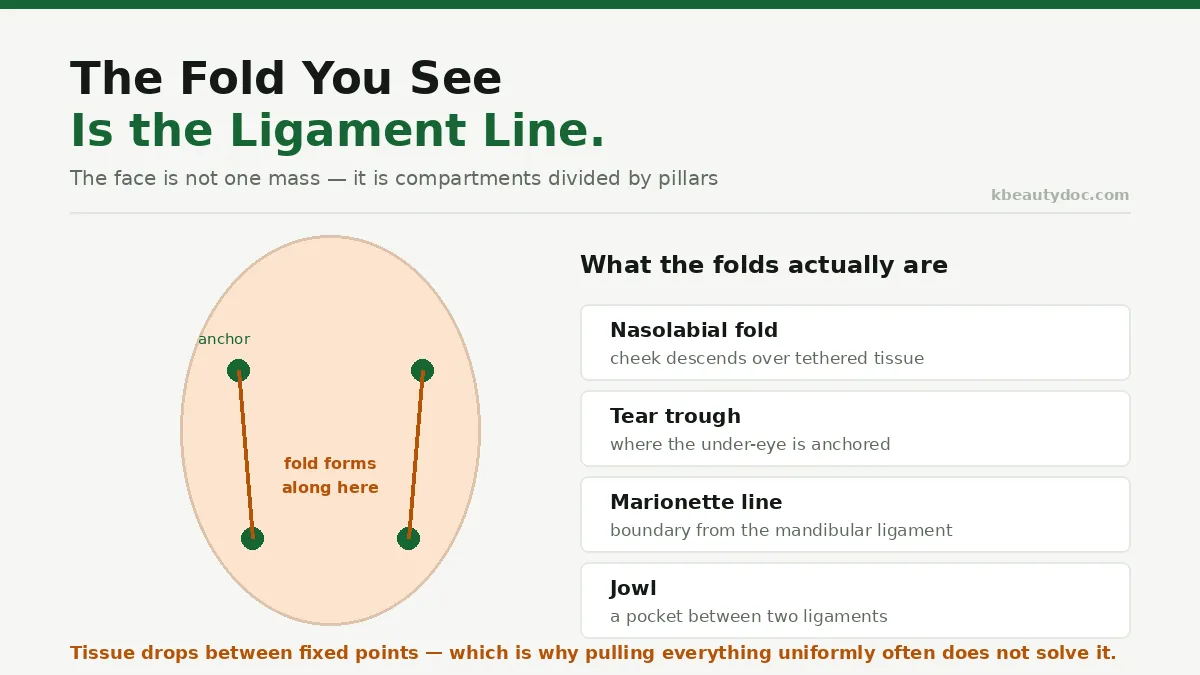
- So the face does not sag evenly. The folds you see are the ligament lines.
- Surgery releases them, threads work around them, energy devices do not reach them. The anatomy is a useful map, not the answer to which treatment you need.
So what does this mean for you?
If you have wondered why the nasolabial fold appears exactly there — that line is tethered. Everything above and below descends while it stays fixed, and a groove forms.
If a treatment is advertised as “targeting the retaining ligaments” — the anatomy is real, but the wording deserves a closer look. I separate the claims below.
If you are Asian — the zygomatic retaining ligament tends to be strong, delaying midface descent, with the trade-off that the area can look indented.
If you are choosing a treatment — the stage your sagging has reached matters more than whether ligaments are mentioned.
That is the practical answer. If you want to know why, keep reading.
What retaining ligaments are
Fibrous structures that keep the face from sliding downward. The classic anatomy describes them anchoring cheek skin to the cheekbone and jawline, holding the face against gravity and marking the front edge of the jowl [1].
There are two kinds: those running from bone to skin, and those running from deep fascia to skin. The bone-origin ones are sturdier, sitting at the zygoma and mandible — the strongest anchoring points in the face.
Between the ligaments, fat sits in compartments. The face is not one mass but a set of compartments divided by pillars, the ligaments sending up thin partitions between them [2].
The face does not sag evenly
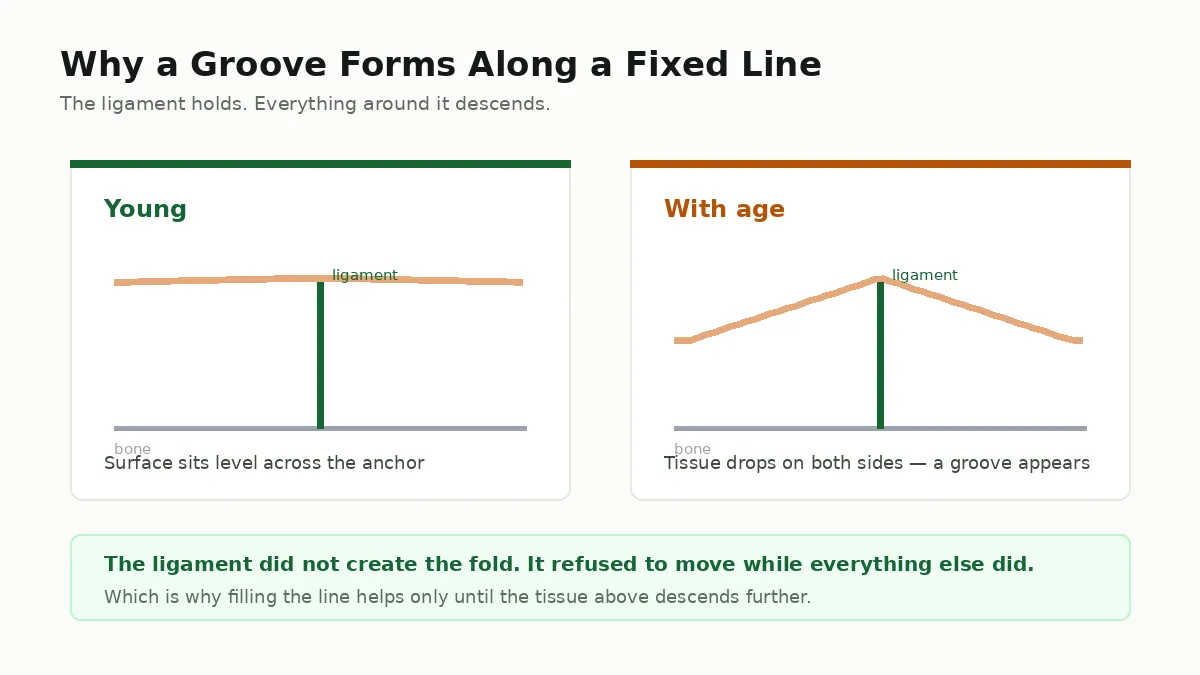
This is the central point. With age, tissue descends — but the points held by ligaments descend less, so tissue drops above and below a fixed line and a groove forms along it. Most of the folds and boundaries we see are ligament lines.
The nasolabial fold — the boundary where the upper cheek descends over tethered tissue below. The tear trough — where tissue under the eye is anchored. The marionette line — the boundary created by the mandibular ligament. The jowl — a pocket where tissue between two ligaments drops.
People describe their face as “sagging all over,” but each compartment dropped differently — which is why pulling everything uniformly often does not solve it.
Asian faces differ
The zygomatic retaining ligament in East Asian faces is often described as strong, delaying midface descent compared with Western faces — clinical impression rather than measured fact. Where a Western patient of the same age shows clear cheek descent, an Asian patient is often still holding.
But it produces a different effect. With a prominent zygoma and a strong zygomatic ligament, that area can look indented, as though pressed with a finger, because the ligament is pulling firmly. The same strong ligament delays sagging and causes a characteristic hollow.
How treatments relate to the ligaments
Each category interacts with the ligaments very differently.
Surgery — the ligaments are actually released
In a facelift, retaining ligaments are divided during dissection. While they hold tissue in place, that tissue cannot be moved upward — the anatomy papers say the same: the tethering has to be interrupted for the skin to move [1][2].
“If the ligaments are cut, will I sag faster later?” A common concern, and the usual answer is that the deeper retaining ligaments remain and post-surgical adhesion takes over a comparable role. A lift works when dissection, the amount of lift, excision and fixation come together — releasing the ligament is only one part of it.
Filler — ligament points used as anchors
An approach gaining ground in Korea. Rather than filling hollows, it places small amounts of firm filler at points with structural support, on the premise that position matters more than volume. Ageing is hard to explain by volume loss alone: skin elasticity, SMAS laxity and ligament weakening act together.
Thread lifting — working with or around them
Ligament position decides vectors and fixation points; forcing a pull across a tethered area looks unnatural.
Energy devices — read this part carefully
Focused ultrasound and monopolar radiofrequency devices are increasingly described as “targeting the retaining ligaments.”
Stated precisely: energy devices do not act selectively. They heat tissue at a set depth, and a ligament in that range is heated along with everything else. Shallower still is bipolar RF, which needs suction to reach below the dermis.
That does not make the idea meaningless. Knowing where ligaments attach, and distributing energy around them, genuinely influences the result. It is a question of where and how much.
But if you hear “we release the ligaments,” ask a follow-up. Releasing a ligament is a surgical concept, and “we release the retaining ligaments” is not the same claim as “this is a good operation.” The same scepticism applies to what a machine was built for: the Titanium laser is hair removal equipment sold as lifting.
What each route can cost you
This article is anatomy, not a treatment plan — but a map is not much use without the risks on each route. In general terms:
- Surgery. The only option that releases ligaments, carrying the risks of dissection near the facial nerve: temporary and, rarely, lasting weakness of an expression muscle, bleeding under the skin in the first day or two, altered sensation for weeks, scars that take a year to mature.
- Threads. Dimpling along the thread line, ends you can feel, asymmetry, infection around a barb. Most settle or can be corrected, and the lift is measured in months.
- Filler at ligament points. Bruising and swelling are common and brief; the rare one is gel entering a vessel. Sudden pain out of proportion to the injection, skin turning pale or mottled, or any change in vision means contacting the doctor who injected you at once.
- Energy devices. Redness and swelling for a day or two, tenderness for longer, and at strong settings blisters, pigment change or a patch of fat loss.
Across all four, people who are pregnant, who have an active infection or inflamed skin in the area, or who take anticoagulants are generally not candidates on the day; a doctor who examines you decides. Afterwards the home routine is deliberately plain, which is where knowing what soothing pads are for and acid pads are not saves trouble.
How to read the claims
The anatomy is real. Retaining ligaments are not a marketing term, and accounting for them is good practice. But listen for the wording.
Reasonable: “we consider ligament position when distributing energy,” “we plan around the ligament attachments.”
Worth questioning: “we release the ligaments,” “we regenerate the ligaments.”
And one more question. More important than whether ligaments are mentioned is whether someone explains what stage your sagging is at and what suits it. Ligament anatomy is a tool, not the goal.
FAQ
Do I sag because my retaining ligaments weakened?
They weaken, but surrounding soft tissue descends more, which is why tethered points appear as fixed grooves.
Why does my nasolabial fold return after filler?
That line is a boundary created by a ligament. Filling makes it less visible, but as the tissue above continues to descend, the boundary reappears.
Will cutting the ligaments make me sag faster later?
Deeper ligaments remain, and post-surgical adhesion takes on a similar role. Releasing a ligament is only one component of a lift.
Can a laser or ultrasound treat the ligaments?
A device heats tissue at a set depth rather than selecting ligaments. Considering ligament position is meaningful; treating the ligament itself is not the same thing.
My cheek looks hollow. Is that the ligament?
With a prominent zygoma and a strong zygomatic retaining ligament, the area can look indented. Raise it at consultation.
Is it true that Asian faces sag later?
A strong zygomatic retaining ligament is described as delaying midface descent. Variation is wide, and later does not mean never.
How long should I wait before judging a lifting treatment?
It depends on the route. Swelling after surgery or threads hides the result for weeks, and collagen-driven change after an energy device is assessed at two to three months, against photographs rather than memory.
References
- Furnas DW. The retaining ligaments of the cheek. Plastic and Reconstructive Surgery 1989;83(1):11-16. PMID 2909050
- Alghoul M, Codner MA. Retaining ligaments of the face: review of anatomy and clinical applications. Aesthetic Surgery Journal 2013;33(6):769-782. PMID 23855010
Disclaimer: This article explains treatments in general terms and is not a diagnosis or a treatment plan. What happens varies from person to person, and no article can tell you what to expect. Please discuss your own case with a licensed medical professional where you live. I do not endorse specific clinics or device brands.

Physician in non-surgical aesthetic medicine, practising in Ansan, South Korea. Every article here is written from clinical practice and the published literature.
About the author · Contact