I used the earlier version of this device for hair removal fifteen years ago, before anyone called it a lifting treatment. That history is the most useful thing to know about it.
In short: it is a hair removal laser. Its clearance documents list hair removal, vessel marks and pigment marks — nothing about tightening. The change people see is real, but it happens near the surface, not in the deep layer.
So should you have it?
- Reasonable if your concern is texture, tone, mild looseness or redness, or you want fine facial hair reduced too. Comfortable, no recovery time.
- Not the right tool if your concern is sagging — jowls, heavy cheeks, a double chin. Those come from the deeper layer, and no evidence says this device reaches it.
- Ask what else is combined with it. Doctors who use it agree it is not a standalone answer after the thirties.
- If your skin is deeper in tone, this class of device has a good safety record, but ask for a test patch — pigment change after laser is likelier in darker skin, whatever the machine.
What this device actually is
The Titanium is the current generation of a diode laser platform sold since 2005 as a hair removal system.
Its clearances run 2005 (a hair removal diode laser), 2011 (SHR mode), 2016 (three wavelengths in one applicator) and 2019–23 (the Titanium itself, launched and then cleared in the US).
The applicator used for lifting fires three wavelengths at once — 755, 810 and 1064 nm — on the idea that each reaches a different depth. SHR is technique, not new physics: many weak pulses while the handpiece moves, rather than one strong pulse. It hurts far less, which is why it took over.
What the clearance documents say
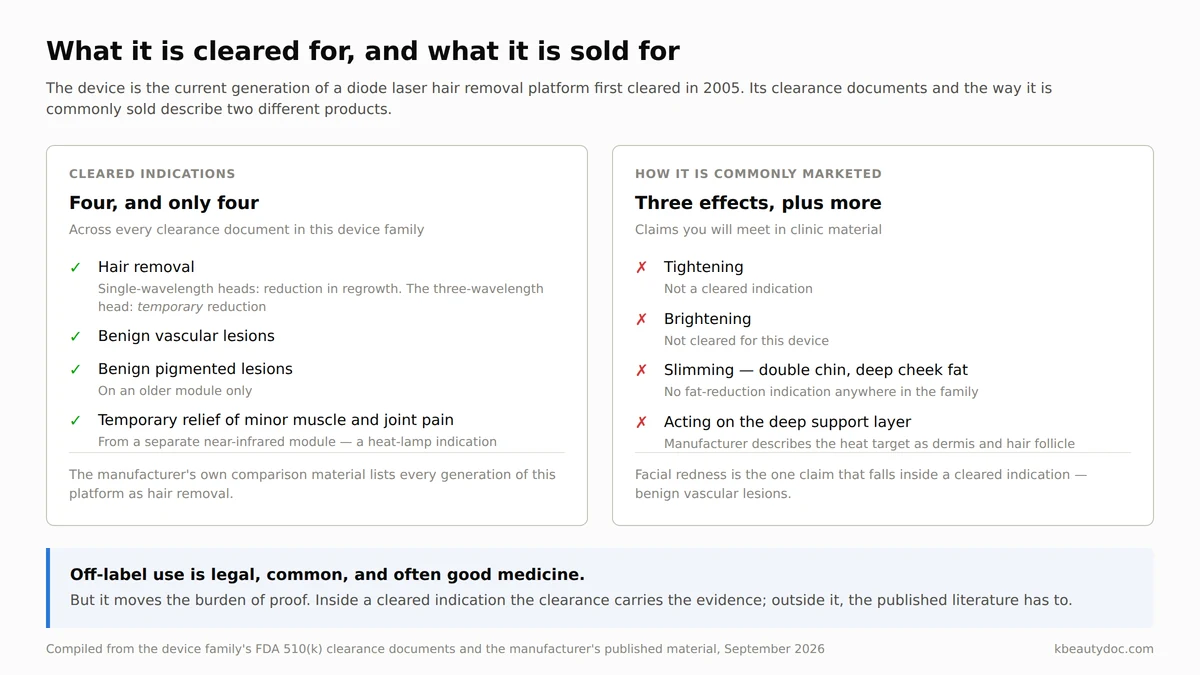
Across every clearance document in this device family, skin tightening does not appear. Not wrinkles, not laxity, not lifting, not collagen. Four indications appear, and that is all:
- Hair removal
- Benign vascular lesions
- Benign pigmented lesions, on an older module
- Temporary relief of minor aches, from a separate near-infrared module — a heat-lamp indication, not a cosmetic one
One detail few people know: the single-wavelength applicators cleared the higher regulatory bar for long-lasting hair reduction, while **the three-wavelength applicator — the one used for lifting — is cleared for temporary hair reduction.** The maker lists this platform as a hair removal system; the lifting story did not come from the company that made it.
None of that makes the treatment improper — off-label use is legal, common and often good medicine. But it moves the burden of proof to the literature.
What I noticed fifteen years ago
Using the earlier Soprano for hair removal, I noticed something unrelated to hair: as a course went on, pores looked smaller and the skin took on a sheen. Patients noticed too, and nobody was marketing anything called lifting then.
I still cannot point to a study measuring pore size before and after. What is documented is that the hair shaft thins and the follicle shrinks. Whether that changes oil output is a hypothesis with less trial support than the marketing suggests.
The change people now pay for as lifting was already there when this was sold as a hair remover. What is new is the name — and the price. The ordinary explanation is that the face carries fine vellus hair: reduce it and light reflects differently, makeup sits better, the surface reads smoother — squarely inside what the device is built to do. More on how much of “better skin” after hair removal is really the hair.
How far the evidence goes
| Claim | Where the evidence stands |
|---|---|
| Comfortable and safe in darker skin | Solid — from a hair removal study [1] |
| 800 nm light stimulates collagen | Cell and animal studies only |
| Three wavelengths rejuvenate skin | One small study, no control group |
| It lifts a sagging face | No controlled human study found |
| It acts on the deep support layer | No evidence |
| It reduces fat or a double chin | No evidence |
| It beats ultrasound or RF lifting | No head-to-head study |
That preliminary study did report more collagen on biopsy — but an uncontrolled handful of patients followed for a fortnight is a research starting point, not a treatment category.
The claim about the deep layer
This is a physics question more than a medical one.
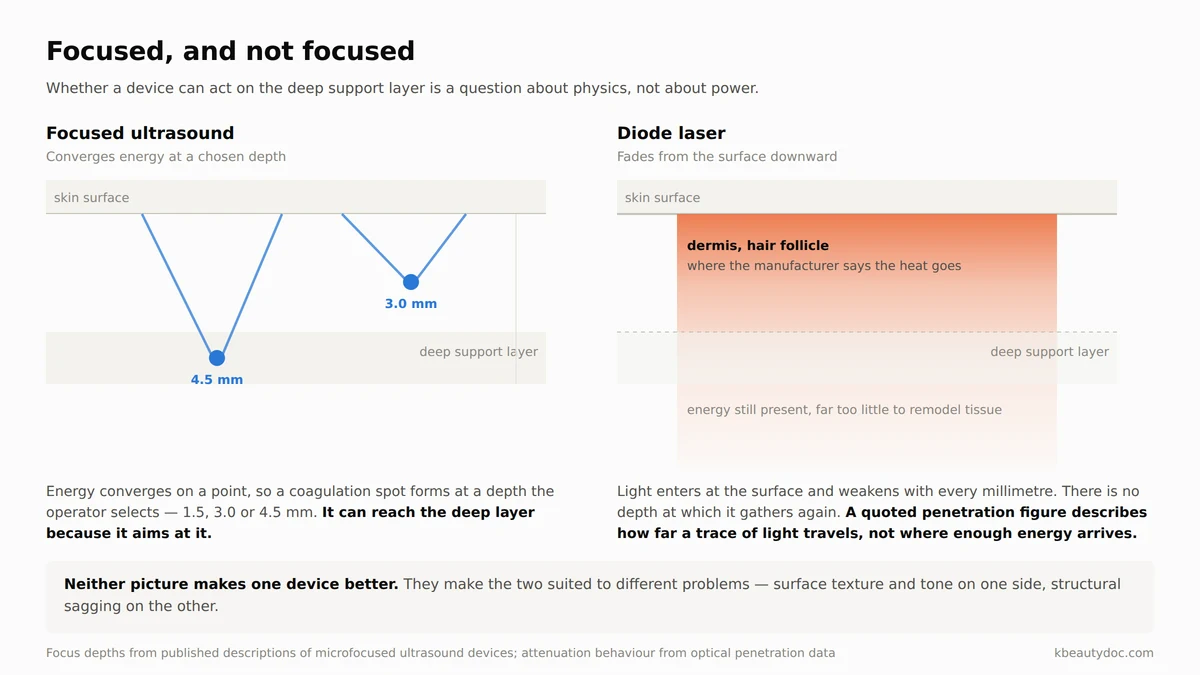
Focused ultrasound does what its name says: energy converges at a chosen depth and leaves a small coagulation point, reaching the deep support layer because it aims at it. How those devices differ is covered separately.
A diode laser cannot focus. Light enters at the surface and fades with depth; there is no point where it gathers again. Marketing sometimes quotes 8 to 10 mm of penetration — that is how far a little light still travels, not where enough energy arrives to change tissue. The maker’s stated target is the dermis and the follicle. Neither picture makes one device better; they suit different problems.
Because it is the face
Hair sometimes grows instead of disappearing. Pooling nearly ten thousand patients, this paradoxical response occurred in about 3%, almost entirely on the face and neck and in 0.08% of treatments elsewhere. The device type made no difference, and in most reports it settled when treatment continued rather than stopped [2].
Burns have been reported. The US adverse event database holds injury reports for this device: burns on face and neck, blistering, pigment change, one scar described as likely lasting. That database is voluntary and has no denominator, so it says this has happened, not how often. Both risks are the price of one fact: it is a hair removal laser working on a face.
How many sessions, and how far apart
There is no published course for the lifting use, because there is no published lifting trial — so clinic schedules are borrowed from what the device was built for. Hair removal on this platform runs on a 3–4 week cycle, the window in which a fresh crop of follicles enters its growing phase, and a face is judged over a course rather than after one visit. For texture and tone I would expect similar spacing across several sessions. Anyone describing a result from one appointment is describing an expectation, not a protocol.
What to ask
- “Which applicator, and how many passes?” The three-wavelength and single-wavelength heads are different treatments.
- “Are you treating texture and tone, or sagging?” If sagging, what else is in the plan?
- “How many sessions, at what interval, and what is the total cost?”
- “Can we do a test patch?”
Asking about a device by name is how most consultations now begin — but the name is the least informative part.
FAQ
Is the Titanium laser a lifting device?
It is a hair removal laser. Its listed indications are hair removal, benign vascular lesions, benign pigmented lesions on an older module, and temporary relief of minor aches — not tightening.
So does it do nothing for the skin?
It does something. A small preliminary study found more collagen on biopsy, and I saw skin look smoother in my own hair removal patients long before anyone called it lifting. The question is how much, and whether lifting is the word.
Why is it offered as a lifting treatment then?
It gives a visible surface change, is comfortable and needs no recovery — an easy combination to sell. The manufacturer makes no cosmetic claims for it.
Can it replace ultrasound or radiofrequency lifting?
No study has compared them directly. Focused ultrasound converges energy at a set depth and reaches the deep support layer; a diode laser fades from the surface downward.
Will it help my jowls or double chin?
I would not expect it to. Those are structural, and no published evidence shows this device reaching that layer.
Is it safe on deeper skin tones?
This class of device is cleared for all skin types, and a study of 71 women with skin types IV to VI recorded no complications [1]. Deeper skin remains more prone to pigment change after any laser.
Could it make facial hair worse?
Uncommon but real — about 3% across pooled studies, almost only on face and neck, and not specific to this device. Continuing treatment usually improves it [2].
References
- Agarwal M, Velaskar S, Gold MH. Efficacy of a low fluence, high repetition rate 810 nm diode laser for hair reduction in Indian patients with skin types IV-VI. Journal of Clinical and Aesthetic Dermatology 2016;9(11):29-33. PMID 28210387
- Snast I, Kaftory R, Lapidoth M, Levi A. Paradoxical hypertrichosis associated with laser and light therapy for hair removal: a systematic review and meta-analysis. American Journal of Clinical Dermatology 2021;22(5):615-624. PMID 34057666
Disclaimer: This article explains treatments in general terms and is not a diagnosis or a treatment plan. What happens varies from person to person, and no article can tell you what to expect. Please discuss your own case with a licensed medical professional where you live. I do not endorse specific clinics or device brands.

Physician in non-surgical aesthetic medicine, practising in Ansan, South Korea. Every article here is written from clinical practice and the published literature.
About the author · Contact