Four machines, one principle — and the differences that decide your price, your pain and your result.
Three things to know first
- All four work the same way — focused ultrasound heating tiny points under the skin.
- What differs is imaging, shot pattern and cooling. Those explain the price and the pain.
- Results appear at two to three months, not the next morning.
So which should you choose?
The most documented option, if budget allows — Ulthera. The only one that shows the operator which layer the energy enters. Also the most uncomfortable and expensive.
If pain worries you, or the area is small — Coolsonic. Cooling, and a pen cartridge for places larger heads cannot reach.
First time, or affordable maintenance — Shurink. More cartridges, faster, cheaper.
Something gentle to repeat often — Liftera, sold on comfort rather than one strong session.
If your face is thin — say so at consultation, whichever device is used. Focused ultrasound also heats fat.
What focused ultrasound actually does
It works like a magnifying glass focusing sunlight. Ultrasound passing through tissue does little on its own. Focus it to a point and the temperature there rises sharply, making a very small injury; repairing it builds new collagen. These are thermal coagulation points, set at chosen depths. Histology of the original device shows them at each depth, with signs of collagen and elastin renewal three months later [1].
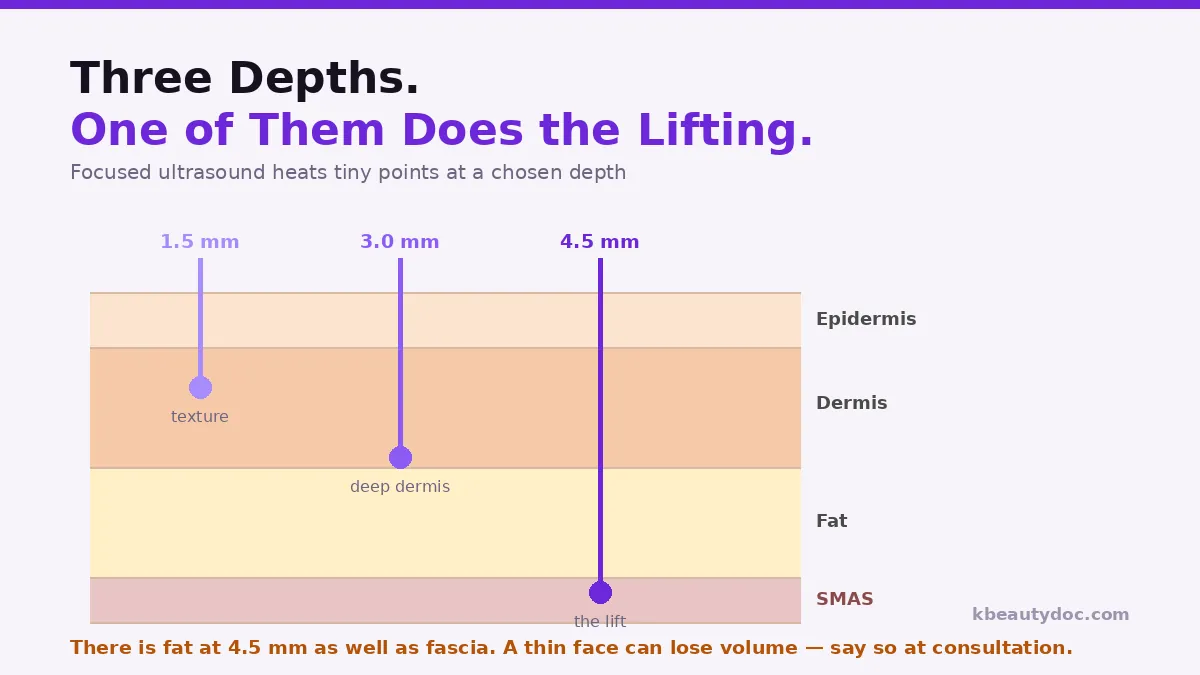
The cartridge sets the depth:
1.5 mm — dermis. Fine lines and texture. 3.0 mm — deep dermis. 4.5 mm — around the SMAS, the fibromuscular layer. This is the layer that lifts.
The 4.5 mm depth is the point of the treatment. Heating the SMAS makes it contract — a different result from anything that treats only the surface, and different again from surgery, threads and lasers, which meet the retaining ligaments in three ways. Monopolar radiofrequency heats the dermis in bulk instead.
One consequence: the surface stays intact while the layer beneath is heated, so there is no scabbing — and almost nothing visible on the day.
Ulthera — you can see where the energy goes
Made by Merz in the United States — the original device in the category.
Its defining feature is real-time ultrasound imaging. The operator can watch which layer is receiving energy; the others rely on experience and feel.
Skin and fat thickness vary, so a 4.5 mm cartridge does not land in the same layer for everyone. Imaging lets the operator check.
It holds US FDA clearance, a different level of review from the Korean approvals held by the domestic devices. The trade-offs are pain and cost: it is the most uncomfortable and the most expensive, because it delivers strong energy down to the SMAS.
Shurink — fast and accessible
Made by Classys in Korea, and the most widely used HIFU device here. There is no imaging; it developed in another direction.
The upgraded Shurink Universe uses two modes and seven cartridge types, so forehead, eyes, mouth, jawline, chin, cheeks and neck each get a suitable cartridge. It is also fast: energy goes in on both passes of the transducer. In a manufacturer-affiliated study of 34 people, upper eyelid position improved twelve weeks after one session of this platform [2].
Less discomfort and lower cost than Ulthera. Ulthera is a treatment you have once, deeply; Shurink is one you repeat.
Coolsonic — comfortable and precise
A Korean device, from Asterasys, and the one that tackled the pain problem directly.
It has a cooling system. Cooling the skin while energy is delivered reduces discomfort, which is why patients choose it.
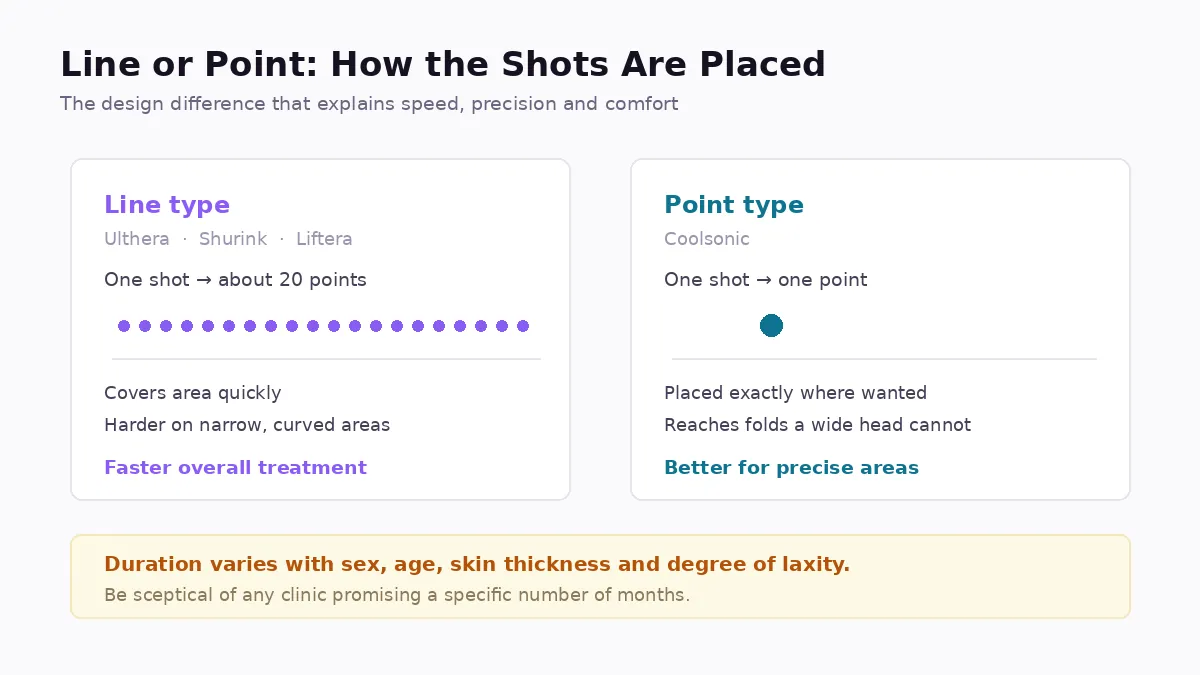
It uses a pen-type cartridge, the meaningful design difference. With Ulthera or Shurink, one shot places a line of coagulation points, around twenty — quick, but awkward on narrow, curved areas. Coolsonic places one point per shot: slower, but each placed exactly, which suits areas like the nasolabial fold.
Cartridges at 4.5 and 3.0 mm match Ulthera’s depths. I could not find a published clinical trial of this device — only maker documentation and a cooling patent.
Liftera — gentle and repeatable
Another Korean focused-ultrasound device, built around comfort rather than intensity: lower energy, repeated more often, minimal downtime.
That makes it a different kind of purchase: not one decisive session on significant laxity, but gradual maintenance. Lower energy is a gentler stimulus and a more modest response.
What I hear in my own room
I use a Korean HIFU device, and reactions split in two. Some patients are relieved their cheeks do not look hollowed afterwards. Others say it feels slightly less than the Ulthera session they remember. Neither group is measuring anything, so take it as what patients report, not a ranking.
One thing has changed: Doublo used to be the name everyone arrived with; now Shurink is the word patients use for the whole category.
Side by side
| Ulthera | Shurink | Coolsonic | Liftera | |
|---|---|---|---|---|
| Made by | Merz (USA) | Classys (Korea) | Asterasys (Korea) | Korea |
| Real-time imaging | Yes | No | No | No |
| Shot pattern | Line, ~20 points | Line | One point per shot | Line |
| Cooling | — | — | Yes | — |
| Discomfort | Higher | Moderate | Lower | Lowest |
| Energy per session | High | Moderate | Moderate | Lower |
| Cost | High | Low | Middle | Low |
| Regulatory | US FDA | Korea | Korea | Korea |
| Strength | Seeing the layer | Cartridges, speed | Comfort, precise areas | Frequent repetition |
Duration varies with age, skin thickness and laxity. Be sceptical of a clinic promising a set number of months.
The part nobody mentions — fat
Heat does not pick out collagen. At 4.5 mm there is fascia and also fat. Some people welcome the slimming. But if your face was already thin, it can look hollow.
Say so at consultation if any of these apply:
- Your cheeks are naturally on the hollow side
- You have little facial fat for your age
- You have lost significant weight recently
In those cases the sensible approach is less 4.5 mm work, weighted to shallower depths. A good clinic asks before you raise it.
Where fat is the target rather than the casualty — under the chin — the American and Korean injections take a chemical route. And a device marketed for lifting is not always built for it: the Titanium laser began as hair removal equipment.
Other things to know
Nerve irritation. Uncommon, but temporary asymmetry or altered sensation can occur, usually settling in weeks.
Do not expect an immediate change. Tightness on the day is swelling, not lift.
It does not replace surgery. Where laxity is advanced, no HIFU device gives a surgical result. A clinic willing to say so is being honest.
Keep home care plain for a few days. Heat went in under intact skin, so the surface is more reactive than it looks — put the acid pads away and stay on the soothing ones, a distinction I set out in the toner pad guide.
What to ask at consultation
Which depths, and how many shots. Shot count drives price and result. Get it in writing.
Whether they assess your fat layer first, particularly if your face is thin.
Who performs the treatment. The less imaging a device has, the more the operator decides the outcome.
When they will reassess. If nobody mentions a review at two to three months, nobody plans to check whether it worked.
FAQ
Is Ulthera simply the best?
The most established, and the only one with imaging — also the most painful and expensive. For a small area or low pain tolerance, another device may suit better.
Do several Shurink sessions equal one Ulthera?
No. Energy and intensity differ, so it does not convert by session count. Treat them as different procedures.
How many shots do I need?
It depends on face size, laxity and target areas. Ask for the count in writing.
How painful is it?
A deep ache, occasionally sharp near bone. Numbing cream is standard and cooled devices are easier. Tell the operator if it is too much.
When will I see results?
New collagen takes time, so change shows from two to three months. Seeing nothing the next morning is normal.
I am worried about my face looking hollow.
A fair concern. There is fat at 4.5 mm, and a thin face can lose volume. Raise it at consultation so the depths can be adjusted.
Can I have this during a short trip?
Yes, downtime is minimal. But results appear months later, so not one to have for photographs on the trip.
References
- Marquardt K, et al. Histological evaluation of microfocused ultrasound with visualisation. Journal of Cosmetic Dermatology 2025;24(1):e16638. PMID 39545626 (authors employed by the device maker)
- Hwang Y, et al. Micro-pulsed high-intensity focused ultrasound for upper eyelid laxity. JPRAS Open 2025;48:147-154. PMID 41438879 (authors affiliated with the manufacturer)
Disclaimer: This article explains treatments in general terms and is not a diagnosis or a treatment plan. What happens varies from person to person, and no article can tell you what to expect. Please discuss your own case with a licensed medical professional where you live. I do not endorse specific clinics or device brands.

Physician in non-surgical aesthetic medicine, practising in Ansan, South Korea. Every article here is written from clinical practice and the published literature.
About the author · Contact