

What does Ultherapy actually do?

Focused ultrasound heats tiny spots in your face’s support layer.
How long does it last?
Change builds over months, and one-year data is mixed.
Who is it worth it for?
Early, mild sagging with a modest goal.
In the longest Ultherapy study, most patients felt better at one year. The reviewers grading their photos were far less sure.
Short answer:
- Ultherapy heats tiny points under the skin with focused ultrasound, down to the firm layer that holds the face up. The surface is left intact.
- Change builds over two to three months. At one year, most people in a small study still rated themselves improved — but blinded reviewers saw a clear change in fewer than half [1].
- It is worth it for early, mild sagging and a modest goal. It is not a fix for heavy jowls, and it needs care if your face is already thin.
What is Ultherapy, in plain words?
Ulthera is the machine; Ultherapy is the treatment. In Korea most people just say “Ulthera”.
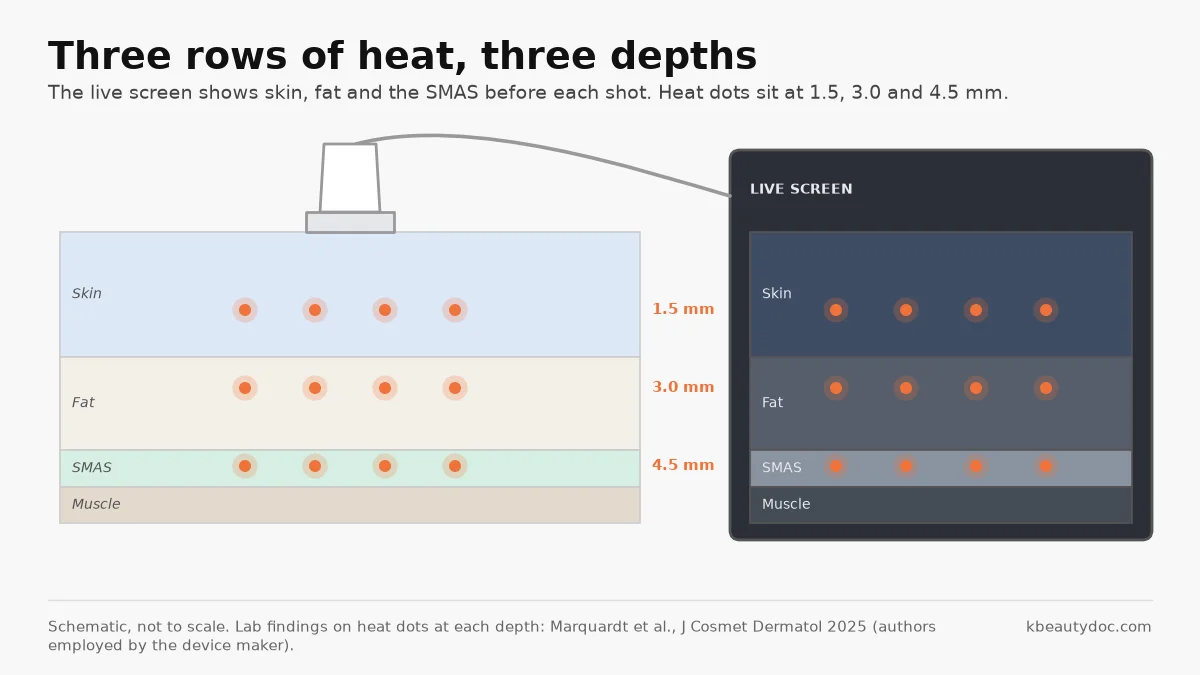
The handpiece sends ultrasound into the skin and focuses it on rows of small heat dots at set depths. The deepest row reaches the SMAS, the tough sheet under the fat that a surgeon tightens in a facelift. A lab study by the maker’s own scientists shows those dots at each depth, and signs of new collagen three months later [2].
Its signature is a live ultrasound screen. Before firing, the operator can see the skin, fat and deeper layer, and check where the energy will land. It was also the first device of its type to go through US FDA review, in 2009.
How long does Ultherapy last?
Nobody can give you a firm number of months. Here is what the research actually shows:
- Day one is not the result. A tight feeling that evening is mostly swelling.
- The real change shows at two to three months, as the heated spots heal into firmer tissue.
- The one-year study was small and paid for by the maker. It treated 20 people, and at one year most still called themselves improved. But when blinded reviewers compared photos, only 6 of the 14 they could rate looked better [1].
- A pooled review of 42 studies found most patients improved to some degree, but the authors warned the figure may be overstated [3].
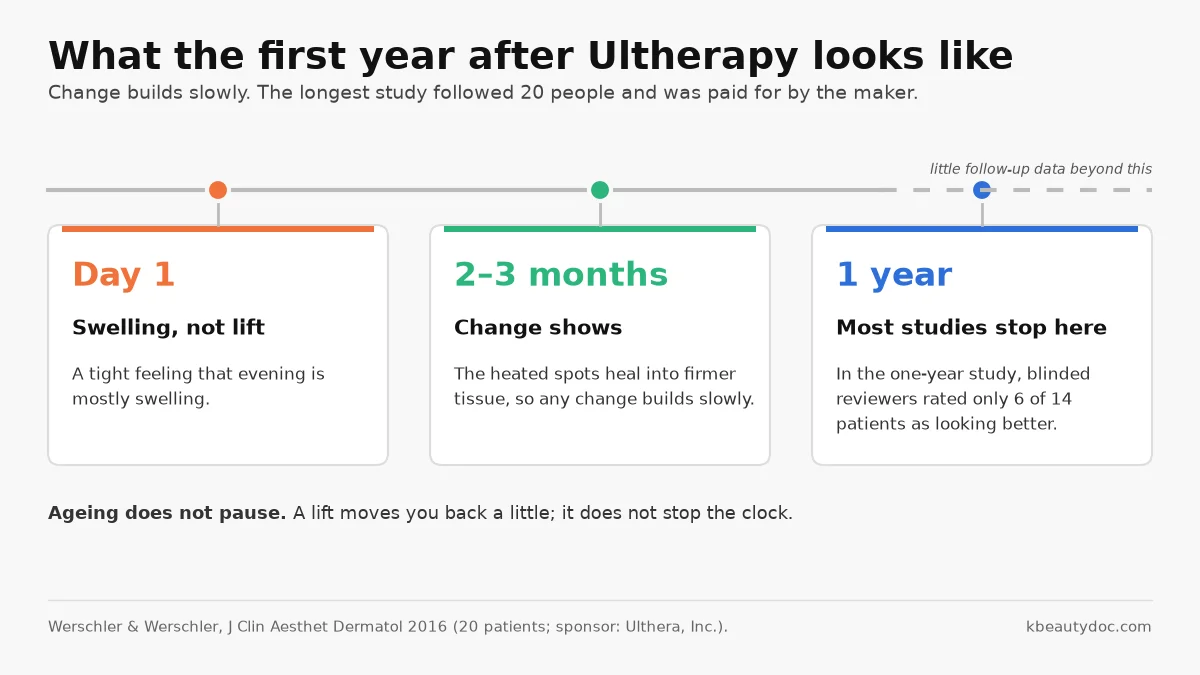
And ageing does not pause. A lift moves you back a little; it does not stop the clock.
Many clinics suggest a repeat about once a year. That is habit, not a proven interval. My clinical judgement, not a proven fact: look again at three months, compare photos, and decide from what you see — not from the calendar.
Is it worth the money? What I tell my patients
Usually worth considering:
- Early softening along the jaw or under the chin, with skin that still has some thickness
- Wanting a subtle change with almost no downtime
Usually not worth it:
- Heavy jowls or loose neck skin — that is surgery territory, and no ultrasound device replaces it
- A thin or hollow face — the deep row also heats fat, and losing some can make cheeks look sunken
- A big event next week — the result is months away
Price in Korea is set mostly by the number of lines (shots). Ask for the count in writing, per area.
How much does it hurt?
It aches. Pooled studies put the average at about 5 out of 10 [3] — moderate. The deep row near bone is usually the worst. Numbing cream is standard; tell the operator if you need a pause.
What are the side effects?
Common and short-lived: redness, swelling and tenderness for a few days; sometimes small bruises or raised lines.
Uncommon but worth knowing. Published studies rarely record serious problems, but reports sent to the US FDA’s device-problem database most often mention these three [4]:
- Nerve problems — numbness, odd sensations, or a smile that looks uneven for a while
- Loss of fat that leaves a hollow look
- Scarring — a small case series also describes blisters and skin breakdown after a single session [5]
What should I ask before I book?
- Which depths, and how many lines per area?
- Will you check the screen for each area? The screen only helps if someone looks.
- Who actually does the treatment?
- When is my review? Two to three months is the fair time to judge.
How do the Korean devices compare? See Is Shurink as good as Ulthera? Weighing radiofrequency instead? See Thermage vs Oligio vs 10Therma. Sagging itself starts at the retaining ligaments.
FAQ
Will I see a lift the next morning?
Not really. What you feel that day is mostly swelling. Judge the result at two to three months.
Can I have it during a short trip to Korea?
Yes. Downtime is small. Just know the result will show after you fly home, so it is not a treatment for holiday photos.
Have a question about your own case? Ask me on LINE or by email — details on the Contact page.
References
- Werschler WP, Werschler PS. Long-term efficacy of micro-focused ultrasound with visualization for lifting and tightening lax facial and neck skin using a customized vectoring treatment method. J Clin Aesthet Dermatol 2016;9(2):27-33. PMID 27047630 (sponsor: Ulthera, Inc., NCT01708512)
- Marquardt K, et al. Histological evaluation of microfocused ultrasound with visualisation. J Cosmet Dermatol 2025;24(1):e16638. 10.1111/jocd.16638 (authors employed by the device maker)
- Amiri M, Ajasllari G, Llane A, et al. Microfocused ultrasound with visualization (MFU-V) effectiveness and safety: a systematic review and meta-analysis. Aesthet Surg J 2025;45(3):NP86-NP94. 10.1093/asj/sjae228
- Humphrey VS, Rambhia PH, Gmyrek R, et al. Microfocused ultrasound with visualization: a systematic review of adverse events and risk of subsequent facelift compromise. Dermatol Surg 2025;51(4):424-429. 10.1097/DSS.0000000000004510
- Friedmann DP, Bourgeois GP, Chan HHL, et al. Complications from microfocused transcutaneous ultrasound: case series and review of the literature. Lasers Surg Med 2018;50(1):13-19. 10.1002/lsm.22768
Disclaimer: This article explains treatments in general terms and is not a diagnosis or a treatment plan. What happens varies from person to person, and no article can tell you what to expect. Please discuss your own case with a licensed medical professional where you live. I do not endorse specific clinics or device brands.
14 years in practice · replies to messages herselfPhysician in non-surgical aesthetic medicine, practising in Ansan, South Korea. Every article here is written from clinical practice and the published literature.
About the author · Contact