Three things to know first
- Bipolar RF is shallow. It cannot reach subcutaneous fat on its own.
- Suction solves that physically — it lifts fat up into the electrode field rather than sending energy deeper.
- Onda uses microwaves, which reach fat directly. That is why it has no suction.
So what should you know before booking?
If you are considering InMode for the face — this is not a treatment that lifts the SMAS; focused ultrasound is the category aimed at that layer. It heats the dermis to tighten it and, depending on the handpiece, reduces superficial fat. If your laxity is significant, a different category suits you better.
If you are choosing between body InMode and Onda — areas you can pinch favour suction; broad areas and deeper fat favour microwave.
Why does the suction exist? A physical necessity, not a marketing feature.
If bruising is a concern — suction-based treatments bruise. Mention upcoming events before you book.
Radiofrequency comes in different configurations
The word “RF” covers several quite different treatments, and the electrode arrangement makes the rest straightforward.
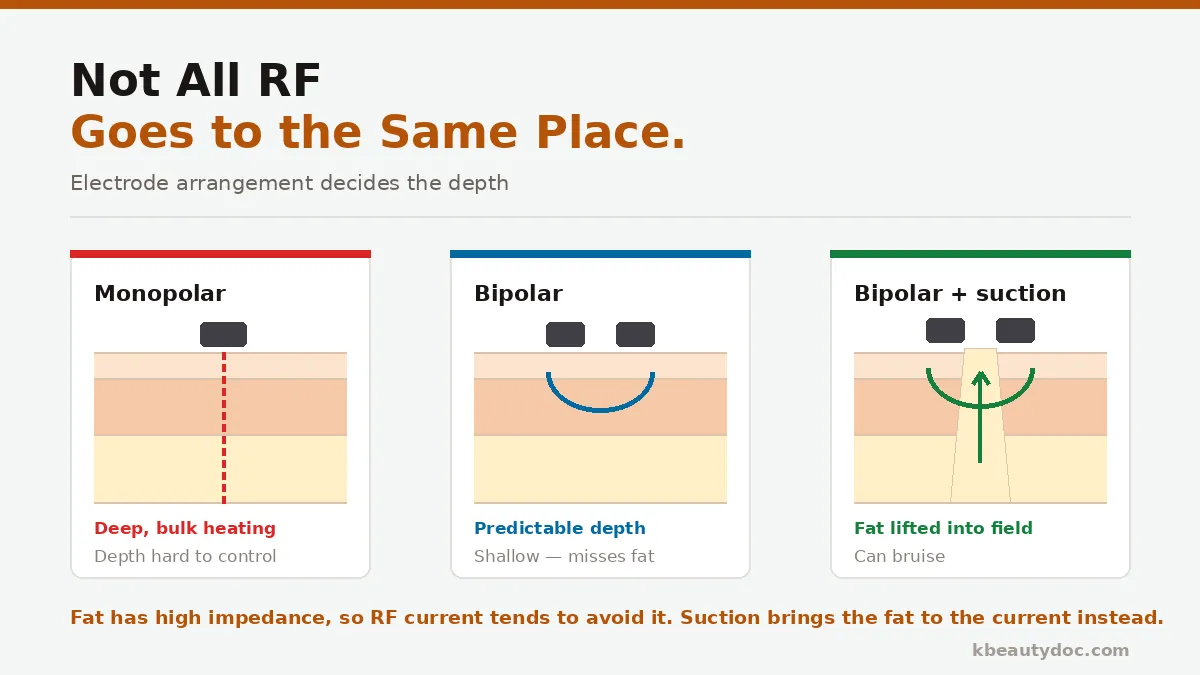
Monopolar. One active electrode, with a return pad elsewhere on the body. Current travels through tissue to reach it, producing deep, bulk heating. Thermage, Oligio and 10Therma work this way. The advantage is depth; the limitation is control, since current follows the path of least resistance and that path varies between people.
Bipolar. Two electrodes sit close together on the handpiece, and current flows only between them. Penetration depth is roughly half the distance between the two electrodes — the defining property of bipolar RF.
- Advantage: predictability. Fix the electrode spacing and you fix the depth. No return pad, and no current through the body.
- Limitation: it is shallow. Widening the gap increases depth but puts more heat into the surface. There is a practical ceiling.
Multipolar. Three or more electrodes firing in alternating pairs, intended to distribute heat more evenly.
What makes InMode different
InMode is a platform from an Israeli manufacturer, used with interchangeable handpieces. In Korea, “InMode” usually refers to a combination of two of them.
FX family — bipolar RF with suction Forma family — bipolar RF, contact only, no suction
Facial InMode is typically both in sequence: FX to address superficial fat, Forma to heat the dermis and tighten.
What sets the FX family apart is not only the suction. Published work describes BodyFX as a suction-coupled, multi-frequency bipolar RF device that also delivers trains of very short, high-voltage pulses, proposed to cause irreversible electroporation of the fat cell membrane — a mechanism distinct from heating [1]. It holds FDA approval for the temporary reduction of cellulite.
So three things happen at once: heat from RF, mechanical repositioning from suction, and membrane disruption from the pulses.
Why suction is necessary — the core of this article
This is the part most explanations skip.
The first problem. Bipolar RF is shallow. The fat you want to treat sits deeper. Widening the electrodes to reach it heats the surface first.
The second problem is less obvious. RF generates heat through resistance, and current follows tissue with more water content. Fat has low water content and high impedance, so the current flows around it, through the more conductive dermis. For a treatment aimed at fat, fat is an awkward target.
Suction solves both problems mechanically. Negative pressure draws a fold of tissue upward, so skin and the fat beneath it are pulled into the space between the electrodes. Fat that was out of reach is now inside the shallow field.
The depth was not increased. The target was brought up. That is a fundamentally different solution.
Suction has secondary benefits too: electrode contact becomes more uniform, local blood and lymphatic flow increase, and lifting the tissue creates distance from underlying muscle and nerve.
There is a cost. Drawing tissue up under negative pressure can cause bruising, particularly in thin skin, fragile vessels, or anyone taking medication affecting clotting. Marks can last several days.
Suction versus no suction
Within InMode itself, the handpiece changes the treatment entirely.
| With suction (FX family) | Without suction (Forma family) | |
|---|---|---|
| Target | Superficial fat and dermis | Dermis |
| Purpose | Volume reduction, contour | Tightening, skin quality |
| Sensation | Pulling plus warmth | Warm massage |
| Bruising | Possible | Rare |
| Suits | Faces with fat to reduce | Thin faces, skin laxity only |
This produces a useful decision rule.
If there is fat and its weight contributes to the sagging, suction-based treatment makes sense. But if the face has already lost volume and only the skin is loose, removing fat makes it look more hollow.
The right order at consultation is not “would you like InMode?” but “are we reducing fat, or tightening skin?” Under the chin there is a third route again — injections rather than devices — and how any of this feels differs by sex, because men’s skin is thicker and denser.
Body InMode versus Onda
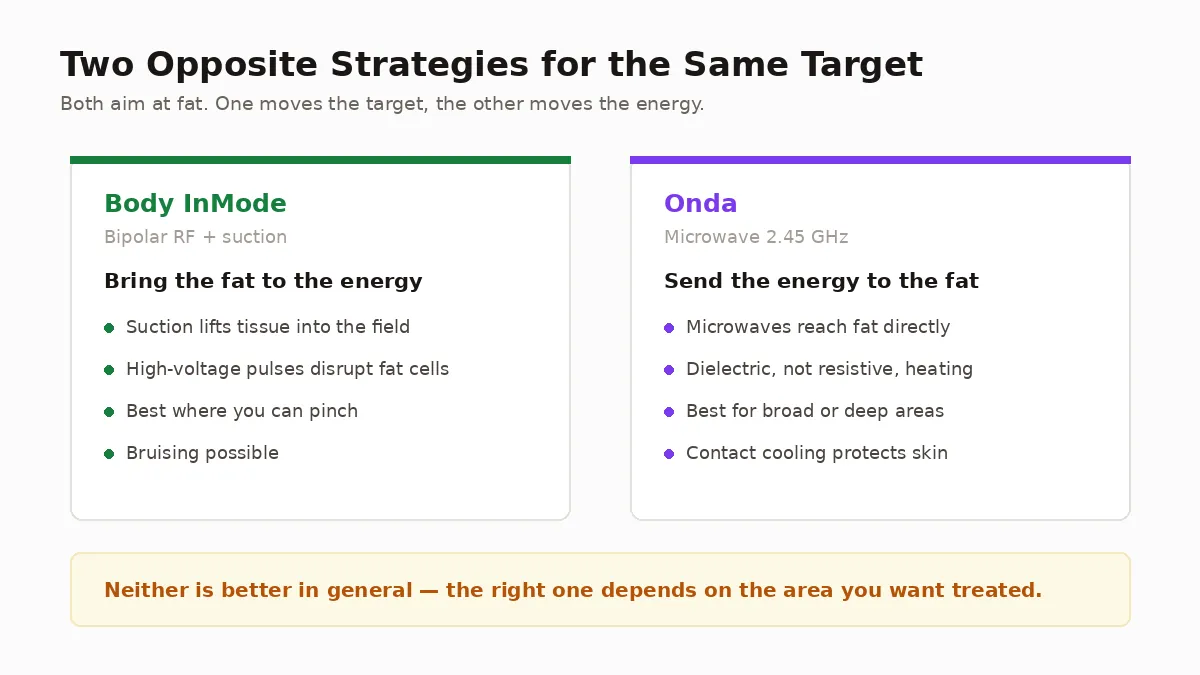
Both target fat, but through opposite strategies.
Body InMode — bring the fat to the energy. Bipolar RF struggles to enter fat, so suction lifts the fat into the field.
Onda — send the energy to the fat. Onda is DEKA’s Coolwaves device from Italy, running 2.45 GHz microwave at up to 200 W. Microwaves heat dielectrically, and the frequency and handpiece design direct energy at subdermal fat. Contact cooling protects the epidermis.
An international advisory board describes the mechanism as microwaves placing adipocytes under enough stress to release lipid content through a process called blebbing, intense enough to lyse the fat cells [2]. It uses two handpieces, one for deeper tissue and one for more superficial layers.
How they compare
| Body InMode (FX) | Onda | |
|---|---|---|
| Energy | Bipolar RF, multi-frequency | Microwave, 2.45 GHz |
| Heating mechanism | Resistive | Dielectric |
| Reaching fat | Suction lifts it into the field | Energy penetrates directly |
| Additional mechanism | High-voltage pulses, electroporation | Blebbing and lysis of adipocytes |
| Suction | Yes | No |
| Skin protection | — | Contact cooling |
| Bruising | Possible | Less common |
Indications
| Body InMode (FX) suits | Onda suits | |
|---|---|---|
| Area type | Areas you can pinch — abdomen, flanks, arms, inner thigh | Broad areas, and areas that cannot be lifted |
| Fat depth | Superficial subcutaneous fat | Deeper subcutaneous fat |
| Skin laxity | Localised fat with moderate laxity | Fat reduction with skin tightening via the shallow handpiece |
| Cellulite | FDA approval for temporary cellulite reduction | Cellulite and localised adiposity |
| Less suitable | Thin skin prone to bruising; areas that cannot be grasped | — |
Neither is better in general. The sensible question is which suits the area you actually want treated.
What to know before you go
This reduces fat in a specific area. No device reduces body weight. These are contouring treatments.
One session is not a course. Both categories assume repeated treatments, and results build gradually — heat and mechanical stress initiate a change, and the body takes time to respond.
Reconsider suction if your skin is thin or your face has little fat. Reducing fat where there is none to spare works against you. Suction-based treatment can also leave marks for several days.
What to ask at consultation
Which handpiece. “InMode” is a platform, not a procedure. Ask whether suction is being used, and whether both handpieces are planned.
Whether the goal is fat or skin. Settle this before choosing a device.
How many sessions, and the total cost. In writing.
Whether bruising is likely, and for how long. Essential if you have an event coming up.
FAQ
How is InMode different from Thermage?
Thermage is monopolar RF, delivering deep bulk heating. InMode is bipolar — shallower and more controlled — and uses suction to bring fat within reach. They are built for different purposes.
Is the treatment ineffective without suction?
No, the purpose is different. Non-suction handpieces heat the dermis to tighten it, which is a valid goal in itself.
Could my face look hollow afterwards?
It is possible, because fat is being reduced. If your face already has little volume, suction-based treatment should be limited or avoided.
Can Onda and InMode be combined?
They can be used for different goals and areas, but treating the same area in immediate succession warrants caution. Discuss it with the treating clinic.
How long does bruising last?
It varies, but generally several days up to a week. Mention thin skin or any medication affecting clotting beforehand.
Will I lose weight?
No. These are contouring treatments for specific areas, not weight-loss treatments.
References
- Boisnic S, Divaris M, Nelson AA, et al. A clinical and biological evaluation of a novel, noninvasive radiofrequency device for the long-term reduction of adipose tissue. Lasers Surg Med 2014;46(2):94-103. DOI: 10.1002/lsm.22223
- Hoffmann K, Zappia E, Bonan P, et al. Microwave-energy-based device for the treatment of cellulite and localized adiposity: recommendations of the “Onda Coolwaves” international advisory board. Bioengineering 2024;11(12):1249. DOI: 10.3390/bioengineering11121249
Disclaimer: This article explains treatments in general terms and is not a diagnosis or a treatment plan. What happens varies from person to person, and no article can tell you what to expect. Please discuss your own case with a licensed medical professional where you live. I do not endorse specific clinics or device brands.

Physician in non-surgical aesthetic medicine, practising in Ansan, South Korea. Every article here is written from clinical practice and the published literature.
About the author · Contact