Three things to know first
- It is a prescription medicine, not a cosmetic.
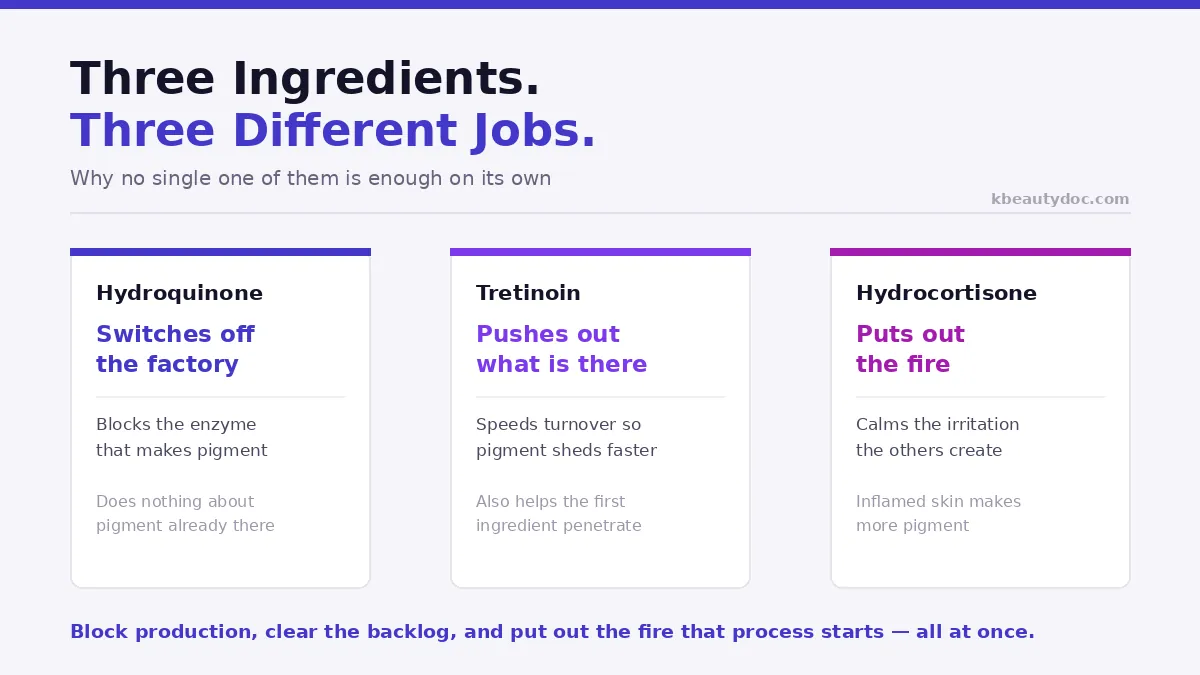
- Three ingredients do three different jobs — stop production, clear the backlog, calm the irritation.
- If pigmentation matters to you, raise it alongside a procedure.
So what should you do?
If pigmentation concerns you, ask at the consultation. “Is there a prescription cream I can use at home?” is enough.
Get the prescription, but do not start using it straight away. When you can begin depends on which procedure you had. Confirm with the clinic before you start.
Ask the pharmacy to explain how to use it. Korean pharmacies provide medication counselling when dispensing. That is the most accurate place to ask.
On the pigmented areas only, as thinly as possible. This is not a cream you spread across the face.
Not during pregnancy, or if pregnancy is possible. Say so at the consultation.
That is the practical answer. If you want to know why, keep reading.
What it is
A prescription medicine combining three ingredients for pigmentation. It is a drug, not a cosmetic, and it requires a prescription.
The formulation goes back to a combination published by the dermatologist Albert Kligman in 1975. In that original work, leaving out any one of the three ingredients meant the formula no longer worked [1]. The early concentrations were strong enough that redness and stinging were common.
The Korean version adjusted the concentrations downward to reduce irritation, and the balance has been refined through long clinical use.
Three ingredients, three jobs
Understanding this explains why no single one of them is enough.
Hydroquinone — switches off the factory
It blocks the enzyme that produces pigment in the skin. Its job is reducing the amount of new pigment being made.
But it does nothing about pigment that already exists. Stopping production leaves the existing stock where it is.
Tretinoin — pushes out what is already there
It accelerates skin cell turnover, so older cells carrying pigment move upward and shed faster.
It does one more thing. It helps hydroquinone penetrate. This is why the two together are stronger than either alone.
The cost is irritation. Faster turnover means dryness, stinging and flaking.
Hydrocortisone — puts out the fire
A mild steroid. It suppresses the irritation and redness the other two produce.
This is not merely damage control. Inflamed skin makes more pigment. Left unmanaged, irritation causes more of exactly what you were treating. So this ingredient is part of the treatment, not a concession.
It is also why this is prescription-only. A steroid means medical supervision.
In short — block production, clear the backlog, and put out the fire that process starts. All three are needed at once, which is exactly what the original study found [1].
Why this matters after a procedure
The most common way a pigmentation procedure disappoints is not that it failed, but that pigment came back afterwards.
This is post-inflammatory hyperpigmentation. A laser injures the skin to some degree, and the skin can answer by making pigment. It is more frequent and more stubborn in darker skin tones [2].
And it is largely preventable. The weeks after treatment are decisive, and what you apply — and avoid — during that window determines the result.
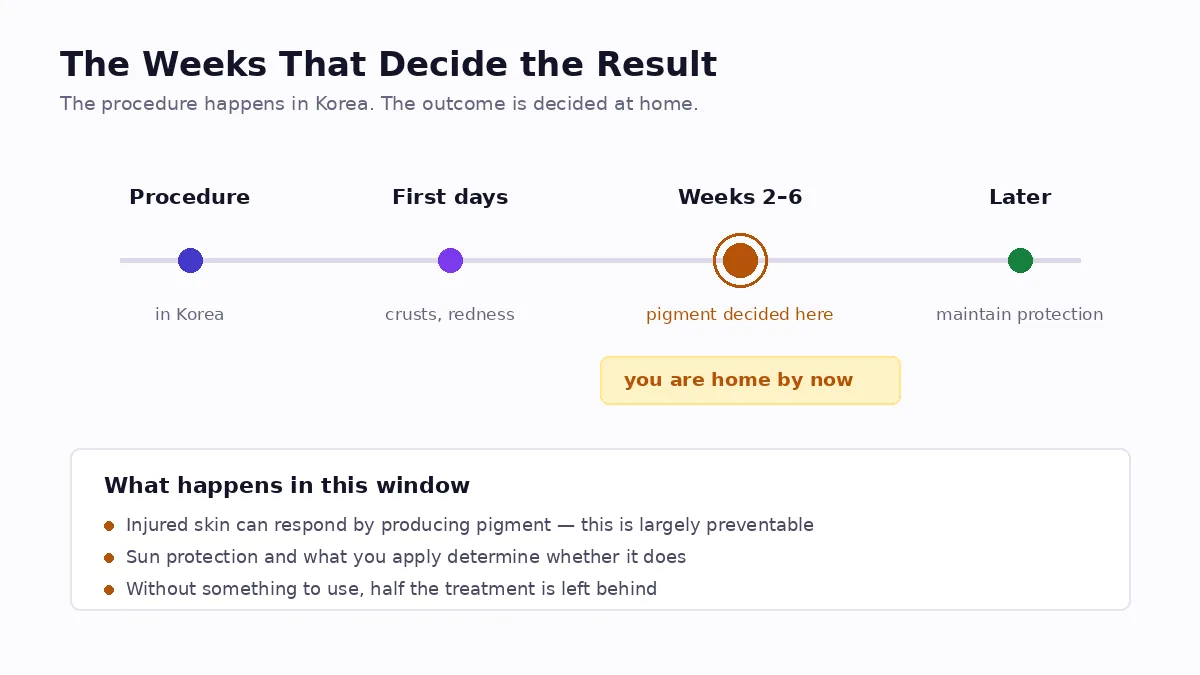
But the procedure happens in Korea while those decisive weeks happen at home. Without something to use then, you leave half the treatment behind.
Access also differs by country. Hydroquinone is restricted over the counter in many places, and a three-ingredient combination harder still. Getting it prescribed in Korea is the most reliable route. Home care sits at the other end, where a vitamin C device depends on which electrode you use.
How to use it
The sequence matters. Applied carelessly, you get the irritation without the benefit.
1. Wait 10–15 minutes after cleansing.
The skin must be dry. Residual moisture means uneven absorption and more irritation.
2. Apply your basic skincare first.
Toner and moisturiser, then the cream on top.
3. Apply as thinly as possible, on the pigmented areas only.
A cotton bud helps with precision. Spreading it across the face is not acceptable. Only where the pigment is, and thinly. On normal skin it can lighten the area unevenly.
4. Follow with moisturiser about ten minutes later.
Tretinoin causes dryness, so moisturising reduces the irritation.
5. Use it in the evening.
Safer than during the day, when UV exposure occurs.
6. Sun protection continues throughout the course — and afterwards.
Because you apply it at night, it is easy to think only the next morning matters. That is not the case.
Your skin stays vulnerable to UV throughout treatment. Tretinoin thins the outer layer, and hydroquinone reduces the skin’s own pigment defence.
And after finishing, sun protection continues in order to protect the lightened areas and prevent recurrence. Korean product labelling specifies sun protection both during and after use.
Without it, there is no point using the medicine at all.
Before your first application
Do a patch test. Apply a small amount and observe for 24 hours. Mild redness is acceptable, but itching, blistering or marked inflammation means do not use it.
When not to use it
Pregnancy, or if pregnancy is possible. Because of the tretinoin. Say so at the consultation.
Across the whole face. Areas without pigment can lighten unevenly.
Continuously for long periods. The steroid content means prolonged use can thin the skin.
Alongside other strong actives. Not with acids, other retinoids, or spicule products.
On broken skin, weeping areas or crusts. Start times differ by procedure — follow the clinic’s instruction.
Without sun protection. This is not optional.
When to stop
If two months of use produces no change at all, that is a reason to review rather than continue. The diagnosis may have been different.
Do not keep using it beyond the period you were given. It contains a steroid, and continuous long-term hydroquinone use is not recommended.
Ask when you are prescribed it — how many weeks, when to pause, and when to be reassessed. If you did not get those answers, you were handed a product rather than given a treatment.
FAQ
Is this a whitening cream?
It is a medicine for lightening pigmented areas, not a product for lightening the skin overall. It is applied only where the pigment is, and applying it to normal skin can leave the area patchy.
Can I buy it without a prescription?
No. The steroid content makes it prescription-only.
Can I start it the day of my procedure?
No. Start times differ depending on the procedure. A gentle treatment and one that leaves crusts are entirely different, so confirm with the clinic that treated you.
How long do I use it for?
For a defined period, then reassessment. It is not a medicine you simply keep using. Confirm the duration when it is prescribed.
Do I really need sunscreen?
Yes, throughout treatment and afterwards. Skin is more vulnerable to UV while using it, and without protection the pigment simply returns.
Stinging and flaking — is that normal?
Some is expected because of the tretinoin. But marked redness, blistering or persistent pain is not; stop and ask.
References
- Kligman AM, Willis I. A new formula for depigmenting human skin. Archives of Dermatology 1975;111(1):40-48. PMID 1119822
- Davis EC, Callender VD. Postinflammatory hyperpigmentation: a review of the epidemiology, clinical features, and treatment options in skin of color. Journal of Clinical and Aesthetic Dermatology 2010;3(7):20-31. PMID 20725554
Disclaimer: This is general information about ingredients and routines, not a prescription or a diagnosis. Prescription medicines need an assessment and a prescription from a doctor in your own country, and the rules differ by country. Please do not start, change or stop a medicine because of an article.

Physician in non-surgical aesthetic medicine, practising in Ansan, South Korea. Every article here is written from clinical practice and the published literature.
About the author · Contact