Three things to know first
- It is an antibiotic. Prescription only. It suppresses bacteria and calms inflammation.
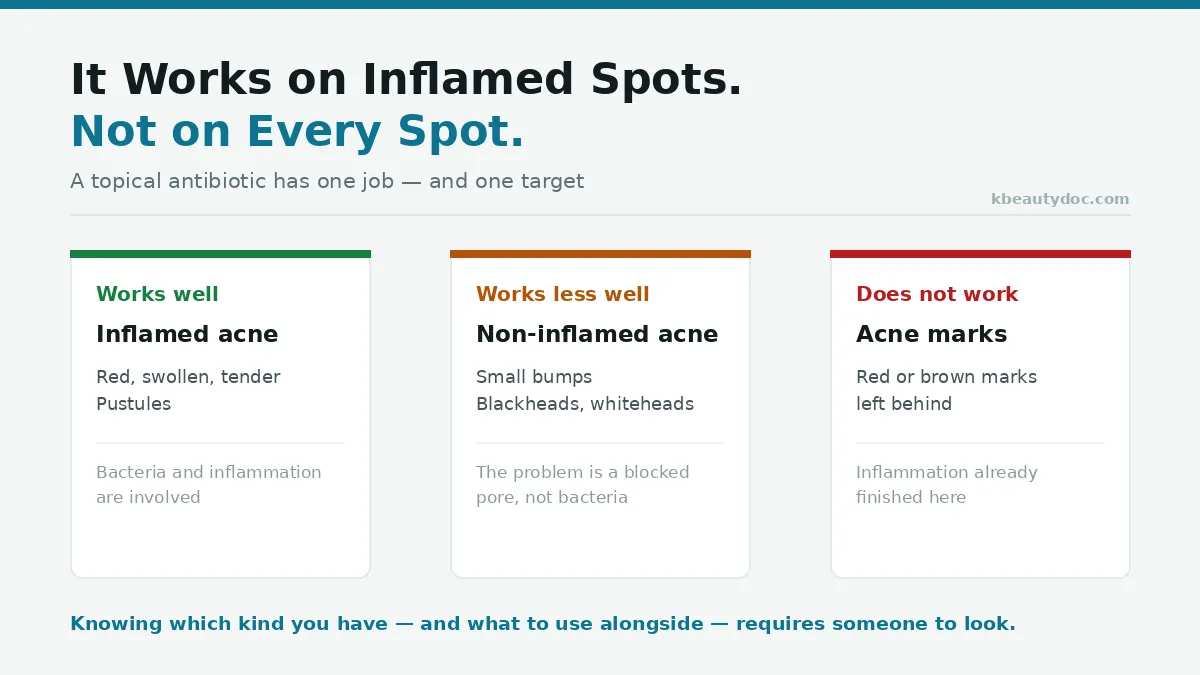
- It works on inflamed acne — not on small bumps, blackheads, or old marks.
- It is not a medicine to use alone long-term. Because of resistance.
So what should you do?
If your spots are red and swollen, ask at the consultation. “Can I be prescribed a topical antibiotic?” is enough.
Ask the pharmacy how to use it. Korean pharmacies counsel patients when dispensing.
On the spots only, thinly. This is not applied across the face.
Do not use it alone indefinitely. What to combine it with is something to discuss with the prescribing doctor.
Not during pregnancy or breastfeeding. Say so at the consultation.
That is the practical answer. If you want to know why, keep reading.
Why people break out while travelling
There are recurring reasons for this.
Starting several new products at once. Five things bought at Olive Young and used the same night is the most common cause.
A change of climate. Humidity and temperature change how much oil your skin produces.
Flights and disrupted sleep. A long-haul flight is a burden on the skin by itself.
Alcohol and an irregular schedule. The things that come with being on holiday — later nights, more drinking, meals at unusual times.
A cushion puff carried for two weeks. The puff, not the formula, is usually where cushion breakouts begin.
The first step is not a medicine — it is stopping whatever you started. Treating skin while leaving the cause in place does not work.
What it is
A topical antibiotic containing clindamycin. It is a prescription medicine, so it requires a doctor’s prescription.
In Korea it was previously available without one, and was reclassified as prescription-only because of side effects and resistance. That reclassification tells you most of what you need to know about it.
How it works
Bacteria are involved in acne. They break down sebum and generate inflammatory substances, which is why a spot becomes red and swollen.
Clindamycin blocks those bacteria from making protein, which prevents them multiplying.
It also has a direct anti-inflammatory effect. Two things happen at once — fewer bacteria, and less inflammation.
It begins to work at around five days. This is not a medicine that settles a spot overnight.
Which acne it works on
This matters. Not all acne is the same problem.
Works well — inflamed acne. Red, swollen, tender. Pustules. Bacteria and inflammation are involved, so there is something for an antibiotic to act on.
Works less well — non-inflamed acne. Small rough bumps, blackheads, whiteheads. The problem is a blocked pore, which an antibiotic does not address; in clinic that means RF microneedling, a laser or a peel.
Does not work — acne marks. These are remnants of inflammation that has finished, so an antibiotic has nothing to act on. Where the surface is dented, the scar shape decides the treatment.
Which is why examination matters. Knowing which kind you have requires someone to look. Brown marks are pigment, where a prescription cream rather than a shelf one is stronger.
The resistance problem
Because it is an antibiotic, resistance can develop.
Used for long periods, bacteria adapt. The same medicine stops working, and other antibiotics can become less effective too.
This is why using it alone is not the recommended approach internationally. Dermatology guidelines say plainly that topical antibiotics should not be used as single therapy [1].
It is generally recommended in combination with benzoyl peroxide or a retinoid, for two reasons.
Effectiveness improves. The antibiotic reduces bacteria while the partner ingredient addresses the blocked pore. Both sides of acne are treated at once.
Resistance is reduced. Benzoyl peroxide in particular is recognised as limiting the emergence of resistant bacteria, which is why guidelines pair the two [1].
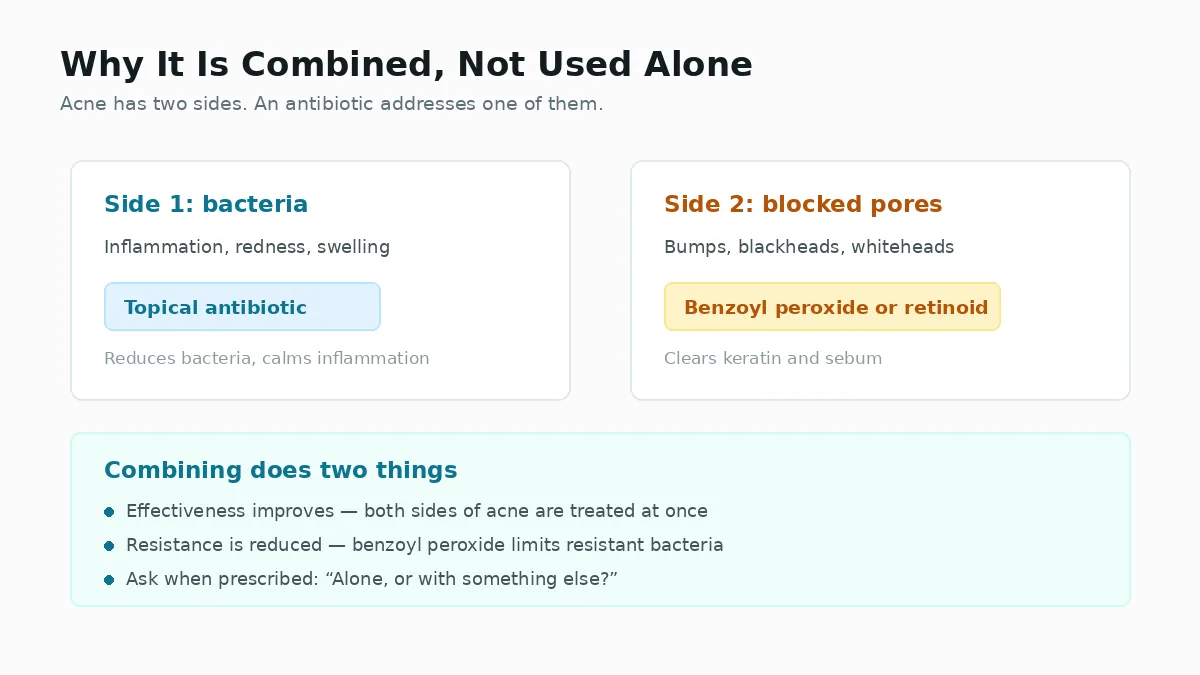
So ask when it is prescribed — “Should I use this alone, or with something else?” A good consultation answers that question.
And do not use it longer than necessary. As symptoms improve, reduce or stop according to plan.
How to use it
1. Cleanse and dry the skin completely.
Residual moisture spreads the medicine beyond the spots.
2. Dab thinly onto the spots only.
Press rather than rub. This is not applied across the whole face.
3. Wait for it to absorb — five to ten minutes. Applying something else before it dries spreads it.
4. Then apply your basic skincare.
5. Twice daily, morning and evening.
If irritation is a problem, the order can be reversed — moisturiser first, then the medicine on top. Absorption is slightly lower, irritation less. Discuss it when it is prescribed.
Do not apply it to a spot you have squeezed. That is now a wound. An unsqueezed spot responds better.
Options by age
The minimum age differs between acne ingredients.
Retinoids can be used from age 15. Below that, the options are narrower.
Topical clindamycin can be considered in that younger band. Not at 12 or under, but above that a retinoid is often not yet available, and for inflamed acne it is worth discussing.
What to combine, and how, is a conversation with the prescribing doctor. The answer changes with age, the type of acne, and what has already been tried.
What to tell the doctor
Pregnancy, possible pregnancy, or breastfeeding.
Any previous reaction to clindamycin or lincomycin.
Any history of colitis — ulcerative colitis, regional enteritis, or colitis that followed antibiotic use.
Atopic dermatitis, or a known allergy to specific ingredients.
Any acne medication you are currently using. Some combinations are avoided.
Avoid the eye area, around the mouth, and broken skin.
When to stop
Reduce as planned once symptoms improve. Applying an antibiotic out of habit is what should be avoided.
If one to two months brings no change, return for review rather than continuing. The type of acne may be different, or a different approach may be needed.
Severe acne is not treated with a topical alone. Deep, painful nodules or cysts require treatment that includes oral medication.
FAQ
Can I buy it without a prescription?
No. It is classified as prescription-only because of side effects and resistance concerns.
How long before I see a difference?
It begins working at around five days. A day or two is too early to judge.
Can I use it on acne marks?
It does not help. Marks are the remnants of inflammation that has already resolved, so there is nothing for an antibiotic to act on.
Can I apply it across my face to prevent breakouts?
Not advisable. Exposing skin that does not need it only raises the risk of resistance.
Can I use it with other acne products?
Combining is often what is recommended. But what to combine it with is a conversation with the prescribing doctor — the answer depends on age and the type of acne.
Stinging and dryness — is that normal?
Some irritation and dryness is common. Marked redness, itching or swelling is not; stop and ask.
References
- Reynolds RV, Yeung H, Cheng CE, et al. Guidelines of care for the management of acne vulgaris. Journal of the American Academy of Dermatology 2024;90(5):1006.e1-1006.e30. PMID 38300170
Disclaimer: This is general information about ingredients and routines, not a prescription or a diagnosis. Prescription medicines need an assessment and a prescription from a doctor in your own country, and the rules differ by country. Please do not start, change or stop a medicine because of an article.
Physician in non-surgical aesthetic medicine, practising in Ansan, South Korea. Every article here is written from clinical practice and the published literature.
About the author · Contact