
What’s Shurink?

A Korean lifting device, similar to Ultherapy.
So what’s different?
No live ultrasound screen, but usually quicker and cheaper.
Does it work as well?
Nobody knows, no study compares them side by side.
Ask a Korean friend where she gets her jawline tightened, and you will probably hear one word: Shurink.
Short answer:
- Shurink is a Korean focused-ultrasound lifting device made by Classys, sold abroad as Ultraformer. It works on the same principle as Ultherapy: small heat dots placed under the skin.
- The practical differences are the screen, the speed and the price. Ultherapy lets the operator see the layers live; Shurink does not, but it is quicker and usually cheaper.
- Its research is newer, smaller and shorter. No study has put the two side by side, so neither can honestly be called the stronger one.
What is Shurink?
Shurink is the Korean brand name; overseas the same machine family is called Ultraformer. The newest version, Shurink Universe, is sold abroad as Ultraformer MPT (Classys press release).
Like every device in this group, it focuses ultrasound to heat tiny points a few millimetres down, while the skin surface stays unbroken. Your body then repairs those points with firmer tissue over the following weeks.
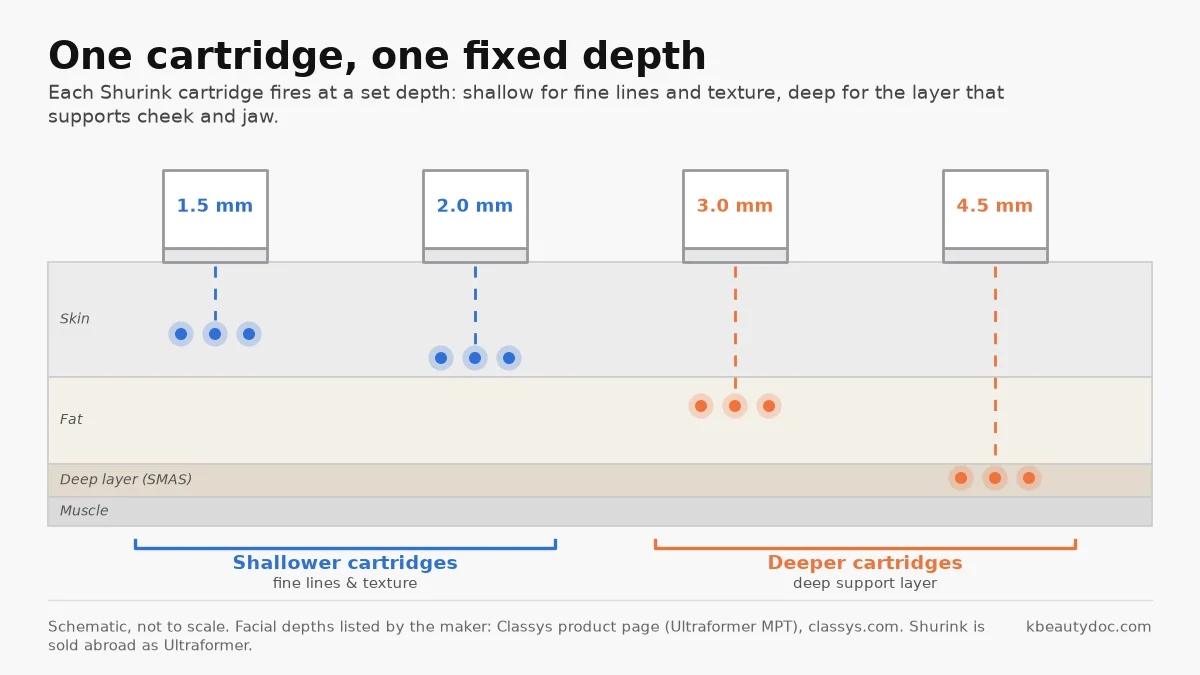
What you choose is the cartridge. Each one fires at a fixed depth. For the face, the maker lists 1.5, 2.0, 3.0 and 4.5 mm (Classys product page): shallow for fine lines and texture, deep for the firmer layer that holds the cheek and jaw.
How is it different from Ultherapy?
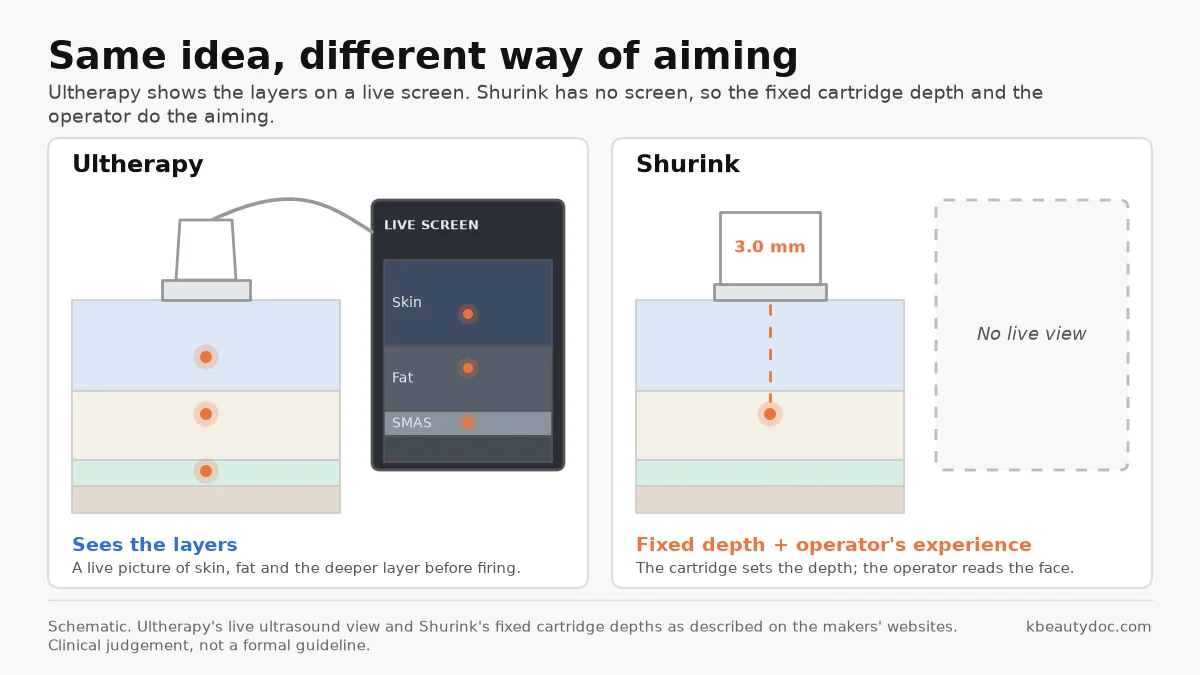
1. Seeing versus knowing. Ultherapy shows a live ultrasound picture, so the operator can check where skin ends and fat begins. Shurink has no such view — the cartridge depth is fixed, and the operator relies on anatomy and experience. On a face with unusually thin or thick layers, that matters.
2. Speed. The maker says its fast mode delivers energy about 2.5 times faster than its normal mode (product page). A full face is usually a shorter appointment.
3. Price and habit. In Korea, Shurink is typically priced well below Ultherapy, so people tend to book it more often — as upkeep rather than a once-a-year event.
4. The evidence. Ultherapy has more than a decade of studies, including a one-year follow-up. Shurink’s published work is recent:
- Upper eyelids, 34 people: a small improvement in eyelid position twelve weeks after one session. Some of the authors work for the maker [1].
- Whole face, 50 people: lift measured with a 3D scanner immediately after one session [2]. Swelling shows up as “lift” at that moment, so this cannot tell you how long anything lasts.
How long does Shurink last, and how often do people repeat it?
There is no long-term study that answers this for Shurink. Change, when it comes, builds over two to three months, as with any ultrasound lift.
Many Korean clinics suggest repeating every few months. My clinical judgement, not a proven fact: judge the result at around three months before booking the next one. Frequent deep passes on a face that is already lean is the pattern I watch most closely.
What are the side effects?
The same family, so the same list:
- Common: redness, swelling and tenderness for a few days
- Uncommon: nerve irritation — numbness, or a smile that looks uneven for a while
- Uncommon: fat loss that makes cheeks look hollow
- Rare: blisters or scarring
Most of the safety data comes from Ultherapy studies [3]; there is no large safety review of Shurink itself.
Who tends to choose Shurink?
- First-timers who want to try an ultrasound lift without the top price
- People maintaining a result rather than chasing a big change
- Anyone who wants a shorter, easier appointment
Who should think twice: anyone with a thin face (say so first), and anyone with heavy sagging — no ultrasound device replaces surgery.
Wondering how it stacks up against the other names? See the overview, Is Shurink as good as Ulthera?, and my guide to choosing a Korean clinic by device name.
FAQ
Is Shurink the same as Ultraformer?
Yes — Shurink is the name used in Korea, and Ultraformer is the export name for the same device family from the same Korean maker.
Does a Shurink session hurt less than Ultherapy?
Many patients say so, but I could not find a study comparing the two for pain. Numbing cream is standard for both.
Can I combine Shurink with other treatments on the same trip?
Often, yes, but tell every clinic what you have had. Heat treatments stacked close together on a thin face is where I would slow down.
Have a question about your own case? Ask me on LINE or by email — details on the Contact page.
References
- Hwang Y, et al. Micro-pulsed high-intensity focused ultrasound for upper eyelid laxity. JPRAS Open 2026;48:147-154. 10.1016/j.jpra.2025.10.036 (authors affiliated with the manufacturer)
- Kim JS. Three-dimensional analysis of lifting effects after high-intensity focused ultrasound (Ultraformer-MPT) across seven facial aesthetic units. Plast Reconstr Surg Glob Open 2024;12(10):e6203. 10.1097/GOX.0000000000006203
- Humphrey VS, Rambhia PH, Gmyrek R, et al. Microfocused ultrasound with visualization: a systematic review of adverse events and risk of subsequent facelift compromise. Dermatol Surg 2025;51(4):424-429. 10.1097/DSS.0000000000004510
Disclaimer: This article explains treatments in general terms and is not a diagnosis or a treatment plan. What happens varies from person to person, and no article can tell you what to expect. Please discuss your own case with a licensed medical professional where you live. I do not endorse specific clinics or device brands.
14 years in practice · replies to messages herselfPhysician in non-surgical aesthetic medicine, practising in Ansan, South Korea. Every article here is written from clinical practice and the published literature.
About the author · Contact