

What is Coolsonic?

A Korean lifting device, similar to Ultherapy.
Why ‘cool’?
It has a cooling tip, so it hurts less, the maker says.
Does it work as well?
No study compares them yet.
For many people, the hardest part of an ultrasound lift is not the bill. It is the deep ache near the jawbone.
Short answer:
- Coolsonic is a Korean focused-ultrasound lifting device from a company called Asterasys. The maker spells it CoolSoniq; clinics and patients mostly write “Coolsonic”.
- It adds two things to the usual design: a cooling system in the tip, and a slim pen-shaped head for the curves of the face.
- The maker says cooling means less pain. My search turned up no published clinical study of this device, so treat that as a promise to test, not a proven result.
What is Coolsonic?
It belongs to the same family as Ultherapy and Shurink. All of them focus ultrasound into small heat points under the skin, leaving the surface intact, and the body slowly firms those points up over the following months.
The maker lists focus depths of 1.5, 3.0 and 4.5 mm (official Korean site) — from the upper skin down to the firmer layer that supports the cheek and jaw.
What does the cooling actually do?
The tip contains what the maker calls Active Conduction Cooling, a small patented refrigeration module that chills the skin surface while the energy passes through (official site).
The idea is simple:
- The heat you want is deep. The target points sit millimetres below the surface.
- The ache and the risk of surface burns start at the top. Keeping the top layer cool may make the session easier to bear.
- The maker adds that cooling lets higher energy be used without harming the surface. That is the company’s claim; I have not seen it tested in people.
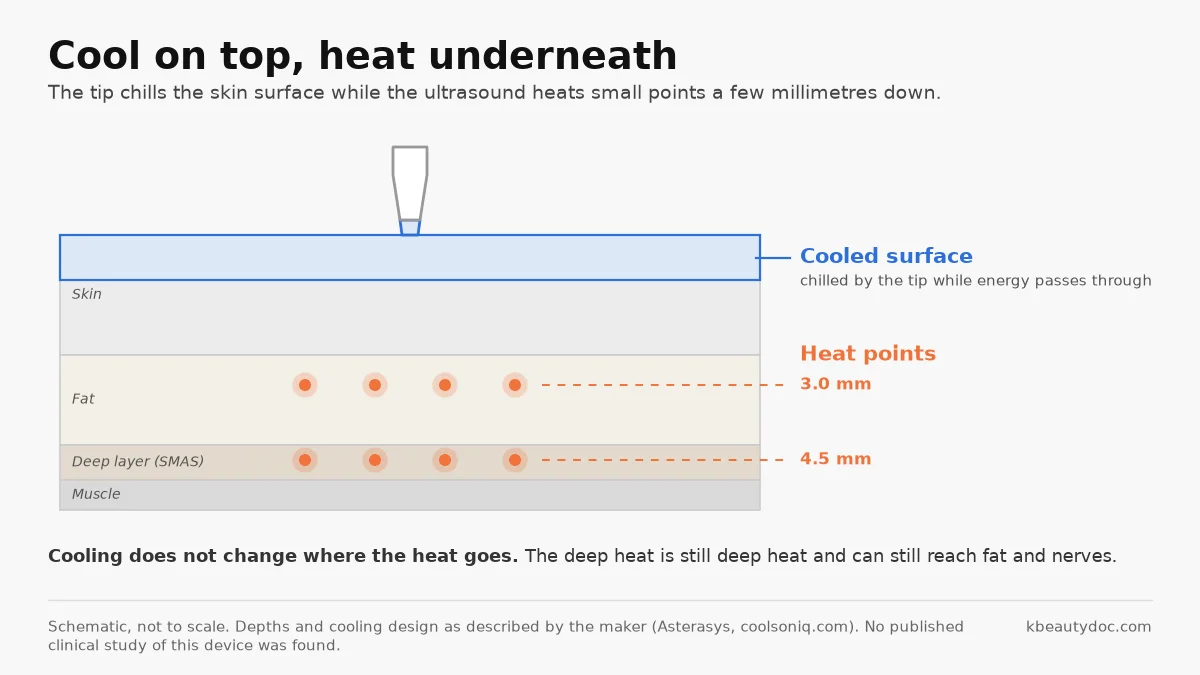
What cooling does not change: the deep heat is still deep heat. It can still reach fat and nerves, so the uncommon risks of every ultrasound lift still apply.
Why a pen-shaped head?
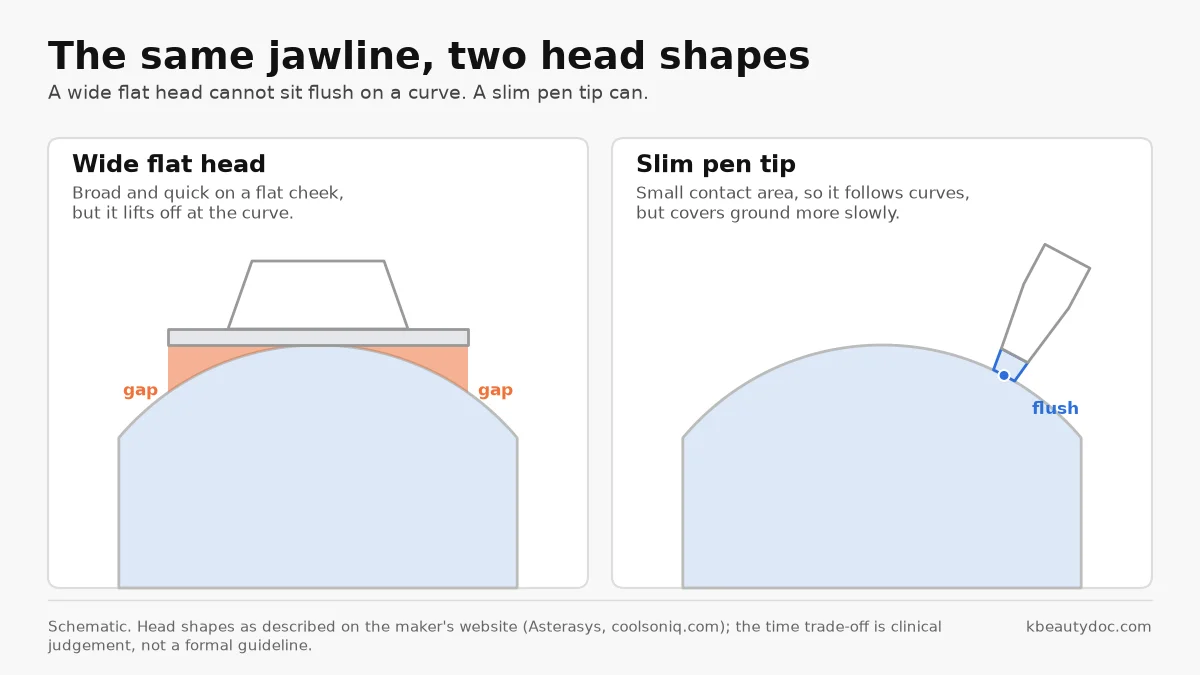
Most ultrasound lifts use a wide, flat head that fires a row of points in one go. That is fast on a broad cheek, but a flat head struggles to sit flush on a curve.
Coolsonic’s pen applicator has a small contact surface, which the maker says makes curved areas easier to treat (official site). In practice that means places like the corners of the mouth, the chin and the angle of the jaw. The trade-off is time: a small head covers a large area more slowly.
What does the research say?
Very little, so far. A search of PubMed for the device name (September 2026) returned nothing. The company’s published research is an animal study of a different machine, a cooled radiofrequency device [1] — useful for that product, not evidence for this one.
That does not mean it fails. It means nobody can tell you from data how its results compare with Ultherapy or Shurink, or how long they last.
How long does it last, and how often?
No study answers this for Coolsonic. As with its cousins, expect any change to build over two to three months.
My clinical judgement, not a proven fact: treat a first session as a trial, compare photos at about three months, and only then decide whether to repeat.
What are the side effects?
- Common: redness, swelling and tenderness for a few days
- Uncommon: nerve irritation — numbness, or a smile that looks uneven for a while
- Uncommon: loss of fat, leaving cheeks looking hollower
- Rare: blisters or scarring
Those come from the much larger research on Ultherapy [2]; there is no separate safety data for Coolsonic. Mention a thin face before you start.
Who might choose Coolsonic?
- People who found another ultrasound lift too uncomfortable
- Anyone focused on small or curved areas rather than the whole face
- Patients who accept a newer device with less research behind it
For how all four machines line up, see Is Shurink as good as Ulthera?
FAQ
Is Coolsonic the same as CoolSoniq?
Yes. CoolSoniq is the maker’s spelling; Coolsonic is how most clinics and patients write it.
Will the cooling mean I feel nothing?
No. Cooling is meant to take the edge off the surface sting; the deep ache can still be felt, and numbing cream is still used.
Is it better than Ultherapy?
Nobody knows yet. There is no head-to-head study, and Coolsonic has no published clinical trials so far.
Have a question about your own case? Ask me on LINE or by email — details on the Contact page.
References
- Goo H, et al. Enhancement of collagen and elastic fibers by direct contact cooling-based monopolar radiofrequency in a minipig model. Clin Cosmet Investig Dermatol 2026;19. 10.2147/CCID.S600858 (animal study of a different device; authors from the manufacturer)
- Humphrey VS, Rambhia PH, Gmyrek R, et al. Microfocused ultrasound with visualization: a systematic review of adverse events and risk of subsequent facelift compromise. Dermatol Surg 2025;51(4):424-429. 10.1097/DSS.0000000000004510
Disclaimer: This article explains treatments in general terms and is not a diagnosis or a treatment plan. What happens varies from person to person, and no article can tell you what to expect. Please discuss your own case with a licensed medical professional where you live. I do not endorse specific clinics or device brands.
14 years in practice · replies to messages herselfPhysician in non-surgical aesthetic medicine, practising in Ansan, South Korea. Every article here is written from clinical practice and the published literature.
About the author · Contact