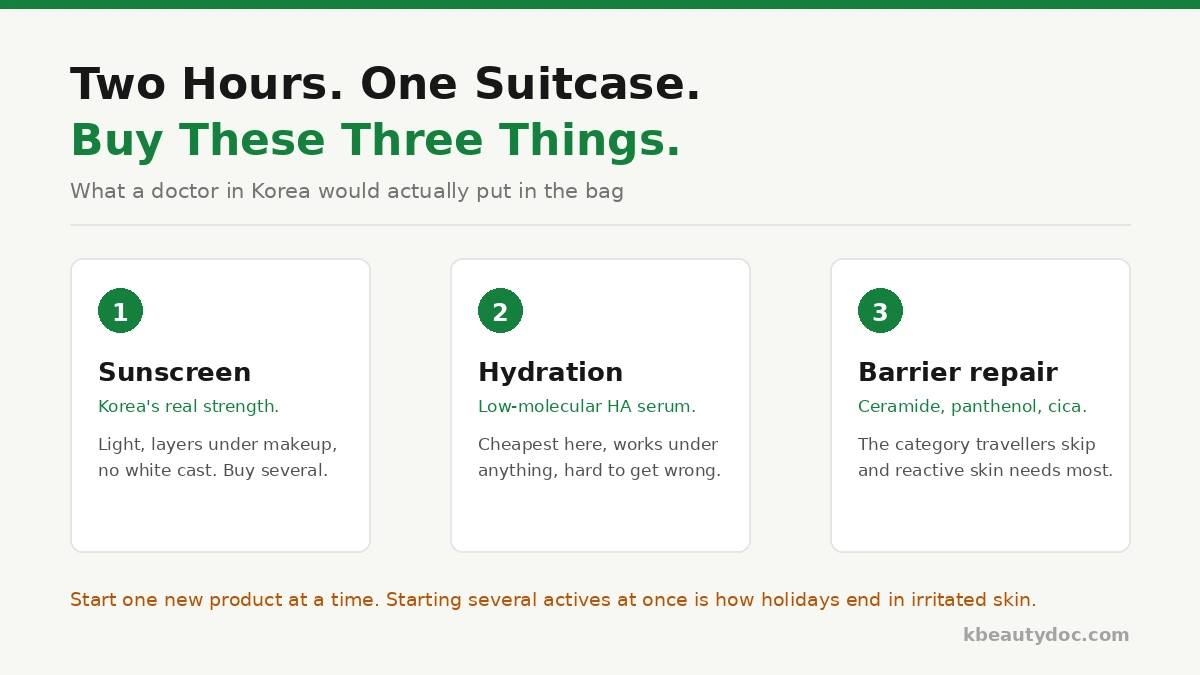
You have a suitcase to fill and about two hours. Here is the short version: buy hydration, barrier repair and sunscreen — those are the categories where Korean products are genuinely good and genuinely cheaper here. Be selective about actives. And understand what a home beauty device can and cannot do before you spend 300,000 won at the airport.
I am a doctor practising aesthetic medicine in Korea, and I see the aftermath of shopping trips — usually irritated skin from three actives started on the same day. So this is what I would tell a patient, not a haul list.
Where to shop, and what each is for
| Where | What it is | Best for | Price level |
|---|---|---|---|
| Olive Young | The dominant health & beauty chain, and the default stop for foreign visitors | Full range, testers, tax refund, English signage | Mid |
| Daiso | Ultra-low-price variety chain whose beauty section has grown sharply | Basics, backups, trying a texture before committing | Very low |
| Brand flagship stores (Myeongdong, Hongdae) | Single-brand stores | Full line, staff who know the products | Mid |
| Duty free / airport | Cosmetics and beauty devices | Devices specifically, where the saving is real | Varies |
Olive Young and Daiso together turn over more than Korea’s major department store groups combined. This is not a niche — it is mainstream retail here.
What is genuinely worth buying
I would organise a purchase by what the product does, not by brand.
Hydration — the strongest category. Low-molecular hyaluronic acid serums are Korea’s most reliable export and cheaper here than anywhere. Torriden’s Dive-In serum is a consistent bestseller for a reason: well formulated, cheap, layers under anything.
Barrier repair — the most underrated. Ceramide, panthenol and centella (Cica). If your skin is reactive, stripped or recovering from a treatment, this category changes how it behaves — and it is the one most travellers skip for something more exciting.
Sunscreen — the real reason to fill your case. Korean and Japanese sunscreens have a cosmetic elegance Western equivalents mostly have not matched: light, layering under makeup, no white cast. Buy several — this does more over ten years than every serum in your bag.
Brightening actives — selectively. Niacinamide is well tolerated and worth having. For pigmentation, tranexamic acid formulations are increasingly common here and have reasonable support. Start one at a time.
Sheet masks — for what they are. A pleasant, hydrating, occlusive twenty minutes. Not a treatment. Buy them as a treat, not a plan.
Four baskets, by skin type
Same shelf, different list. General guidance, not a prescription for anyone.
- Oily. A gel or light lotion sunscreen, a hydrating serum without oils, one niacinamide product. Skip rich creams — oily skin is often short of water rather than oil.
- Combination, dry cheeks with an oily T-zone. The most common description I hear, and the most over-bought. One barrier cream for the cheeks, one light sunscreen for the whole face, and nothing promising to “control” oil, which usually means stripping it.
- Dry. Ceramide cream first, hydrating serum underneath, and a cleanser that leaves skin comfortable rather than squeaky.
- Sensitive or easily reddened. Centella and panthenol, fragrance-free where you can find it, one new product at a time so you can tell what caused what.
- Acne-prone. A non-comedogenic sunscreen, one gentle exfoliating acid, and no second acid stacked on it.
Daiso: where the low price works well
Reasonable to buy at Daiso: basic hydrating toners, sheet masks, cotton pads and tools, cleansing basics, travel containers. Simple formulas do not need a premium price. The same holds one shelf over, where a Daiso cleansing foam and an Olive Young one differ less than their prices do, and where soothing and acid toner pads are not one product.
A practical use: buy a texture at Daiso to find out whether you like it before buying the expensive version.
Spicule and microneedle products — read this before you buy
A category of Korean products suspends microscopic spicules — often sponge-derived — in a serum. Marketed as “needle” products, they open micro-channels in the surface to aid penetration, and they are extremely popular with visitors. They do something, which is precisely why they need care.
What I tell patients: these are not hydrating serums. Start at a low frequency, not on the same day as retinoids, acids or vitamin C, and not on skin that is already irritated — and not at all in the days around a clinic procedure. The tingling people read as proof it is working is mechanical irritation: some is expected, persistent stinging or redness means stop.
The numbers on these bottles — 100, 300, 700 — are a schedule rather than a ranking, and buying the highest first is the common mistake. I have written separately on how to use each number, and how clinic spicule peeling differs.
Beauty devices at duty free — the honest assessment
This is where I get the most questions, and where marketing is furthest ahead of the explanation.
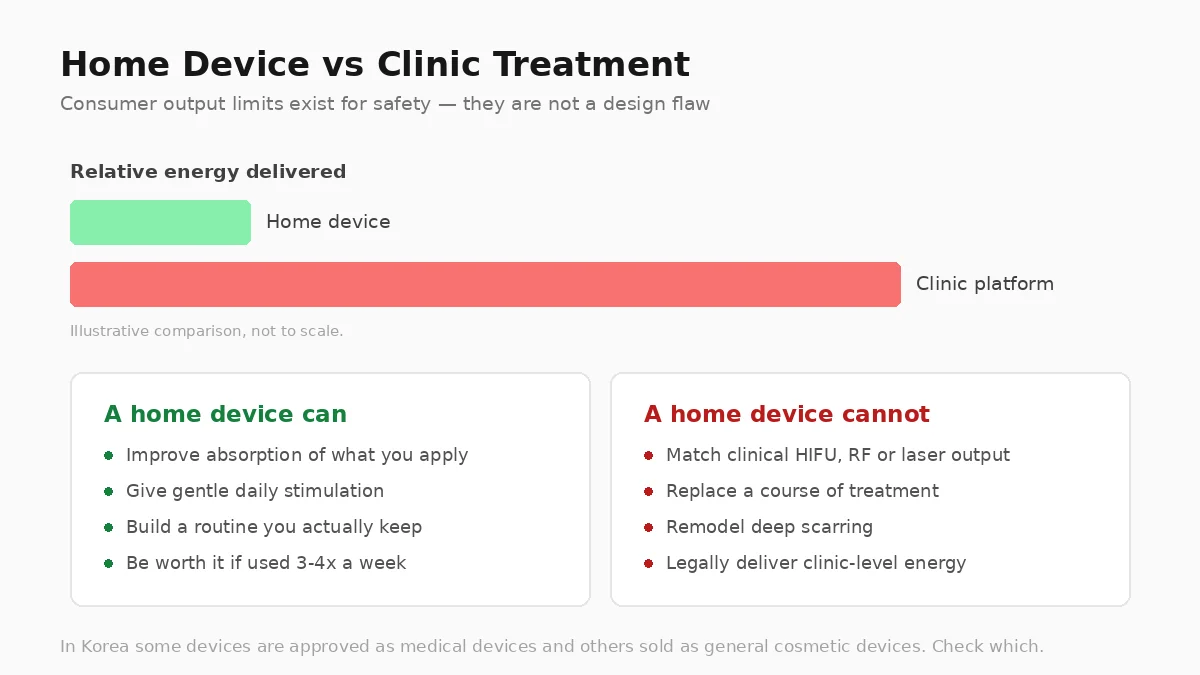
Home beauty devices are now a major duty-free category — retailers report device brands at the top of their own rankings, and forecasts have the category growing several-fold this decade. I could not verify those figures against a primary source, so treat them as trade reporting rather than data.
What home devices genuinely do. Improve absorption of what you apply, give gentle daily stimulation, and build a routine you keep — which over months matters more than most single treatments. Microcurrent, low-level EMS and LED are the common technologies, safe at consumer output levels.
What they do not do. Reproduce a clinic treatment. A home device at consumer-safe output does not deliver the energy density of a clinical HIFU, RF or laser platform, and is not supposed to — those limits exist because unsupervised high-energy delivery to the face is dangerous.
The distinction to check before buying. In Korea some devices are approved as medical devices and others sold as general cosmetic devices, and the two face different requirements for proving what they claim. Read the box rather than assuming the category is uniform.
My practical view: if you will use it three or four times a week for a year, a home device is a reasonable purchase and duty-free pricing makes it better. If you are buying because a video suggested it replaces a procedure, you will have spent clinic money on a gadget.
What I would skip
Anything promising to replace a procedure. Multi-step routines bought all at once — you cannot tell what caused a reaction if you started six products on Tuesday. And a second exfoliating acid when you already own one. Body products are the exception worth a bag: a grain scrub soap costs almost nothing, though the Italy towel versus the foam glove is where the damage is decided.
If you have had a treatment while in Korea
After laser, RF microneedling or injectables, your barrier is compromised and the priority is recovery, not improvement — this matters most on a short trip, where pigment treatment and a flight home share the same fortnight.
For the first several days: gentle cleanser, a bland barrier cream, sunscreen. Nothing with acids, retinoids, vitamin C or spicules, and no new products — this is not the week to test a haul. Sun protection is not optional: pigmentation after energy-based treatment is largely preventable, and largely caused by exposure in the days afterwards.
FAQ
Is Olive Young cheaper than buying Korean brands abroad?
Usually yes, and the range is wider. Tax refund is available above a minimum purchase — bring your passport. Some products are unavailable outside Korea.
Is Daiso worth a stop?
Yes, particularly for basics, tools and travel containers, and as a cheap way to try a texture.
Are duty-free beauty devices worth it?
If you will use it consistently, yes — the duty-free price advantage is real. If you expect clinic-level results, no. Output limits exist for safety.
Can I use a spicule serum after a clinic treatment?
No. Wait until skin has recovered — at least a week after a gentle treatment, longer after resurfacing. Ask the clinic that treated you.
What is the single best purchase for most people?
Sunscreen, then a hydrating serum, then a barrier cream. Not exciting, but it is what produces visible skin quality over a year.
Disclaimer: I write about cosmetics and shops as general information, not as a recommendation of any particular product or retailer. I receive no sponsorship, samples or payment from the brands mentioned. Skin responds differently from person to person, so patch test anything new, and see a doctor about a skin condition.

Physician in non-surgical aesthetic medicine, practising in Ansan, South Korea. Every article here is written from clinical practice and the published literature.
About the author · Contact