Three things to know first
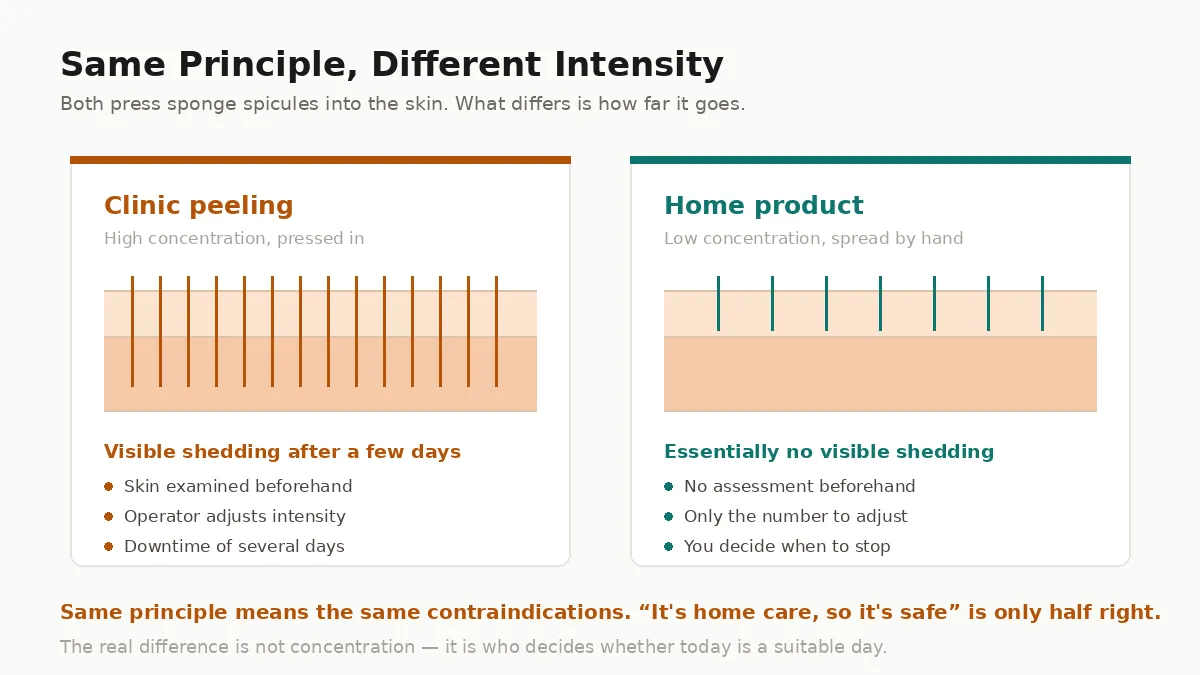
- Clinic spicule peeling and Reedle Shot are the same principle — sponge spicules pressed into the skin.
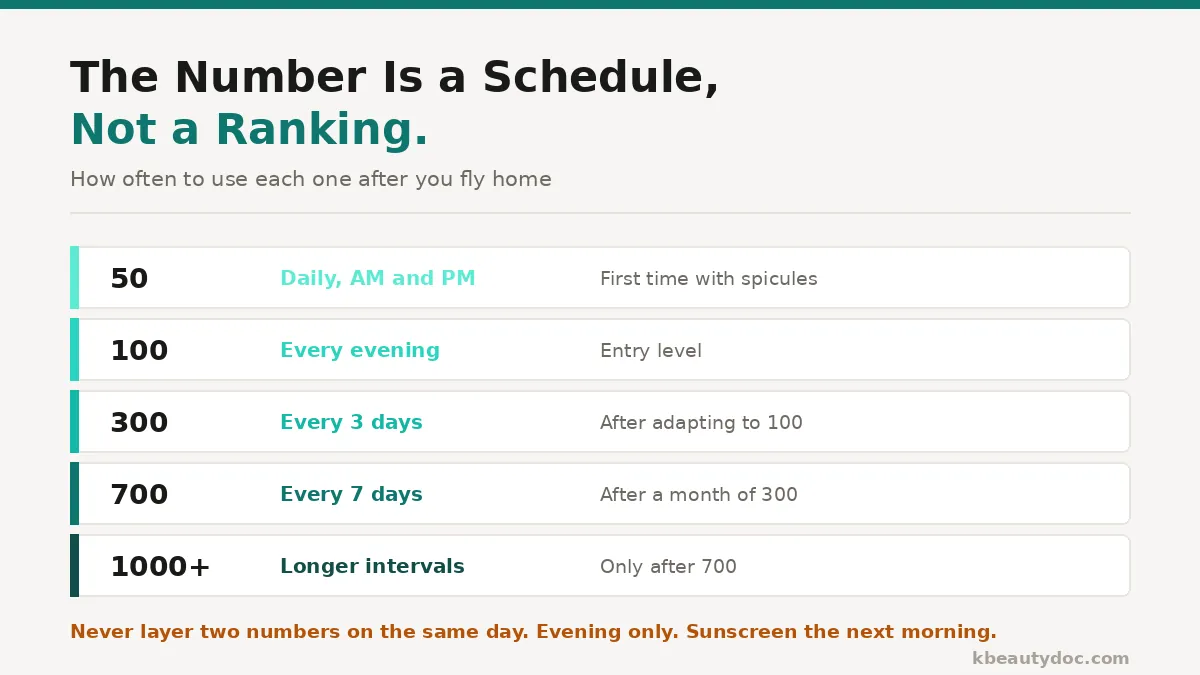
- The number is a schedule, not a ranking. 100 daily, 300 every three days, 700 every seven.
- Start low. The most common accident is buying 700 and using it straight away.
If you already bought it, here is how to use it
| Product | How often | Intensity | Suits |
|---|---|---|---|
| 50 | Morning and evening, daily | Very low | First time with spicules, thin or reactive skin |
| 100 | Evening, daily | Low | Entry level, healthy skin |
| 300 | Every three days | Moderate | After adapting to 100 |
| 700 | Every seven days | Strong | After a month or more of 300 without problems |
| 1000 and above | Longer intervals | Very strong | Only after adapting to 700 |
The number is essentially the interval. That is the easiest way to understand this product line.
Evening only. On a clean bare face after cleansing, pressed rather than rubbed. Avoid the eye and lip areas.
Never layer two numbers on the same day. Applying 100 and 700 together is not a way to adjust concentration.
Follow with soothing and moisturising. And sunscreen the next morning is not optional. If you are buying the bottle on the trip itself, Olive Young, Daiso and duty-free stock different things.
That is the practical answer. If you want to know why, keep reading.
What a spicule actually is
A microscopic needle from the skeleton of a sea sponge. Too small to see, and sharp.
Applied to the skin and pressed, these needles embed in the stratum corneum. Two things then happen.
First, channels open. The stratum corneum normally blocks most ingredients. Micro-openings mean whatever you apply alongside penetrates more readily.
A Korean laboratory study found that adding purified spicules to a niacinamide product made roughly two to three times as much of it pass through a test membrane [1]; a separate laboratory study of needle-shaped particles reached the same conclusion [2]. That is measured data rather than a marketing claim, though it was measured on an artificial membrane, not on a face.
Second, the skin reacts. A foreign body has embedded itself, so the skin works to expel it. Turnover accelerates, and the spicules leave along with old keratin and aged epidermal cells.
So this is simultaneously a delivery enhancer and a physical peel. Both are happening.
Clinic peeling and Reedle Shot are the same thing
This is the central point of the article.
Spicule peeling — known in Korea as seaweed or herbal peeling — has been used in clinics and skin studios for acne and problem skin for years. The method: a large quantity of spicules is pressed into the skin, the startled dermis accelerates its renewal, and it pushes out the spicules along with accumulated dead skin.
Reedle Shot is that same principle, reduced to a home-use strength.
It is not a different category of treatment. It is a milder version of the same thing. Which means “it’s home care, so it must be safe” is only half right — the same principle carries the same contraindications.
The difference you can see
After clinic peeling, the skin visibly sheds. Several days later the surface whitens and flakes away. This is the skin expelling the embedded spicules, and during that period going out or wearing makeup can be uncomfortable.
Reedle Shot does not produce that. It refines surface keratin, but there is usually nothing you would describe as visible peeling.
Visible shedding means the treatment reached further and wider — and that recovery time is required.
What else differs
| Clinic peeling | Reedle Shot | |
|---|---|---|
| Spicule concentration | High | Low |
| Pressure | Pressed in by the operator | Spread by hand |
| Assessment beforehand | Skin is examined first | None |
| Intensity control | Adjusted by the operator | Only by product number |
| Visible shedding | Yes, keratin flakes away | Essentially none |
| Downtime | Redness, shedding, stinging for days | Mild tingling |
| Deciding to stop | The operator decides | You have to decide |
The most important difference is not concentration or pressure — it is who makes the judgement.
In a clinic, someone examines your skin and decides whether today is a suitable day. At home, you make that call yourself. And most people do not know whether their skin is currently in a state to receive spicules.
Moving up a level
Stay at each level for at least four weeks. A few applications does not tell you whether your skin has adapted.
Conditions for moving up: four weeks or more at the current level and interval, no redness the next day, and stinging only during application.
Signs to step back down: redness persisting into the next day, excessive flaking, burning or stinging lasting hours, or an increase in breakouts.
Signs to stop entirely: weeping, swelling, or significant itching. Stop the product and wait until the skin recovers. Even after recovery, restart at a lower level.
Raising the number does not raise the benefit proportionally. Beyond what your skin tolerates it is not improvement but damage.
When not to use it at all
This list applies to both clinic peeling and home products. Same principle, same contraindications.
Thin or reactive skin. Spicules breach the stratum corneum, and in thin skin the damage is proportionally greater.
Pustular acne. Adding physical trauma to inflamed tissue makes it worse.
Atopic dermatitis or other inflammatory skin conditions. The barrier is already compromised.
Immediately after any clinic procedure or device treatment. After laser, peeling, microneedling or injectables, wait until the barrier has recovered — at least a week after a gentle treatment, longer after resurfacing.
Immediately after high-strength retinol or vitamin C. Do not combine on the same day. The same goes for an acid pad — a soothing pad and an acid pad follow different rules, and only one of them stacks with a spicule.
When skin is already red or stinging. Today is a rest day.
One more if you are travelling. If you came to Korea for a procedure, do not use these around the appointment. Ask the treating clinic when you may resume.
When you need a clinic instead
Some things this cannot do.
Deep acne scarring. Breaching the stratum corneum does not fill a structural defect in the dermis; that is the territory of RF microneedling, fractional lasers and peels.
Pustular acne. This needs treatment, not physical stimulation.
Melasma. Irritation can worsen it.
No change after three months. The problem may be a different kind.
The dividing line is simple. If surface keratin and texture are the problem, home care is enough. If the problem is depth, home care will not reach it.
FAQ
Is a higher number better?
No. The number is intensity, not quality, and benefit only occurs within what your skin tolerates.
Will using it daily work faster?
No. 100 is formulated for daily use; 300 and 700 are not. The interval accounts for recovery time.
Can I use two numbers together?
No. Layering them on the same day is not a way to fine-tune concentration.
Can I use it in the morning?
Apart from 50, use it in the evening. UV after irritation raises the risk of pigmentation.
I had clinic peeling — can I also use Reedle Shot?
Wait until you have recovered. Otherwise you are stacking the same kind of irritation.
Will my skin peel like it does after clinic treatment?
No. Clinic peeling produces visible shedding; home products generally do not. Not shedding does not mean nothing is happening.
Does stinging mean it is working?
Stinging is physical irritation. Mild tingling during application is expected; stinging for hours or redness the next day means the intensity is too high.
References
- Han DS, Kim GS, Kang SM. Journal of the Korean Society of Cosmetology 2020;26(4):886-896. Full text (PDF)
- Shin CI, Kim M, Kim YC. Delivery of niacinamide to the skin using microneedle-like particles. Pharmaceutics 2019;11(7):326. doi:10.3390/pharmaceutics11070326
Disclaimer: I write about cosmetics and shops as general information, not as a recommendation of any particular product or retailer. I receive no sponsorship, samples or payment from the brands mentioned. Skin responds differently from person to person, so patch test anything new, and see a doctor about a skin condition.

Physician in non-surgical aesthetic medicine, practising in Ansan, South Korea. Every article here is written from clinical practice and the published literature.
About the author · Contact