Four things to know first
- Three routes go to the same place: injectables, threads, laser.
- The pore did not get bigger. The skin holding it lost support.
- So the answer is not tightening the pore — it is rebuilding the dermis.
- Standard session counts assume you live nearby. On a trip, the strategy changes.
A 30-second self-check
Try this in front of a mirror.
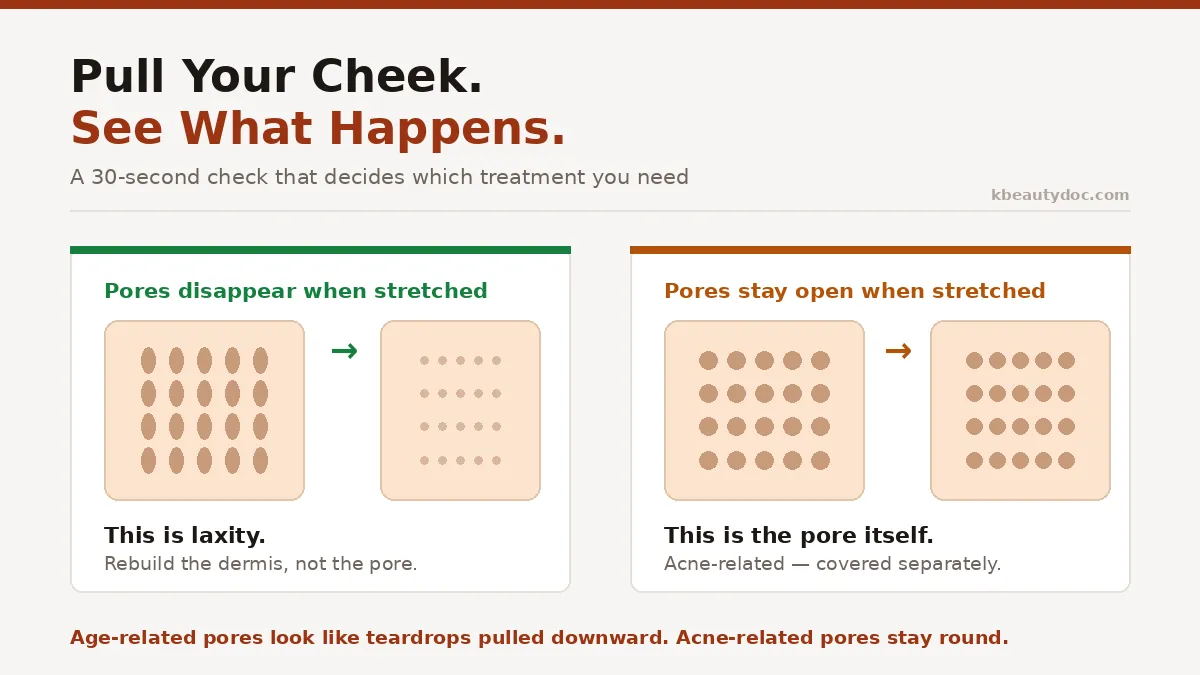
Pull the skin of your cheek sideways with your fingers.
If the pores largely disappear — this is laxity. The pores are unchanged; the skin around them has slackened, so they gape. That is what this article covers.
If they stay round and open even when stretched — the pore itself is the problem. This is usually related to acne or oil, and the approach is different.
Look at the shape too. Age-related pores appear teardrop or oval, pulled downward. They are most noticeable on the cheeks and look worse standing up or looking down. Acne-related pores stay round.
So what should you do?
Consider treatment that rebuilds the dermis, rather than anything aimed at the pore itself — the target is the supporting tissue around it.
One session is not the whole treatment. Every method assumes a course — but those session counts assume you live nearby. If you are visiting, see the strategy section below.
Pores do not disappear. The goal is making them less visible. Accepting that first prevents disappointment later.
Sunscreen matters here too. UV is the largest single cause of dermal collagen breakdown. Building collagen while destroying it daily leaves you where you started.
That is the practical answer. If you want to know why, keep reading.
Why pores sag with age
A pore is not a hole punched in the skin. It is a channel held open by the tissue around it.
In young skin, dense collagen and elastic fibres in the dermis keep the opening taut, so it stays small and inconspicuous.
With age that collagen declines — UV, time and hormonal change all contribute.
The pore did not enlarge; what was holding it gave way, so it gapes and stretches in the direction of gravity.
Which is why “tightening the pores” misses the cause. The problem is not the pore. It is what surrounds it.
The consultation that is hardest to have
Clinical observation. People often arrive with the treatment already chosen. A few pages online turn the answer into “pores means Fraxel”; Instagram turns it into “pores means skin botox”. Both are real treatments with their own uses, but neither is where the question starts. If your pores flatten when you stretch the skin, what changed is the collagen underneath, and a plan that puts nothing back into the dermis is aimed at the wrong layer. The hard part of that consultation is not medical — it is asking someone to set aside an answer they arrived confident about.
Three routes, one destination
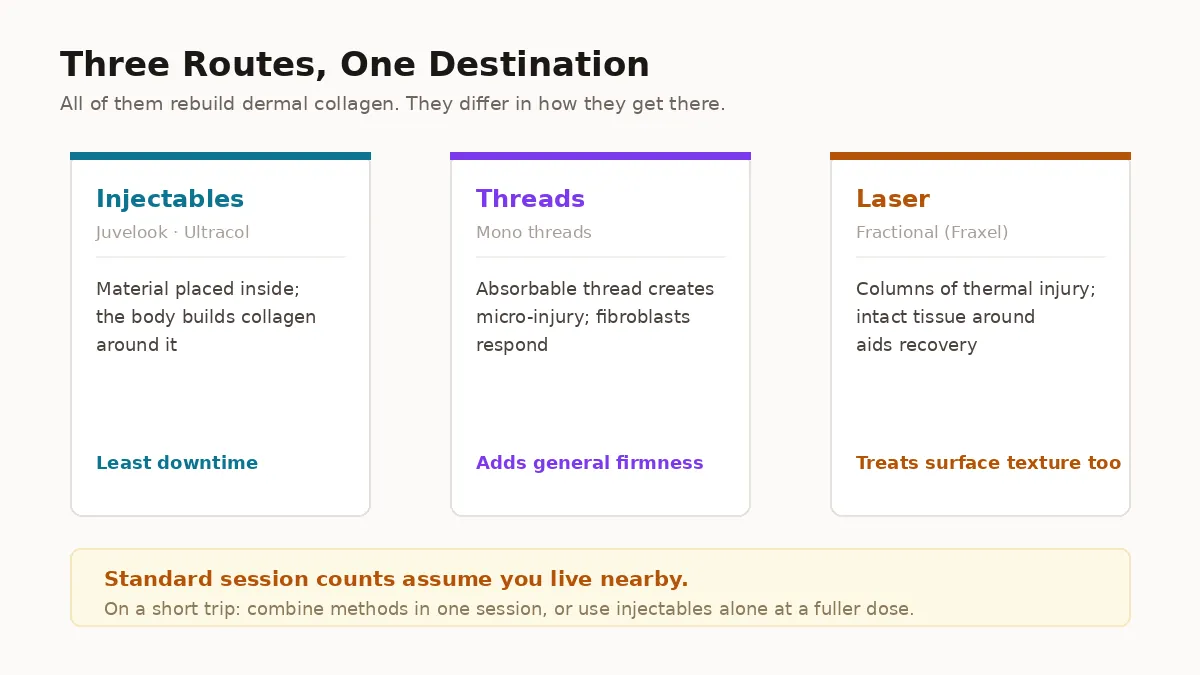
All three aim to rebuild collagen in the dermis. They differ only in how they get there.
Injectables — supplying the material from within
Juvelook combines PDLLA microparticles with hyaluronic acid. The HA gives immediate hydration while the PDLLA prompts collagen formation over subsequent weeks.
Ultracol is polydioxanone in microparticle form, sometimes called “liquid thread” — the same material used in thread lifting, delivered by injection instead. Collagen forms gradually from around four weeks, and three or more sessions at monthly intervals is the usual recommendation. That schedule assumes someone living locally.
What they share — the body responds to the material by building collagen at that site, so results appear over weeks to months.
Threads — mechanical stimulus and scaffold
Mono threads have no barbs. Unlike cog threads, the aim is not to pull tissue but to improve firmness and fine lines.
Placing an absorbable thread in the dermis creates deliberate micro-injury, activating fibroblasts that produce more collagen and elastin.
The thread is eventually absorbed, but the collagen structure built during that process remains. Duration is generally described as around six months.
Materials include PDO, PLLA and PCL, which affects how long it lasts.
Laser — heat-driven remodelling
Fractional lasers such as Fraxel create microscopic columns of thermal injury. Because the surrounding tissue is left intact, it assists recovery — the basis of the fractional approach.
During that recovery, dermal collagen is remodelled and newly formed, and surface texture improves alongside.
There is downtime. Redness and flaking last several days. Ablative and non-ablative devices differ considerably in recovery time, so confirm which is planned.
If you are visiting — the strategy changes
Three sessions at monthly intervals assumes you live in Korea. For someone staying a few days, that plan was never available.
Having one session, flying home and returning months later does not produce a course — it produces isolated single sessions. Collagen response builds when stimulus accumulates, and it does not accumulate across long gaps.
So visitors need a different approach. There are two routes.
Combine methods in a single session
If you cannot increase the number of sessions, you can use different mechanisms within one session.
A fractional laser delivers thermal stimulus from above, while a collagen-stimulating injectable works from within. The two routes do not overlap, so they can be combined.
The trade-off is downtime. Redness and swelling can last longer than either treatment alone. Schedule it at least five to seven days before you fly, and preferably early in the trip.
Or injectables only, at a fuller dose
If your schedule is tight, or photographs make redness unacceptable, skipping the laser and using injectables alone is reasonable.
In that case a more generous amount is placed in the single session — with no opportunity to build up across visits, the aim is as much stimulus as one session safely allows.
But it cannot be increased indefinitely. Excessive volume raises the risk of nodules and lumpiness, and how far is safe depends on your skin — so say at the consultation that you only have a few days. That information changes the plan.
And after you get home
Fractional lasers are available in most countries. Starting in Korea and continuing locally is realistic.
Collagen-stimulating injectables also have equivalents elsewhere. The brand names differ; the category does not.
Record what you had and how much. For a doctor at home, that is the starting point.
Choosing between them
None of them is superior in general. It depends on your situation.
If you cannot take downtime, injectables are easier — shorter redness, faster return to normal.
If you want surface texture addressed too, laser has the advantage — it treats fine lines and texture alongside pores.
If general laxity is also present, threads are worth considering.
Combining is common. But overlapping treatments accumulates irritation, so spacing and order should be discussed with the clinic.
Realistic expectations
It takes time. Collagen formation needs weeks to months. Judging from the mirror the next morning is meaningless.
Maintenance is required. Collagen you build declines over time.
And sun protection is decisive. UV is the main destroyer of dermal collagen.
What to ask at consultation
“Is this a laxity problem or a pore problem?” The answer determines everything else.
“How many sessions, and what is the total cost?” In writing.
“How many days of downtime?” Essential if you have plans.
“When will you reassess?” If nobody mentions reviewing the result in a few months, nobody plans to check.
FAQ
Can pores be removed completely?
No. Pores are normal skin structure. The goal is making them less noticeable.
Can skincare do this?
Surface exfoliation and hydration can make pores temporarily less visible, but where the cause is dermal collagen loss, topical products cannot reverse it.
Can I have several treatments together?
Combining is common, but timing and order matter. Overlapping accumulates irritation — discuss it with the clinic.
I only have a few days — is it worth it?
Yes, but the plan changes. Either combine methods in one session, or if downtime is unacceptable, use injectables alone at a fuller dose. Tell the clinic how long you have.
How long do results last?
It varies by method and individual. Collagen built also declines over time, so maintenance treatment becomes a consideration.
Does this work for acne-related pores?
The approach differs. Pores widened by oil are covered in a separate article, and acne treatment itself here.
Disclaimer: This article explains treatments in general terms and is not a diagnosis or a treatment plan. What happens varies from person to person, and no article can tell you what to expect. Please discuss your own case with a licensed medical professional where you live. I do not endorse specific clinics or device brands.

Physician in non-surgical aesthetic medicine, practising in Ansan, South Korea. Every article here is written from clinical practice and the published literature.
About the author · Contact