Three things to know first
- Toner pads are completely different products by ingredient family. They just share a shelf.
- Acid pads are a two-or-three-times-a-week thing. Daily use damages the barrier.
- The same pad exfoliates when you wipe and hydrates when you leave it on.
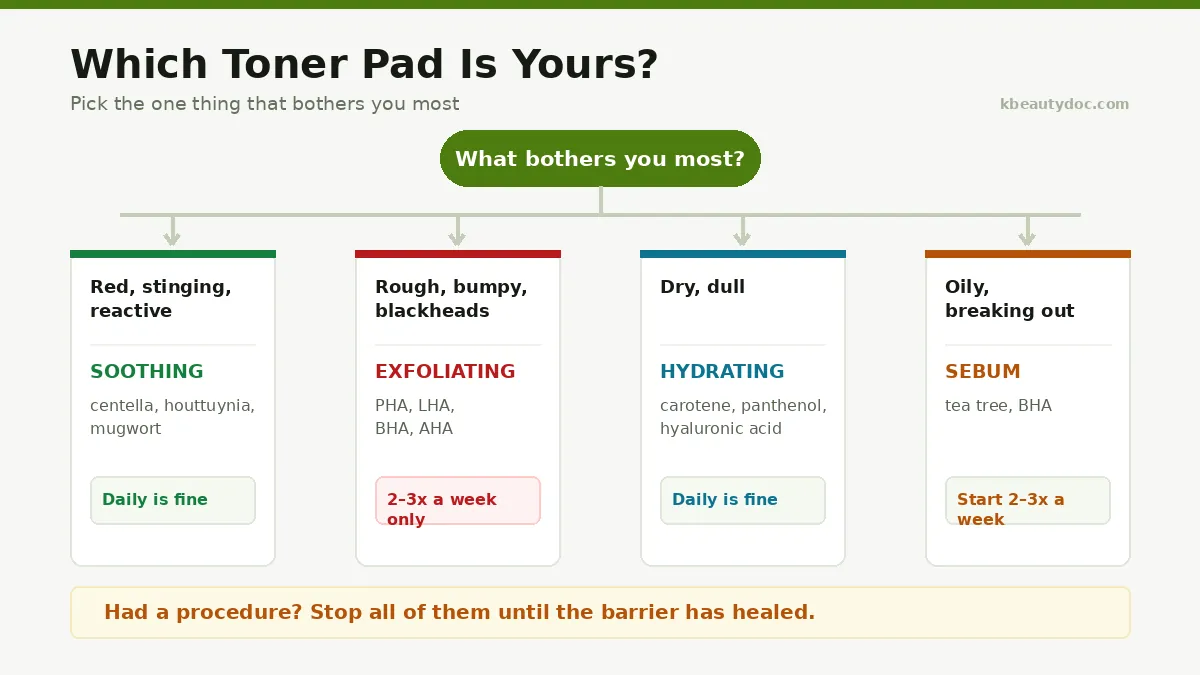
A 30-second guide
Pick the one thing that bothers you most.
Red, stinging, reactive → Soothing — centella, houttuynia, mugwort → Daily is fine
Rough, bumpy, blackheads → Exfoliating — PHA, LHA, BHA, AHA → Two or three times a week only. This is the most important line in the article.
Dry, dull → Hydrating — carotene, panthenol, hyaluronic acid → Daily is fine
Oily, breaking out → Sebum-focused — tea tree, BHA → Start at two or three times a week and watch how skin responds
If you have had a procedure → stop all of them until healed.
That is the practical answer. If you want to know why, keep reading.
Why does Korea have so many of these?
The number on the shelf is overwhelming. There is a reason, and it is not that Koreans need more pads.
Layering culture created the slot. Korean skincare has many steps — toner, essence, serum, ampoule, lotion, cream — and people want fewer steps, not fewer results. A toner pad combines toner, light exfoliation and a small mask in one jar.
The manufacturing base makes it easy. Korea has a deep bench of contract manufacturers, so a brand does not need a factory. Pads have a low technical barrier — formulate a liquid, saturate a nonwoven — so they are the fastest category to launch. There are as many pads as brands.
One retailer functions as the proving ground. Stores nationwide, online in one channel, annual awards ranking the results: success in a category pulls everyone else into it. One pad winning five years running is enough to make every brand launch one.
And the climate rewards the format. Seasons swing between humid summers and dry winters, and a pad is easy to swap seasonally — acids in summer, hydration in winter.
So the abundance is normal. The differences are not meaningless — you just choose by the ingredient list, not the shelf.
What a toner pad actually is
A pad soaked in liquid. That is the whole format.
But what is in the liquid makes it a completely different product. A soothing pad and an acid pad have nothing in common except the cotton.
And yet they sit side by side. Similar packaging and price, so people treat them as one category — where the trouble starts.
The ingredient families
Soothing — centella, houttuynia, mugwort
Aimed at calming redness and heat. Low irritation, so daily use is fine.
When it fits — reactive periods, changing seasons, after any irritation.
What to expect — comfort and calm. These do not remove keratin or shrink pores.
Exfoliating — PHA, LHA, BHA, AHA
This is where most of the misunderstanding lives.
Acids loosen the bonds between skin cells so accumulated keratin sheds; the surface smooths and pores block less.
But this is not a daily activity. The stratum corneum is a wall. Strip it every day and the wall thins — skin becomes reactive, dry, and often breaks out more. Sun protection stops being optional once acids are in the routine, and Korean and Western labels differ.
Two to three times a week. That is the standard.
The acids differ. PHA has larger molecules, works slowly and is gentlest. AHA works on surface keratin. BHA dissolves in oil and reaches inside the pore. LHA is in the BHA family but gentler.
If this is new to you, start with PHA.
Hydrating — carotene, panthenol, hyaluronic acid
Replenishing water and settling texture. Daily use is fine.
Carrot (carotene) pads are the emblem of this category. Skinfood’s carrot pad is the one people name: the brand reports it past 12 million units, and it has taken the Olive Young Awards pad category five years running. Both figures come from the brand and the retailer, not from an independent audit.
When it fits — dry seasons, after a flight, after long exposure to heating or air conditioning.
Sebum-focused — tea tree, BHA
Aimed at controlling oil and calming breakouts.
If it contains BHA, treat it as an exfoliating pad. A tea tree pad and a BHA pad follow different frequency rules. Check the ingredient list.
Wiping versus leaving on
Korea uses toner pads two ways, a distinction unfamiliar to most visitors.
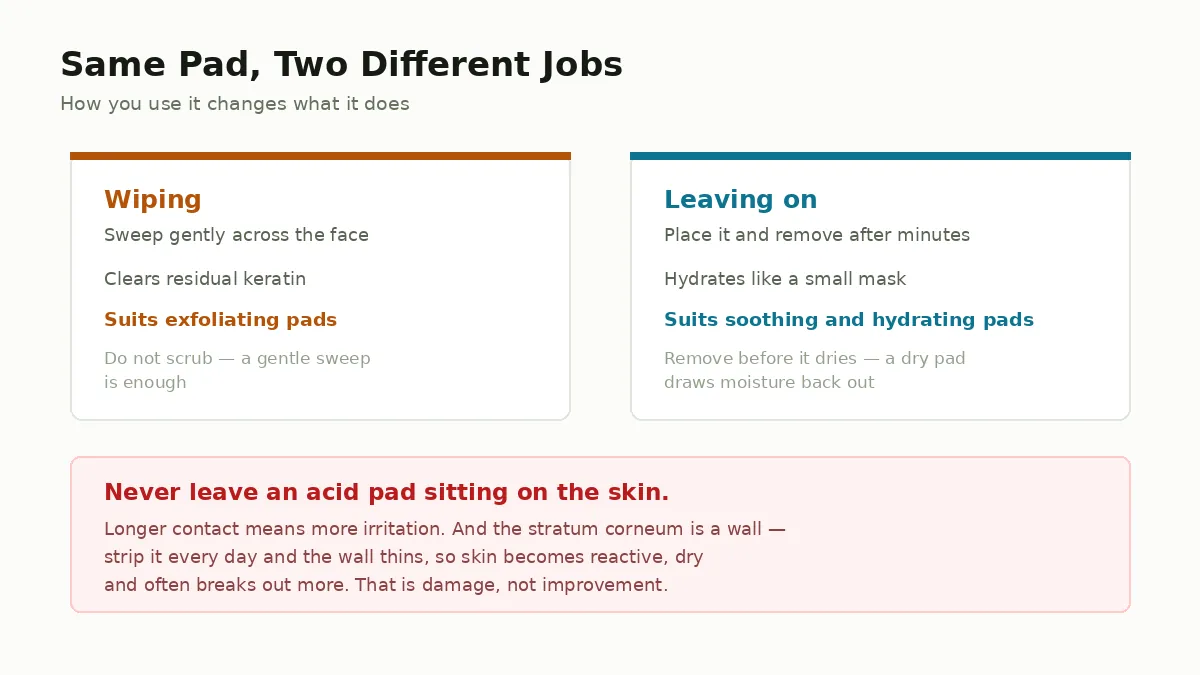
Wiping. Sweep the pad gently across the face, clearing residual keratin and leftover product.
Leaving on. Place the pad on the skin for a few minutes, then remove — a small sheet mask, essentially, for hydration.
The same product changes purpose depending on which you do. Soothing and hydrating pads suit leaving on; exfoliating pads are for wiping.
One caution — do not leave an acid pad sitting on the skin; longer contact means more irritation.
The common mistakes
Clinical observation. Patients who come in after a toner pad usually bring one of two stories. The first is reactive skin meeting an acid pad: someone whose face stings easily buys the pad promising smoothness, uses it nightly, and arrives red and sore. Nothing was wrong with the product. The frequency was.
The second is harder to spot at home. Flaking at the sides of the nose, the brows and the hairline is often seborrhoeic dermatitis rather than dryness, and scale from inflamed skin does not improve by being wiped off. If it keeps returning to the same places, have it looked at.
1. Assuming daily is better.
For soothing and hydrating pads, fine. For acid pads, no. Stripping every day is damage, not improvement.
2. Using several types together.
An acid pad followed by retinol or vitamin C the same night stacks the irritation. One thing per day.
3. Scrubbing.
Rubbing hard adds mechanical injury on top. A gentle sweep is enough. On the body the same argument decides more than the soap does: the Italy towel versus the foam glove.
4. Buying without reading the ingredients.
The word “soothing” on the front is less reliable than the list on the back. If it contains an acid, it is not a soothing product.
5. Starting several at once while travelling.
Buying five at Olive Young and trying them all that night is the most common route to a reaction.
If you have had a procedure
Stop all of them.
After laser, peeling, microneedling or injectables, the barrier is compromised. Sweeping a pad across it adds irritation. The commonest case among visitors is focused ultrasound lifting, where the skin looks untouched because the energy went deeper than the surface — and gets treated as if nothing happened.
Acid pads especially. The stratum corneum is already damaged; adding acid is the wrong direction.
Ask the treating clinic when you can resume. At least a week after a gentle treatment, longer after resurfacing.
When you do restart, begin with soothing, one product at a time. Spicule products follow the same rule, and the home dose is not the clinic dose.
How to buy
Read the back, not the front. Look for acid names.
Avoid fragrance if your skin is reactive.
Check the pad texture. A heavily embossed surface adds physical exfoliation, compounding with an acid.
Buy the small size first. Do not commit to a large jar untested.
Start one at a time. Two new products at once means you cannot tell what caused a reaction.
FAQ
Does a toner pad replace toner?
It can. But an acid pad is not a toner — treat it as a twice-weekly treatment step.
Can I use one morning and night?
Soothing and hydrating, yes. Exfoliating, no.
How long should I leave a pad on?
Follow the product guidance, but remove it before it dries. A dry pad draws moisture back out. Do not leave acid pads on at all.
Will an acid pad shrink my pores?
Clearing blockage can make them less noticeable. It does not reduce a pore that has stretched.
Can I mix brands?
Yes, as long as the families do not overlap. Just do not layer several in one day.
It stings — does that mean it is working?
No. Slight tingling from an acid can occur, but if it persists or redness remains, reduce the frequency or change family.
Disclaimer: I write about cosmetics and shops as general information, not as a recommendation of any particular product or retailer. I receive no sponsorship, samples or payment from the brands mentioned. Skin responds differently from person to person, so patch test anything new, and see a doctor about a skin condition.

Physician in non-surgical aesthetic medicine, practising in Ansan, South Korea. Every article here is written from clinical practice and the published literature.
About the author · Contact