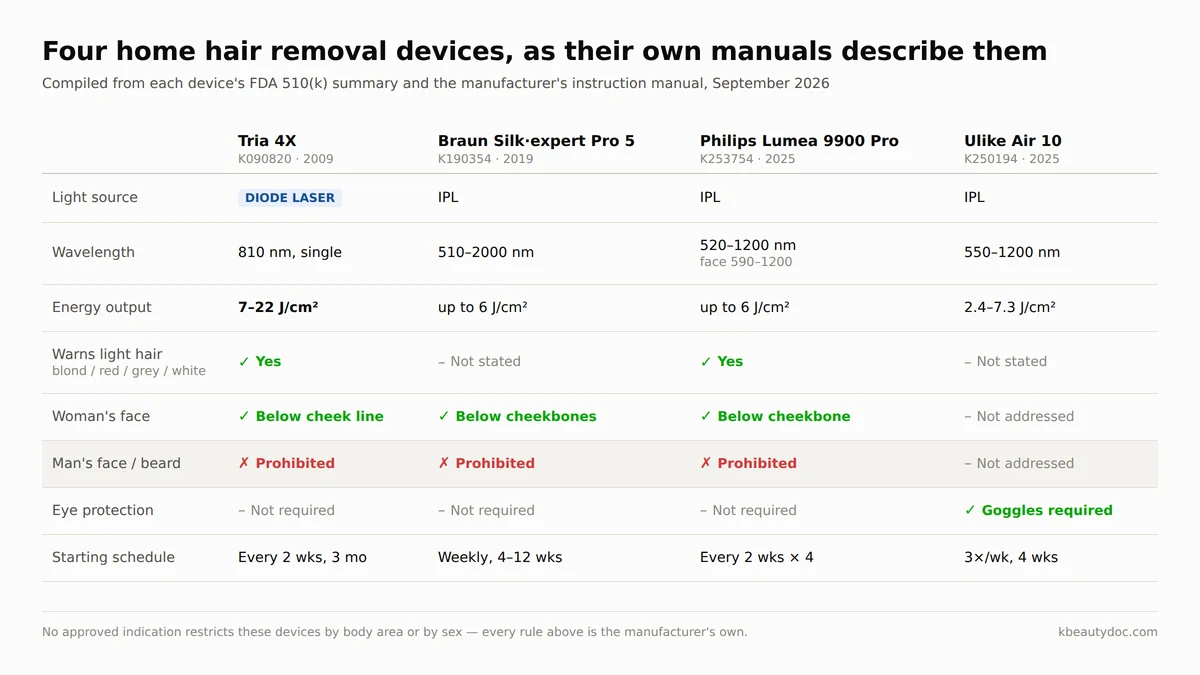
Only one of the four big home hair removal devices is actually a laser; the other three are flash lamps sold with “laser” in the name. And three of the four tell men not to use them on the face or beard, while allowing the same device on a woman’s face.
The short answer: read the manual before you buy. Four things decide. Hair colour — dark brown or black, because all of them aim at pigment inside the hair. Skin tone — up to medium brown; most devices refuse to fire outside their range. The area — three of four brands prohibit a man’s face, jaw and neck. The claim on the box — regulators approved a reduction in regrowth measured up to twelve months.
The four devices side by side
| Tria 4X | Braun Silk·expert Pro 5 | Philips Lumea 9900 Pro | Ulike Air 10 | |
|---|---|---|---|---|
| Light source | Diode laser | IPL | IPL | IPL |
| Wavelength | 810 nm, single | 510–2000 nm | 520–1200 nm (face attachment 590–1200) | 550–1200 nm |
| FDA 510(k) | K090820 (2009) | K190354 (2019) | K253754 (2025) | K250194 (2025) |
| Energy output | 7–22 J/cm² | up to 6 J/cm² | up to 6 J/cm² | 2.42–7.27 J/cm² |
| Man’s face / beard | Prohibited | Prohibited | Prohibited | Not addressed |
| Starting schedule | Every 2 weeks | Weekly | Every 2 weeks | 3× per week |
From each device’s FDA 510(k) summary and instruction manual.
Laser or IPL? Only one of the four
Most are sold as “IPL laser hair removal” — a phrase naming two different things. IPL is not a laser: it is a xenon flash lamp, like a camera flash, releasing a wide band of light that scatters rather than travelling in a straight beam. The filter these devices advertise does not create a wavelength; it removes one, discarding the short end that skin pigment absorbs most. “Laser” in a product name is not a specification — the same confusion patients meet when they choose a clinic by device name.
Only the Tria is a real laser: one 810 nm diode beam at 7 to 22 J/cm², against the IPL maximum of 6. Which makes its own line about beards worth reading twice:
“The hair in a man’s beard area is too dense.”
— Tria Beauty Hair Removal Laser 4X, instruction manual
Not that the device is too weak — that the hair is too dense.
Hair colour: two brands tell you, two do not
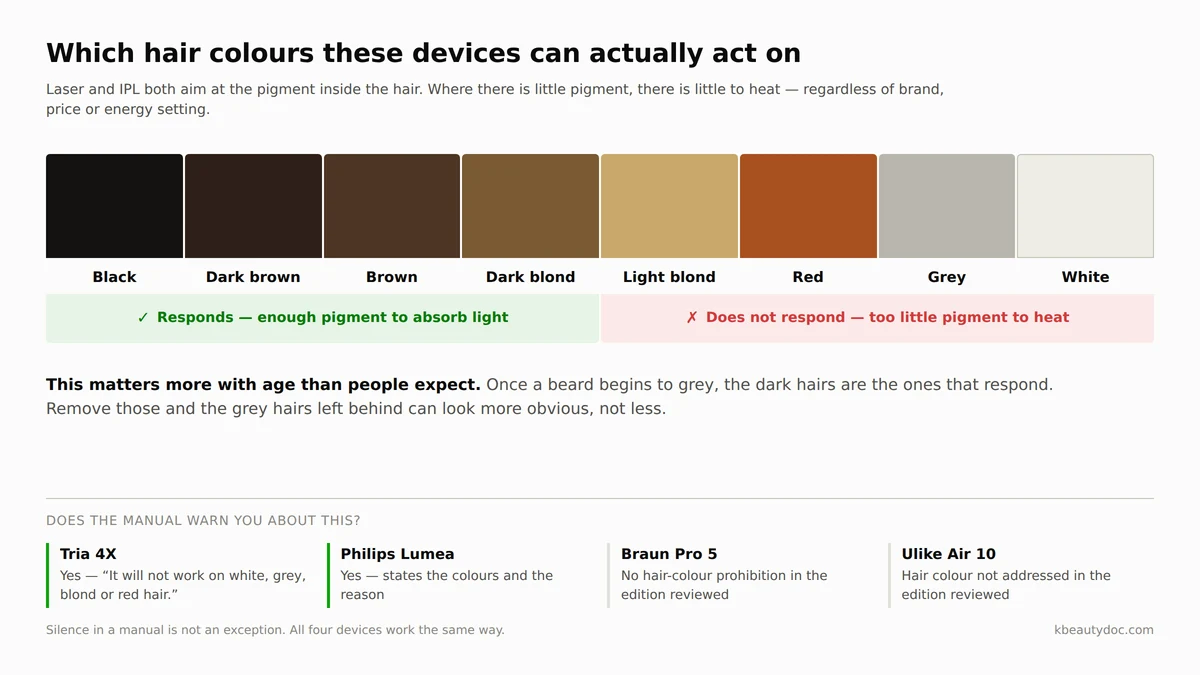
Pigment inside the hair absorbs light and turns it into heat that reaches the follicle. With no pigment, there is nothing to warm up.
Philips: treatment “is not effective if you have light blond, grey, red or white hairs”. Tria: “It will not work on white, grey, blond or red hair.” The Braun and Ulike manuals we reviewed carry no hair-colour prohibition at all; regional editions may differ. Silence is not an exception to physics — all four target pigment.
Once a beard turns grey, the dark hairs are the ones that respond, and the grey ones left behind can look more obvious.
Skin tone: the device may simply refuse
Skin pigment absorbs the same light, so on darker skin the surface heats up alongside the hair. Philips: “DO NOT use Lumea if you have dark brown or darker skin tone.” Braun: not if “your skin is darker than skin tone V”. Tria allows “light to medium skin tones”; Ulike is cleared for types I–V. Most of these read skin tone before firing and refuse outside their range.
Men’s faces: three prohibitions and one silence
Tria: “DO NOT use the Tria Laser 4X on a man’s face, jaw or neck.”
Philips: “DO NOT use Lumea on male neck and face. The hairs in these areas have different characteristics.”
Braun: the men’s chart allows shoulders and below — “Do not use on the face, neck or genital area.” Use on male beards “may lead to permanent or uneven results which may produce changes in facial characteristics”.
Ulike: its manual does not mention men’s faces or beards. The other three allow a woman the face below the cheekbone.
Three explanations for one rule: density, different hair characteristics, an uneven result — and male skin does respond differently. The Braun wording is the most revealing: a beard line is not uniform, so a partial result can look worse than none.
None of it comes from the regulator. The approved indications restrict neither body area nor sex, so each company decided this alone.
What the approval actually says
Plenty of these promise permanence in the product title. The approved wording, identical across every brand we checked, is narrower:
“…reduction in hair regrowth, defined as the long-term, stable reduction in the number of hairs regrowing when measured at 6, 9 and 12 months after the completion of a treatment regime.”
A reduction, and the measurement stops at twelve months.
Eyes: one brand asks for goggles
Ulike is the only one of the four that requires them; the other three exclude the area instead, warning of eye injury. The US adverse-event database holds one report worth knowing: in May 2023 a first-time user slipped while treating her face and fired toward her eyes; a dark ring obscured her central vision for two nights. Her materials had said goggles were not necessary.
One reported pattern worth knowing
Another report describes a user whose neck, jaw and chin hair grew back “dark black, thicker and more course” after she extended treatment across her face. This has a name: paradoxical hypertrichosis, hair growing in response to treatment.
A meta-analysis pooling nearly ten thousand treated people put the overall rate at about 3% — and found it almost entirely on the face and neck, with no difference between device types [1]. The leading explanation is that heat too low to disable a follicle may instead stimulate it. That has not been tested directly, but it makes a low-energy device on a face unappealing.
What I am asked in the consultation room
Clinical observation, offered as such. Two conversations come up often enough to belong here. The first is simply “how is this different from the machine in a clinic?”, usually from someone who already owns a device and wants to know what they bought. The second is more specific: patients sometimes come in after buying a device for their lower legs, getting on with it there, then trying it on a bikini line or a beard and concluding the device is faulty. Read against the manuals above, that is close to what the documents themselves predict — those are precisely the areas the manufacturers either restrict or decline to address.
Frequently asked questions
Will this work on blond or white hair?
No. They aim at pigment inside the hair, and blond, red, grey and white hair has very little. Philips and Tria say so; the other two stay silent on it.
What is the difference between IPL and laser? I keep seeing “IPL laser”.
A laser emits one wavelength in a straight beam; IPL is a filtered flash lamp. Of these four, only the Tria is a laser.
I am a man. Can I use one on my beard?
Tria, Braun and Philips say no — density, different hair characteristics, an uneven result. Ulike does not address it.
My manual says nothing about hair colour. Does that mean it works on mine?
No. A manual that omits the warning has not changed how the device works.
The box promises permanent results. Is that accurate?
The approved wording is narrower: a reduction in regrowth, measured up to twelve months.
Is it as good as a clinic treatment?
In a small trial of six underarm sessions, the clinic diode laser removed roughly twice as much hair as the home device [2]. Clinic lasers also work at energies that reach the glands beside the follicle.
Do I need to wear goggles?
Only Ulike requires them; the others prohibit use near the eyes instead. Since an eye injury has been reported after a device slipped, goggles are a reasonable precaution.
References
- Snast I, Kaftory R, Lapidoth M, Levi A. Paradoxical hypertrichosis associated with laser and light therapy for hair removal: a systematic review and meta-analysis. Am J Clin Dermatol 2021;22(5):615-624. 10.1007/s40257-021-00611-w
- Hendricks K, Nxumalo CT, Makgobole MU, Ghuman S, Jacobs D, Mpofana N. Evaluating the effectiveness of laser hair reduction using a home use laser in comparison to a diode laser. PLoS One 2023;18(5):e0286162. 10.1371/journal.pone.0286162
Disclaimer: Home devices should be used according to the manufacturer’s manual and safety instructions, which take priority over anything I write here. Device approvals and permitted claims differ from country to country. I mention products for information only, receive nothing from the makers, and do not recommend any particular model.

Physician in non-surgical aesthetic medicine, practising in Ansan, South Korea. Every article here is written from clinical practice and the published literature.
About the author · Contact