

What’s Liftera?

Korean focused ultrasound, the same idea as Ultherapy.
So what’s different?
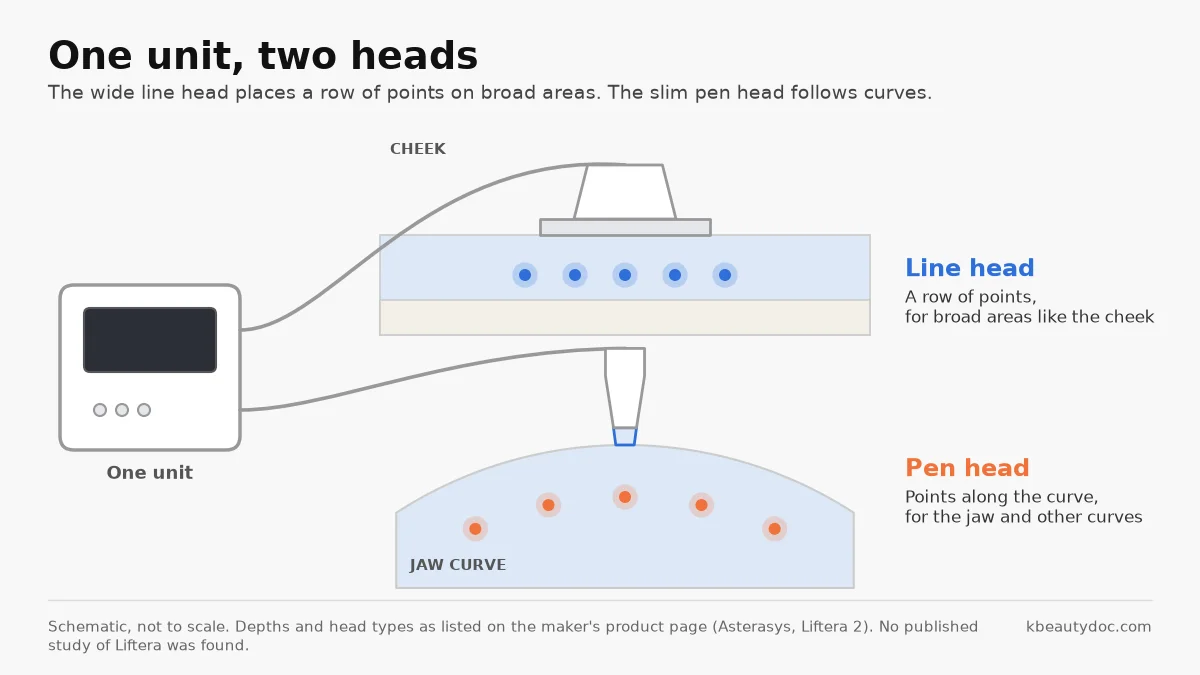
Two heads, a wide line one and a slim pen.
Is it really gentler?
That’s the ads talking, no study has tested it.
Liftera and Shurink often sit next to each other on a Korean clinic menu, and the descriptions can sound almost identical. They are not the same machine.
Short answer:
- Liftera is a Korean focused-ultrasound lifting device from Asterasys — the same company behind Coolsonic. The current version is Liftera 2.
- Like Shurink, it places heat dots at set depths under the skin. The visible difference is its two kinds of head: a wide line head and a slim pen head.
- “Gentler” is a clinic and marketing description, not a test result. I found no published study of Liftera, and none comparing it with Shurink.
What is Liftera?
Asterasys is a Korean device company founded in 2015 that now sells in dozens of countries (Korea Biomedical Review). Liftera is its best-known product.
It works like every ultrasound lift: focused energy heats tiny points a few millimetres down, the surface stays unbroken, and the body firms those points up over the next months. The maker lists three depths — 1.5, 3.0 and 4.5 mm (official product page) — from upper skin to the firmer layer that supports the cheek and jaw.
How is Liftera different from Shurink?
1. A different maker. Shurink comes from Classys; Liftera from Asterasys. Two Korean companies, two separate designs of the same idea.
2. Two head shapes. Liftera offers a line head for broad areas like the cheek, and a pen head that the maker says also reaches curved areas (official page). Shurink relies on a set of cartridges, including an extra 2.0 mm depth.
3. Research on the record. Shurink, under its export name Ultraformer, has a handful of recent published studies. For Liftera, a PubMed search for the name (September 2026) found none.
4. What they share: neither is sold on the live ultrasound picture that Ultherapy is known for. The Liftera 2 page does not describe one.
Is Liftera really gentler?
You will often read that Liftera is “more comfortable” or “gentler” than Shurink. Some things to know:
- The depths are the same. Both reach the deep 4.5 mm layer.
- How much it hurts depends mostly on settings — energy per shot, number of lines, the area — which the operator chooses on either machine.
- A pen head covers less skin at once, which some people find easier near bone. That is my clinical impression, not a measured result.
So “gentler” may be true in one clinic’s hands and not in another’s. Ask what settings they use, not which brand is softer.
How long does it last, and how often?
No published data exists for Liftera. As with the rest of the family, change builds over two to three months.
Clinics often present it as something to repeat regularly. My clinical judgement, not a proven fact: compare photos at about three months before booking again, especially if your face is lean.
What are the side effects?
- Common: redness, swelling and tenderness for a few days
- Uncommon: nerve irritation — numbness, or a smile that looks uneven for a while
- Uncommon: fat loss that leaves cheeks hollower
- Rare: blisters or scarring
These come from the larger research on Ultherapy [1]. There is no separate safety review for Liftera.
What I tell my patients to ask before booking

- Which depths, and how many lines per area?
- Line head, pen head, or both — and where?
- Who performs it? Without a live picture, the operator’s hands matter more.
- When do we review the result?
If a curved area is your main worry, Asterasys also makes Coolsonic, a pen-tip device with built-in cooling. For all four machines at a glance, see Is Shurink as good as Ulthera?
FAQ
Are Liftera and Coolsonic the same machine?
No. Both come from Asterasys and both have a pen-shaped head, but Coolsonic is built around a cooling tip. They are sold as separate devices.
Is Liftera better than Shurink?
There is no study comparing them. Choose by the clinic, the settings and the area, not the brand.
Can I switch between Shurink and Liftera?
Yes, they work on the same principle. Just tell the clinic what you had and when, so the deep layers are not overheated too soon.
Have a question about your own case? Ask me on LINE or by email — details on the Contact page.
References
- Humphrey VS, Rambhia PH, Gmyrek R, et al. Microfocused ultrasound with visualization: a systematic review of adverse events and risk of subsequent facelift compromise. Dermatol Surg 2025;51(4):424-429. 10.1097/DSS.0000000000004510
Disclaimer: This article explains treatments in general terms and is not a diagnosis or a treatment plan. What happens varies from person to person, and no article can tell you what to expect. Please discuss your own case with a licensed medical professional where you live. I do not endorse specific clinics or device brands.
14 years in practice · replies to messages herselfPhysician in non-surgical aesthetic medicine, practising in Ansan, South Korea. Every article here is written from clinical practice and the published literature.
About the author · Contact