

I paid for Ultherapy and nothing changed.

That happens, and usually there’s a reason we can name.
Did the clinic do it wrong?
Sometimes, but often it’s your face, not the machine.
So whose face sees less?
I’ll walk you through five kinds of faces.
In one Ultherapy study, more than half of the people with a BMI over 30 showed no detectable change at three months [3].
Short answer:
- Some faces get less from Ultherapy. The usual reasons are anatomy and body shape, not a broken machine.
- Five faces see less: a heavier face, heavy sagging, jowls as the main goal, a very thin face, and a cut-down session.
- The “SMAS” it aims for is messier than the brochure drawing. A 2024 study of 50 heads found it is not one continuous layer [1].
Why does Ultherapy lift some faces more than others?
The handpiece fires rows of tiny heat points at fixed depths: 1.5, 3.0 and 4.5 mm. The maker calls the 4.5 mm row the “SMAS/Platysma” layer [8], the firm sheet a surgeon tightens in a facelift.
But faces are not built to one ruler. In an ultrasound study of 150 people, that layer sat 2.6 to 6.9 mm deep in the cheek (average 4.82 mm). It was deeper with a higher BMI and shallower with age [4].
So a fixed 4.5 mm row may land near the layer in one face and well above it in another. That last step is my reading of the numbers, not a tested result.
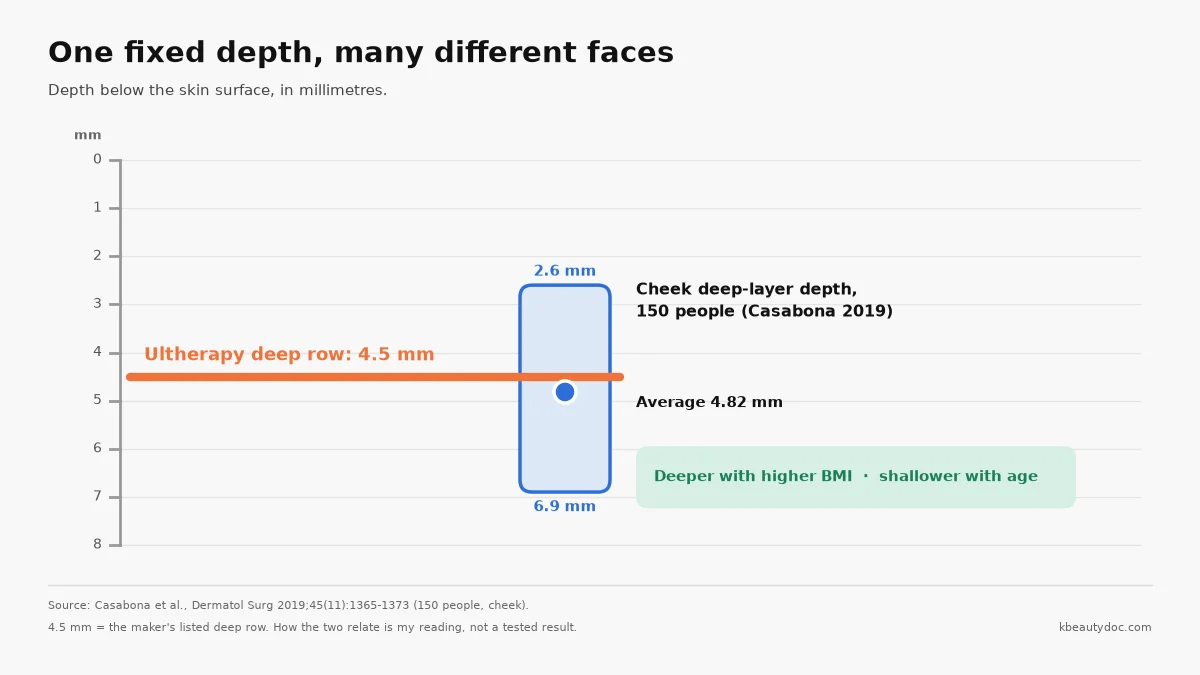
One fixed depth, many different faces.
Is the SMAS a myth?
Not quite, but it is less tidy than the textbook picture.
- 2024, 50 cadaver heads: the authors concluded the SMAS “as originally described does not exist as a specific anatomical entity”. They found the layer only where flat face muscles sit, not between them [1].
- 2021, 7 cadavers plus CT scans: another team called it “a definite anatomical structure” [2].
Both teams can be partly right. The part most anatomy papers share: the layer changes from one area, and one person, to the next. So results that vary from face to face should not surprise anyone.
Which 5 faces see less lift?
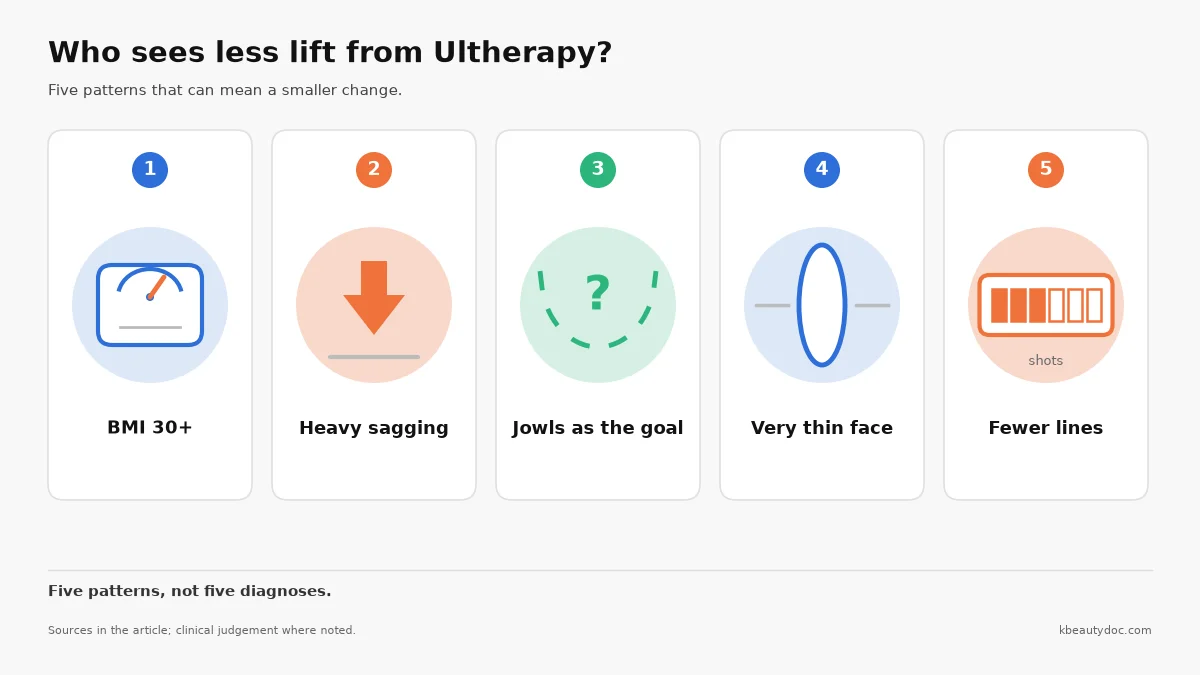
Five patterns, not five diagnoses.
1. A heavier face (BMI over 30)
In a 93-patient lower-face study, no change was detected in 54.5% of people with a BMI over 30, against 12.2% at 30 or under [3]. The maker’s own research trial left out anyone with a BMI of 25 or more, or “excessive subcutaneous fat” [6].
2. Heavy sagging
A 2023 review of 16 studies called excessive skin laxity and a BMI over 30 “relative contraindications”: results fell as sagging rose [5]. It did best on mild to moderate looseness. Heavy jowls and a loose neck are surgery territory.
3. Jowls and cheeks as the main goal
Ultherapy’s listed uses are lifting the brow, under the chin and the neck, plus chest lines, arms and abdomen [7]. Jawline and cheeks are treated every day, and they have been studied [3]. But they are not on that list, so I set expectations by the areas that are.
4. A very thin face
Fat loss is rare in published studies: one case across 19 papers. Yet lipoatrophy (fat loss) is among the problems reported most often to the US FDA’s device database, which counts reports, not rates [9]. On a hollow face I am cautious with the deep row. That is clinical judgement, not a proven fact.
5. A cut-down session
In Korea, the price follows the number of lines (shots). A maker-funded Asian expert panel put full face and neck at 800 to 1,200 lines, adjusted to each face [10]. A cheap package may mean fewer lines or only one depth. That is my observation, not a study.
What I tell my patients before Ultherapy
- How many lines, at which depths, for each area? Ask for it in writing.
- Who holds the handpiece? And will they check the screen for every area?
- Is my face a good match? Talk about weight, how much sagging, and how thin your cheeks are.
- When do we judge? At two to three months, with photos.
How long a good result lasts is in Is Ultherapy worth it? Comparing Korean devices? See Shurink vs Ulthera. Already booked? Here is skincare after HIFU. More in Korean clinics, honestly.
Have a question about your own case? Ask me on LINE or by email — details on the Contact page.
FAQ
Why did Ultherapy not work for me?
The common reasons in studies are a higher BMI, heavy sagging, and areas outside its main uses. A session with fewer lines or one depth may also give less. Judge at two to three months, not the next week.
Who is not a candidate for Ultherapy?
Results drop with heavy sagging and a BMI over 30, which one review called relative contraindications [5]. A very thin face needs care because of reported fat loss. Mild to moderate looseness is where it did best.
Can Ultherapy cause fat loss in the face?
It has been reported. Published studies record it rarely, but it is among the most frequent reports in the US FDA’s device database [9]. That database cannot tell you how often it happens.
References
- Minelli L, van der Lei B, Mendelson BC. The superficial musculoaponeurotic system: does it really exist as an anatomical entity? Plast Reconstr Surg 2024;153(5):1023-1034. 10.1097/PRS.0000000000010557
- Okuda I, Akita K, Komemushi T, et al. Basic consideration for facial aging: analyses of the superficial musculoaponeurotic system based on anatomy. Aesthet Surg J 2021;41(3):NP113-NP123. 10.1093/asj/sjaa305
- Oni G, Hoxworth R, Teotia S, et al. Evaluation of a microfocused ultrasound system for improving skin laxity and tightening in the lower face. Aesthet Surg J 2014;34(7):1099-1110. PMID 24990884
- Casabona G, Frank K, Koban KC, et al. Influence of age, sex, and body mass index on the depth of the superficial fascia in the face and neck. Dermatol Surg 2019;45(11):1365-1373. 10.1097/DSS.0000000000001909
- Contini M, Hollander MHJ, Vissink A, et al. A systematic review of the efficacy of microfocused ultrasound for facial skin tightening. Int J Environ Res Public Health 2023;20(2):1522. 10.3390/ijerph20021522
- Ulthera, Inc. Evaluation of the Ulthera System and efficacy correlation to morphological differences. ClinicalTrials.gov NCT03599349 (eligibility criteria).
- Merz Aesthetics. Ultherapy indication statement, press release of 5 November 2025. Accessed 2026-10-02.
- Merz Aesthetics. Ultherapy physician page, “Key factors” (depth of the skin’s foundation). Accessed 2026-10-02.
- Humphrey VS, Rambhia PH, Gmyrek R, Chapas A. Microfocused ultrasound with visualization: a systematic review of adverse events and risk of subsequent facelift compromise. Dermatol Surg 2025;51(4):424-429. 10.1097/DSS.0000000000004510
- Park JY, Lin F, Suwanchinda A, et al. Customized treatment using microfocused ultrasound with visualization for optimized patient outcomes: a pan-Asian adaptation of the expert panel’s gold standard consensus. J Clin Aesthet Dermatol 2021;14(5):E70-E79. PMID 34188753 (funded by Merz Asia Pacific)
Disclaimer: This article explains treatments in general terms and is not a diagnosis or a treatment plan. What happens varies from person to person, and no article can tell you what to expect. Please discuss your own case with a licensed medical professional where you live. I do not endorse specific clinics or device brands.
14 years in practice · replies to messages herselfA doctor in Korea, in practice since 2012 — your K-Beauty Doc. Physician in non-surgical aesthetic medicine, practising in Ansan, South Korea. Every article here is written from clinical practice and the published literature. Not medical advice.
About the author · Contact