If you take one thing home from a Korean pharmacy or Olive Young, make it sunscreen. Korean sunscreens genuinely are lighter and more wearable than most Western equivalents, and the reason is regulatory, not marketing. Different countries allow different UV filters, and Korea has access to a newer generation of them.
Here is how to read the label, how much to use, and — for deeper skin tones — which ingredient names to check before you buy.
Why Korean sunscreens feel different
Sunscreen is regulated as an over-the-counter drug in the United States, so new UV filters need a full drug approval pathway, and very few have been approved in decades. Korea, Japan and the European Union regulate sunscreen as a cosmetic, which allows a broader and more modern set of filters.
Those newer filters tend to be more photostable, spread more easily, and produce less of the heavy, greasy, white finish of older formulations. That is the entire explanation for why a Korean SPF 50+ can feel like a light serum while an American SPF 50 feels like a mask.
It is not that Korean sunscreen is “better.” Korean formulators have had a larger toolbox.
Reading the label
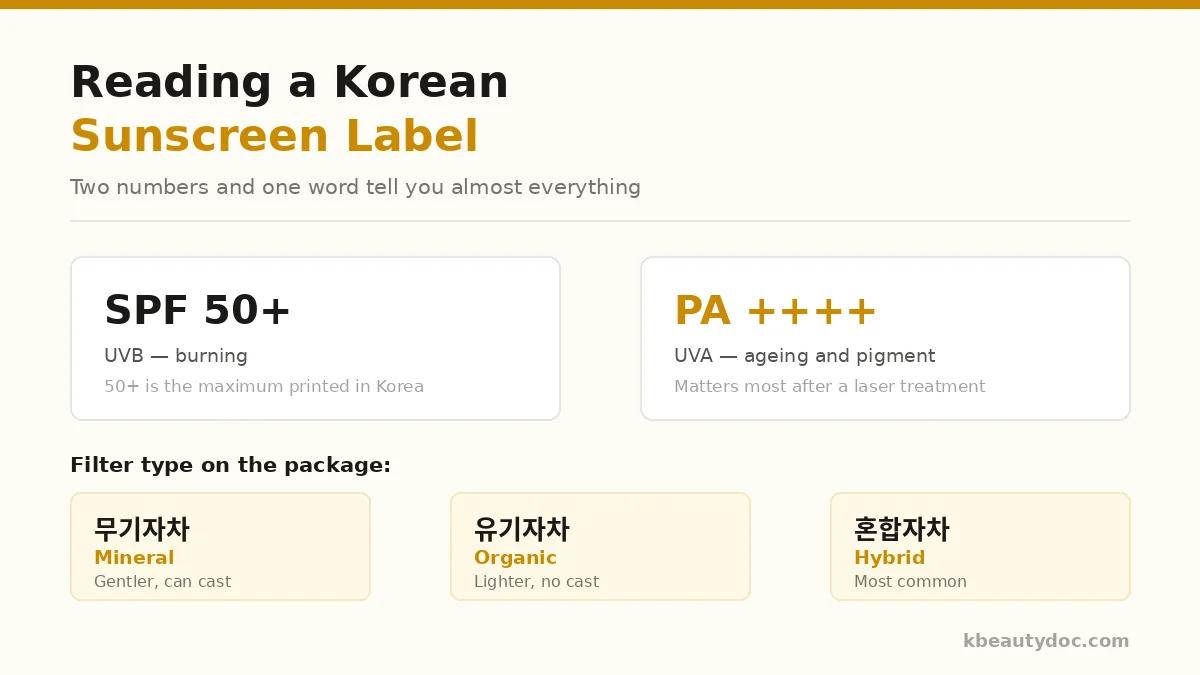
SPF measures protection against UVB, the radiation responsible for burning. SPF 50+ is the highest figure permitted on Korean labels.
PA rating measures protection against UVA — the radiation associated with photoaging and pigmentation. It runs PA+ to PA++++, and it is useful information most Western labels do not give clearly.
After a laser or energy-based treatment, the PA rating matters more than the SPF number, because post-treatment pigmentation is driven substantially by UVA. Buy PA++++.
Filter type. Korean labels and product names distinguish two categories, and you will see these terms constantly:
| Korean term | What it means | Characteristics |
|---|---|---|
| 무기자차 (mugi-jacha) | Mineral / inorganic filters | Zinc oxide, titanium dioxide. Gentler on reactive skin. Can leave a cast. |
| 유기자차 (yugi-jacha) | Organic / chemical filters | Modern filters. Lighter finish, no cast. Occasionally stings around the eyes. |
| 혼합자차 (honhap-jacha) | Hybrid of both | Most common in practice |
Neither category is superior. Mineral suits reactive or freshly treated skin; organic suits daily wear under makeup — though stinging and irritation are not the same test, which is why a filter can pass and still burn your eyes.
The grey cast problem — and exactly which ingredients cause it
If you have a deeper skin tone, this section is the reason I wrote this article.
Many Korean sunscreens are formulated with a tone-up effect, marketed as brightening the complexion. Plenty are excellent products. But the effect comes from white or pearlescent pigments, and on deeper skin tones those do not read as “brightening” — they read as grey or ashy.
Check the ingredient list for these three names:
Titanium Dioxide. The main one. It works as both a mineral UV filter and a white pigment, which is why it is so common in tone-up products. The higher it sits in the list, the stronger the whitening.
CI 77891. The colour-index designation for titanium dioxide used as a colourant rather than a UV filter. Seeing it listed separately signals that whitening is an intended cosmetic effect.
Mica. A pearlescent mineral that produces a light-reflecting sheen. On lighter skin this reads as glow; on deeper skin it can read as grey shimmer.
Zinc Oxide also casts, but generally less, and modern micronised zinc is considerably better than it used to be.
The practical rule: if the name contains “tone up,” “white” or “brightening,” and titanium dioxide, CI 77891 or mica appear high in the list, test it on your jawline in natural light before buying several. Transparent, water-based organic-filter sunscreens are the safest choice for deeper skin tones.
Most Korean drugstore products carry Korean-only labelling, but the ingredient list is still printed in International Nomenclature format — the Latin and chemical names are the same worldwide.
The amount nobody applies
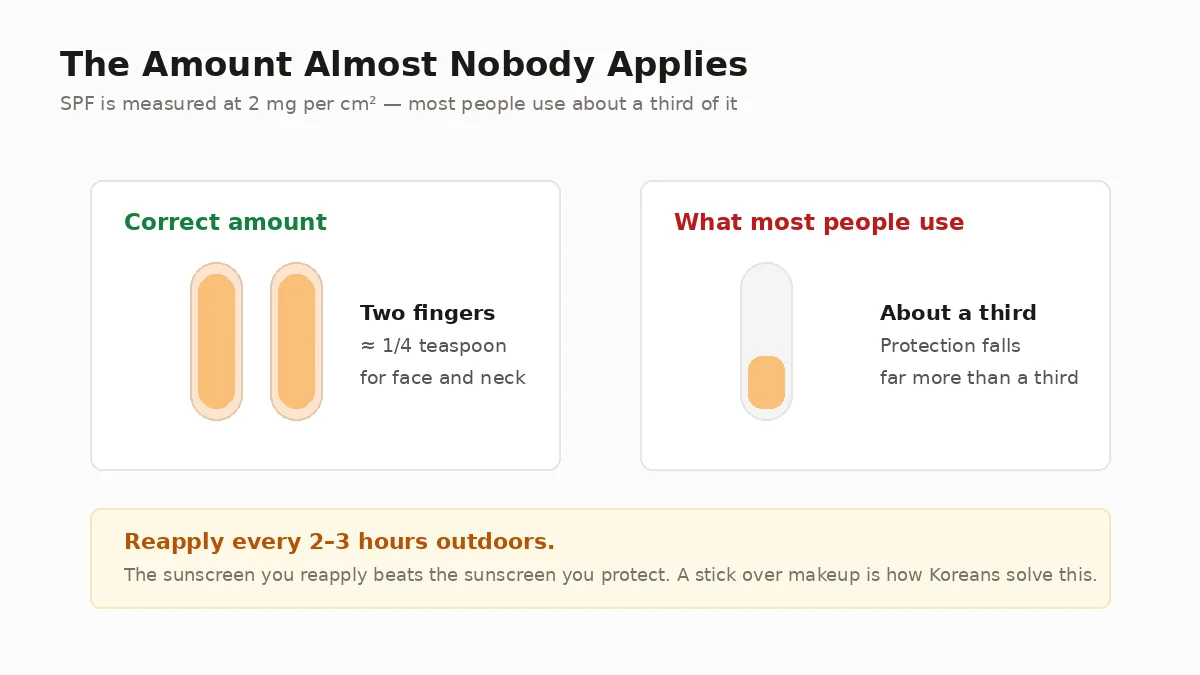
The SPF figure on the bottle is measured at 2 mg per square centimetre of skin. For an adult face and neck that is roughly a quarter of a teaspoon, or the length of your index and middle fingers squeezed out full.
Real-world application is far below that, and the protection you actually get falls with it, because the relationship is not linear [1].
This is the commonest reason people who “always wear sunscreen” still develop pigmentation. It is not the product. It is the quantity.
Reapplication: the Korean solution
Sunscreen degrades, and it comes off with sweat and touching your face. It needs reapplying every two to three hours outdoors, and this is where Korean product design has genuinely solved something.
Sun sticks are the format most Koreans carry. You swipe them over makeup without your hands touching your face, they do not disturb foundation, and they fit in any bag.
Sun cushions apply with a puff, pressed rather than rubbed, so they go over makeup without smearing it. Some include tone-up pigment — see the section above.
One I use myself: Kim Jung Moon Aloe’s Cure Alpha Water Splash Cooling Sun Stick, sold at Daiso for 5,000 won. It has a cooling finish that suits Korean summer humidity, and at that price I keep one in the car and one in my bag. I have no commercial relationship with the brand.
That is the principle whatever you buy: the sunscreen you reapply beats the sunscreen you protect. An expensive product used sparingly performs worse than a cheap one used properly.
Where to buy
Olive Young for range — every format, with testers and staff used to foreign customers. Tax refund applies above the minimum purchase; bring your passport. Centella-based water-textured sun serums are a light starting point that layer under anything.
Daiso for reapplication stock. Sun sticks and small formats sit around 3,000–5,000 won, which changes the economics of reapplying. Most carry no English labelling, so read the ingredient list rather than the front.
Buy for the format you will actually use: a perfect sunscreen you find annoying is worse than an adequate one you reapply at lunch.
After a treatment
If you have had laser, RF microneedling, peeling or any energy-based procedure while in Korea, sun protection stops being cosmetic and becomes part of the treatment. It works both ways: pigment change after monopolar radiofrequency is reported more often on recently sun-exposed skin, and even the bruises left by a botulinum toxin appointment mark more stubbornly in strong sun.
For the first days, use a mineral sunscreen on healed skin — gentler on a compromised barrier. Do not apply it to broken or weeping skin; ask the treating clinic when to start. Then use the full amount, reapply, and avoid direct sun.
Post-inflammatory hyperpigmentation after energy-based treatment is substantially preventable, mostly in the first two weeks. If you are flying home somewhere sunny, plan for it.
FAQ
Is SPF 50+ meaningfully better than SPF 30?
SPF 30 blocks roughly 97% of UVB and SPF 50 roughly 98% when applied at the tested amount. The bigger factor is how much you apply and whether you reapply. Since Korean SPF 50+ products are light and inexpensive, there is little reason to choose lower.
What does PA++++ mean?
It is the highest UVA protection grade in the Asian rating system. UVA drives photoaging and pigmentation, so for anyone concerned about dark spots — or recovering from a laser — it matters more than the SPF number.
Will Korean sunscreen leave a white cast on my skin?
It depends on the product, not the country. Check for titanium dioxide, CI 77891 and mica high in the ingredient list, and be cautious with anything labelled tone-up. Transparent organic-filter formulas generally do not cast.
How often should I reapply?
Every two to three hours outdoors, and after swimming or heavy sweating. Indoors away from windows, a single morning application is generally reasonable.
Can I use a sun stick over makeup?
Yes — that is the main reason the format exists in Korea. Swipe and press gently rather than rubbing.
Is mineral sunscreen better for sensitive skin?
It is often better tolerated, particularly on freshly treated or reactive skin, because mineral filters sit on the surface rather than absorbing. The trade-off is a heavier finish and more cast.
References
- Petersen B, Wulf HC. Application of sunscreen — theory and reality. Photodermatol Photoimmunol Photomed 2014;30(2-3):96-101. DOI: 10.1111/phpp.12099
Disclaimer: I write about cosmetics and shops as general information, not as a recommendation of any particular product or retailer. I receive no sponsorship, samples or payment from the brands mentioned. Skin responds differently from person to person, so patch test anything new, and see a doctor about a skin condition.
Physician in non-surgical aesthetic medicine, practising in Ansan, South Korea. Every article here is written from clinical practice and the published literature.
About the author · Contact