Three things to know first
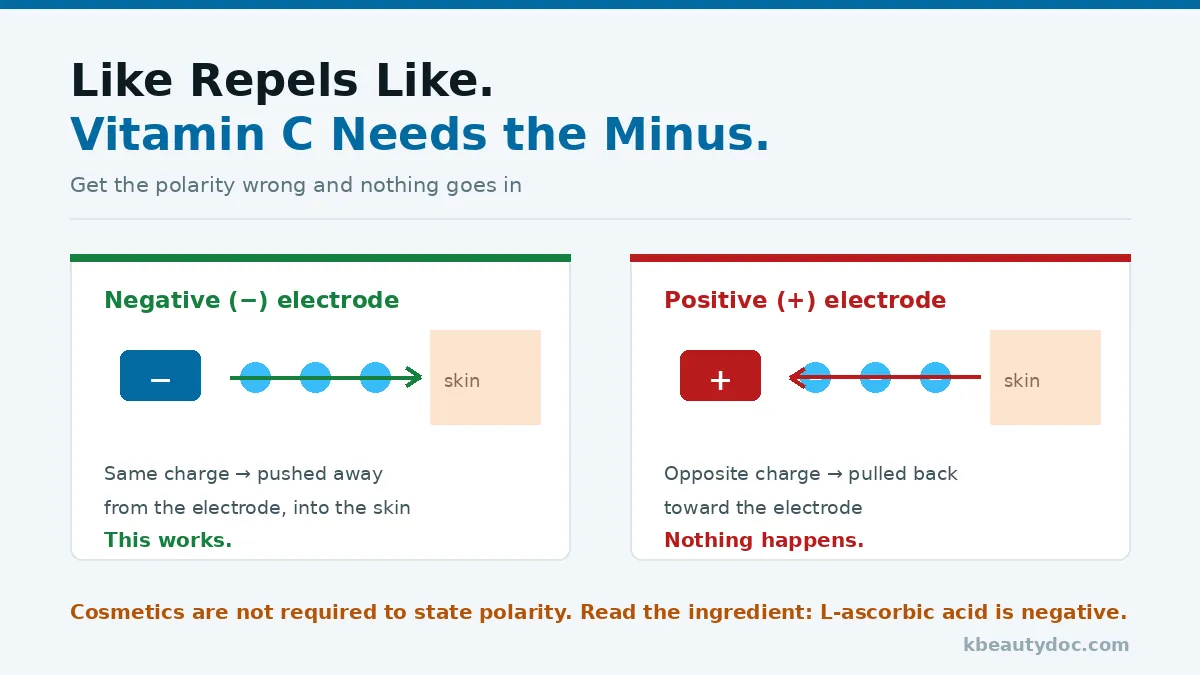
- Vitamin C needs the negative electrode. Wrong polarity means nothing happens.
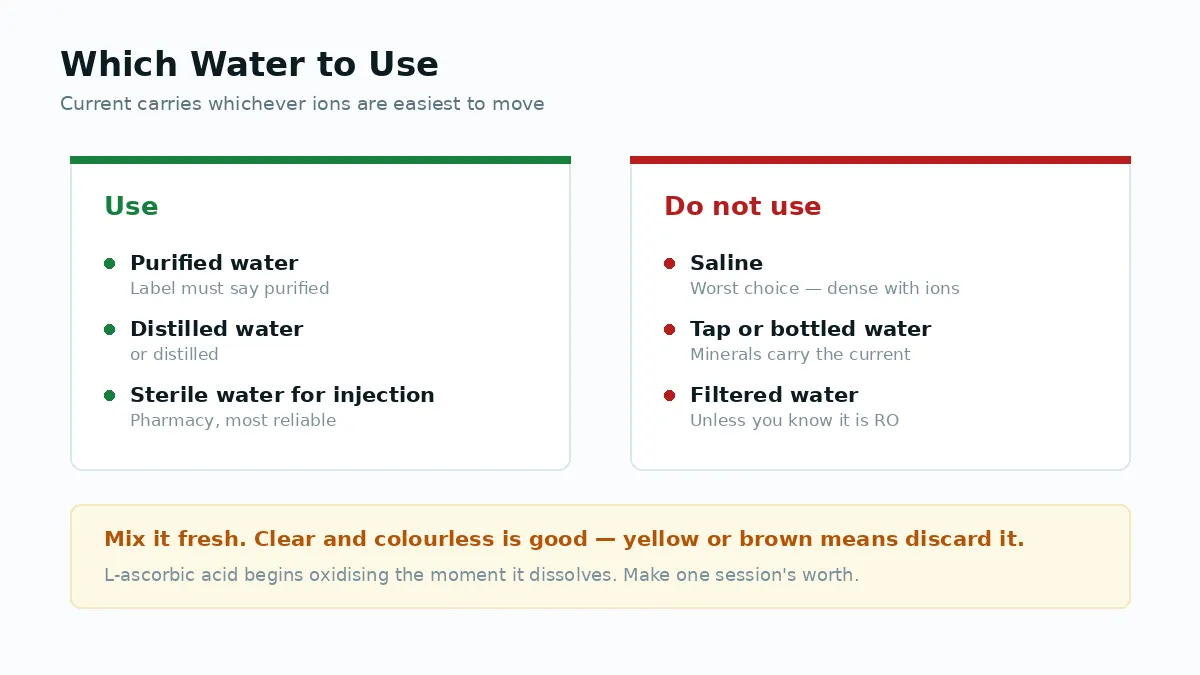
- Use purified or distilled water. Tap water, bottled water and saline carry the current instead.
- Mix it fresh and throw it away the same day. It oxidises the moment it dissolves.
So what should you do?
If you are buying a device — look for a mode labelled galvanic, ion or booster. That mode is iontophoresis. A device that only vibrates or has LED lights will not do this.
Set it to the negative (−) mode. Vitamin C is negatively charged, so the negative electrode is what pushes it toward the skin.
Use L-ascorbic acid powder mixed with purified water. There is essentially no “iontophoresis ampoule” on a drugstore shelf, and ordinary serums are too thick and carry other ingredients.
Follow the device manual for time and frequency. Output differs between devices, so the manufacturer’s guidance is the reference.
That is the practical answer. If you want to know why, keep reading.
What iontophoresis actually is
The principle is the same as a magnet. Like repels like.
A very low direct current passes through the skin. An electrode carrying the same charge as the ingredient pushes it away from itself and into the skin. In animal skin, this moved far more vitamin C into the dermis than simply applying it did [1] — animal data, but it is the reason the method exists.
Two conditions have to be met. The ingredient must carry a charge — neutral molecules are not pushed. And the polarity must match: pushing a negatively charged ingredient with the positive electrode moves it the wrong way.
The polarity of vitamin C — the most important part of this article
L-ascorbic acid is negatively charged. It therefore needs the negative (−) electrode.
If your device has a “+ / −” switch or an “anion / cation” mode, use the anion (−) setting.
Many home devices do not label polarity. The manual may say “ion delivery” or “galvanic” without saying which electrode is active. Ask the maker; if no answer comes, that device’s “absorption boost” may be warmth and vibration rather than ion delivery.
Different ingredients have different polarities, so using one mode for every product is wrong in principle.
Why the water matters
This is the part that is most often misunderstood.
Electric current carries whichever ions move most easily. If the water holds calcium, magnesium or chloride, the current carries those instead, and the vitamin C barely moves.
What not to use
Tap water — minerals and disinfection residue. Bottled or mineral water — mineral content is the point of the product.
Filtered water — depends on the system: reverse osmosis removes most ions, carbon and hollow-fibre filters do not.
Saline, and contact lens solution — the worst choices. Salt water is dense with ions. People reach for them because they seem clean and medical.
Where to buy purified water
Pharmacy. Sterile water for injection, in small volumes — the most reliable option. Supermarket. Purified water sold for humidifiers and steam irons has essentially no ions; it is not sterile, so close it tightly and refrigerate after opening.
One rule. The label must say purified or distilled. Spring, mineral and drinking water are excluded.
Choosing the powder
Cosmetics are not required to state polarity, so read the ingredient name instead — that is what sets it. Three things to check on the shelf:
Is it L-ascorbic acid? The derivatives sold as gentler versions are not interchangeable here, because the thing that makes them stable also changes what the current can move.
| Form on the label | Charge | What it means under current |
|---|---|---|
| L-ascorbic acid | Negative | The active form; negative electrode |
| Magnesium or sodium ascorbyl phosphate | Negative, weakly | Milder and more stable, but the skin has to convert it |
| Ascorbyl glucoside | Essentially uncharged | Stable and gentle; little for the current to push |
Are there additives? Fragrance, colour and sweetener mean the product is meant for eating. Ideally the ingredient list has one item.
Is the powder fine? Finer powder dissolves properly. Undissolved particles become physical abrasion when you move the device across your face.
All three are visible on the ingredient list, which means you can decide in the shop.
And who should start low. L-ascorbic acid at a working concentration is acidic, so acid and current arrive together. If your face reddens easily, flushes with heat, or you have been told you have rosacea, begin at the lowest concentration and the shortest time your device allows, and treat a stinging session as a reason to stop rather than push through. Oily, resilient skin generally tolerates it best; dry or barrier-damaged skin is better served by settling the barrier first.
Handling the solution — where most people go wrong
It starts oxidising the moment it dissolves, which is why clinics mix it just before treatment.
You can see it. Fresh solution is clear and colourless; as it oxidises it turns yellow, then brown. If the colour has changed, throw it away.
Mix it the day you use it, keep it out of light, and make one session’s worth. Keeping it overnight means applying oxidised solution.
Choosing a device
Home devices that can do this usually have a mode named galvanic, ion or booster. If you are buying one on a trip, I have compared Olive Young, Daiso and duty-free for beauty devices separately.
Does it state polarity? For the reason above. Is it a medical device or a general cosmetic device? In Korea these are separate categories with different rules for proving claims, and it is on the packaging. Do you understand the output limit? Home devices are capped for safety — regulation, not a design flaw.
How to use it
1. Cleanse and dry your face. Water left on the skin disperses the current.
2. Apply the solution. Never run the device on dry skin — it stings.
3. Set the negative (−) mode.
4. Keep moving slowly. Holding it in one place concentrates everything there.
5. Follow the manual for duration and frequency, moisturise afterwards, add sunscreen if it is morning, and stay off the eye area.
When not to do it
Absolute contraindications
- Pacemaker or any implanted electronic device
- Metal implants in the treatment area
- Pregnancy
- Broken skin, wounds or active infection in the area
Timing to avoid
- After laser, peeling, microneedling or injectable treatment — wait until the barrier has recovered
- The same day as a spicule product, or just after strong acids or retinoids
- When skin is already red or stinging
Stop if stinging becomes hard to bear, redness lasts hours, or the skin feels hot. Normal sensation is a mild tingle.
Realistic expectations
What it can do. Improve absorption compared with applying alone, and support gradual improvement in texture and tone with steady use. Most usefully, it builds a routine you keep.
What it cannot do. Replace a clinic procedure — picosecond versus conventional toning is a different order of intervention, and so is a prescription cream. It will not clear melasma or rebuild scarring.
When to judge it. Three months is the minimum useful period; two weeks tells you nothing.
And even then, sunscreen matters more. UV damages faster than vitamin C repairs.
FAQ
Can I just buy an iontophoresis ampoule instead?
Almost nothing on a drugstore shelf states polarity. Unless the ampoule is sold by the device maker for that device, powder plus purified water is closer to the principle.
My product does not state polarity. How do I know?
You do not need it to. Read the ingredient name. L-ascorbic acid is negatively charged, so use the negative (−) electrode.
Can I use tap water?
No. The ions in tap water carry the current instead of the vitamin C.
What about filtered water?
It depends on the filtration method. Reverse osmosis removes most ions; other systems do not. If you are unsure, buy purified water.
What about saline?
The worst option. It is dense with ions, and the current will carry those.
My solution turned yellow. Can I still use it?
No, it has oxidised. Fresh solution is clear and colourless. Discard it.
I had a treatment in Korea. When can I start?
Only once your skin barrier has recovered — at least a week after a gentle treatment, longer after resurfacing. Ask the clinic that treated you.
References
- Ebihara M, Akiyama M, Ohnishi Y, Tajima S, Komata K, Mitsui Y. Iontophoresis promotes percutaneous absorption of L-ascorbic acid in rat skin. Journal of Dermatological Science 2003;32(3):217-222. PMID 1450744700105-1)
Disclaimer: Home devices should be used according to the manufacturer’s manual and safety instructions, which take priority over anything I write here. Device approvals and permitted claims differ from country to country. I mention products for information only, receive nothing from the makers, and do not recommend any particular model.

Physician in non-surgical aesthetic medicine, practising in Ansan, South Korea. Every article here is written from clinical practice and the published literature.
About the author · Contact