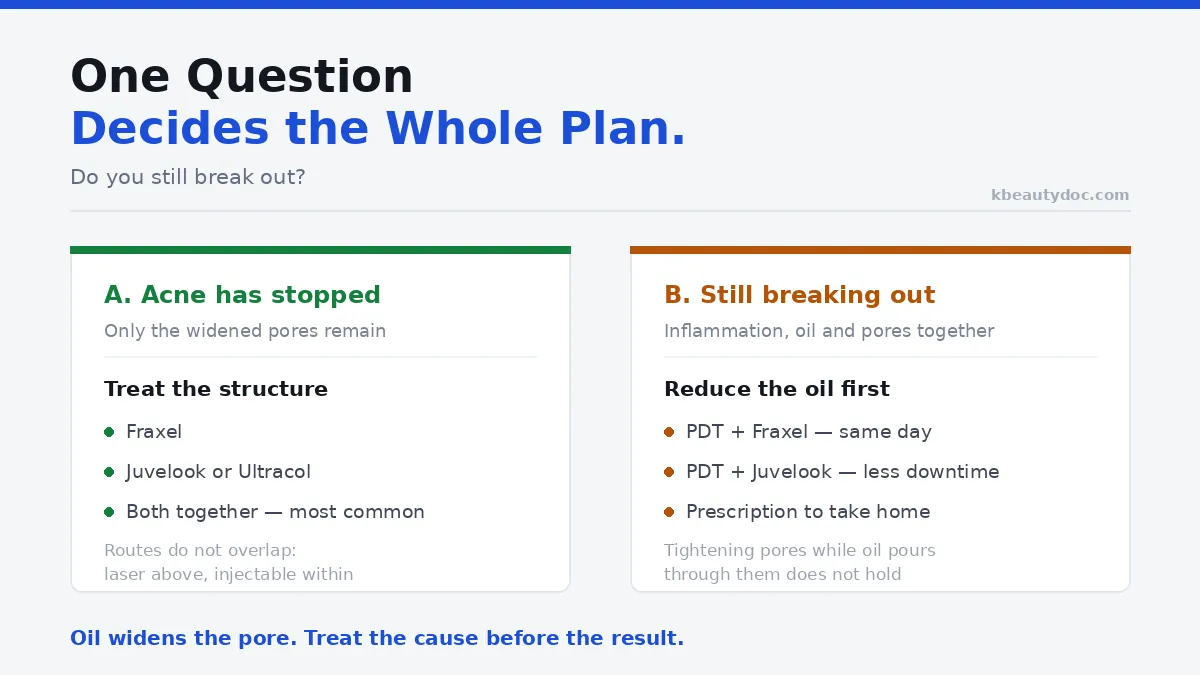
Whether you still break out is the single question that decides which pore treatment fits you — more than pore size, skin type or budget.
The short answer. If acne has stopped, treating the structure is enough: a fractional laser, a collagen-stimulating injectable, or both. If you still break out, reduce the oil first — tightening a pore while oil still pours through it means it widens again. Either way, ask for a prescription to take home before you leave the clinic; that is what decides whether the result holds.
Decide which situation you are in
A. Acne has stopped, but the pores remain. Widened pores are still there; there is no active inflammation now.
B. You still break out, skin is oily, and pores are wide. Inflammation, oil and pores are present together, so treating one alone leaves the others generating it again.
What I see most often
Clinical observation. The heaviest oil production I see is usually in people who have had it since their teens and can name a relative with the same skin. That is the group where a combination stops being optional.
The other pattern is timing. Younger patients often arrive worse during exam periods and settle over the holidays, and the weeks in between hold the same two things: late nights and refined carbohydrate, which lift insulin and the hormonal signalling that follows it. No single food causes acne. But in a randomised trial in Korean patients, ten weeks of a low-glycaemic-load diet left fewer spots of both kinds, and smaller oil glands in the skin samples taken afterwards [1]. An Australian randomised trial found the same direction of change [2], and a two-week trial found that the same kind of diet lowered IGF-1, one of the hormones that drives oil glands [3]. Saying all that in a consultation is easy; living it during an exam week is not.
Why oil widens pores
A pore is the channel oil comes out of. When oil production is high that channel is continuously filled and stretched; add keratin and it blocks, creating pressure from within that widens the opening further. Once inflammation joins in, the surrounding tissue is damaged, and as it heals the opening does not return to its original size.
A. Without active acne — treat the structure
With no inflammation, what remains is a stretched channel and weakened support around it. If your pores are not widened but sagging — they flatten when you stretch the skin — that is a different problem: pores that sag rather than widen.
Fraxel. A fractional laser addressing surface and dermis together: tissue around the pore is remodelled and texture improves alongside. Redness and flaking last several days.
Juvelook or Ultracol. Injectables that stimulate collagen formation, restoring dermal support from within so the pore is held rather than gaping. Downtime is short.
Both together. The most common choice in practice: the laser works from above and the injectable from within, so the routes do not overlap. Include the laser if you can take downtime; weight toward injectables if redness is unacceptable.
B. With active acne — reduce the oil first
This is where PDT comes in.
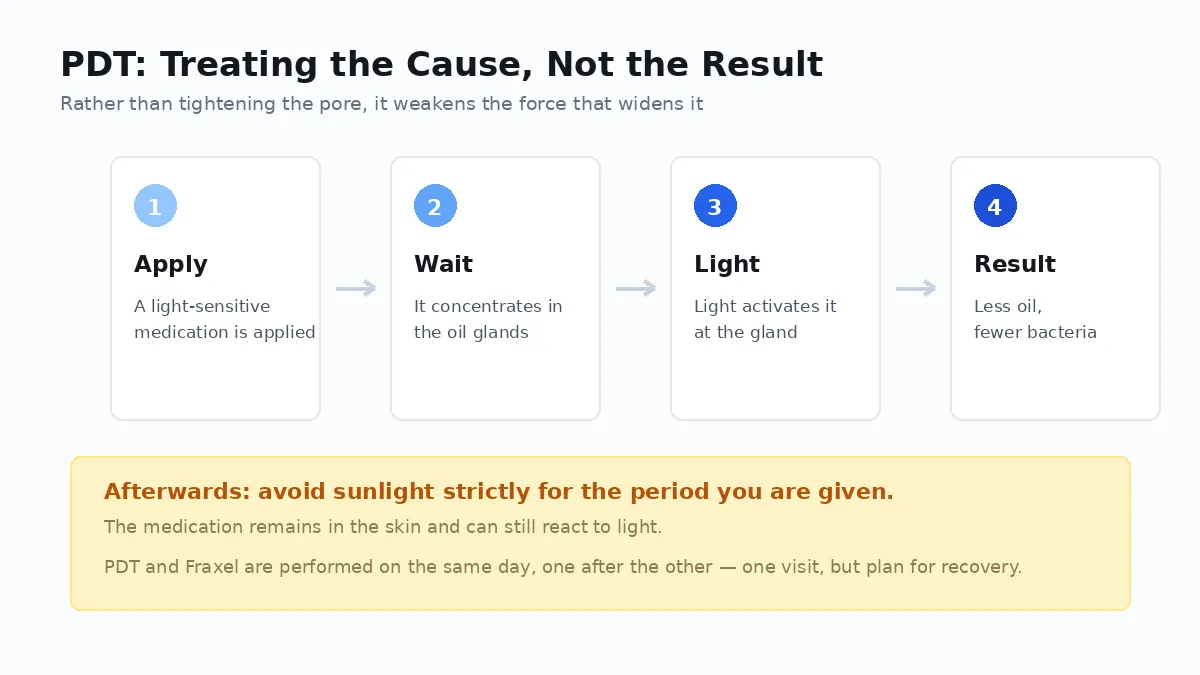
A light-sensitive medication is applied and concentrates in the sebaceous glands. Light then activates it and it acts on the gland itself, so oil production falls and the bacteria involved in acne are reduced. Rather than tightening the pore, it weakens the force that widens it.
There is downtime. Redness and flaking follow, and afterwards you must avoid sunlight strictly for a period: the medication remains in the skin and can still react to light.
PDT plus Fraxel is done on the same day, one after the other — acne, pores and texture in a single session, with the greatest downtime of the options. PDT plus Juvelook rebuilds dermal support instead, and leaving out the laser reduces redness and flaking. Finishing in one visit helps if you are travelling, but schedule it early in the trip.
What to take home for maintenance
This is the part visitors most often miss. A procedure does not stop acne returning: PDT lowers oil production, but output rises again, and if nothing is managing the skin meanwhile, breakouts resume — often within weeks of flying home. Several of these medicines are prescription-only in Korea, so getting them prescribed before you leave is the reliable route.
Topical antibiotic — clindamycin. Sold in Korea under names including Cleocin T, a 1% solution. It suppresses the bacteria involved in acne and is directly anti-inflammatory, so it works on inflamed spots and does very little for blackheads or old marks — what a topical antibiotic does and does not treat is covered here. It is not used alone indefinitely, because resistance develops.
Topical retinoid — adapalene, tretinoin and related compounds. These normalise how skin cells shed inside the follicle, which prevents the blockage that starts a spot. This is the maintenance category: antibiotics treat what is already inflamed, retinoids reduce what forms next. Expect an adjustment period — dryness, flaking and stinging are common in the first weeks, and starting every second or third night makes this easier. Retinoids are generally used from age 15, so for younger patients the antibiotic route becomes more relevant. Products pairing the two categories are often preferred: they treat both sides of acne and reduce the resistance problem.
The question that actually matters
“After this procedure, when can I start using it?” Ask before you leave. Too early, and you are applying an irritant to skin that is still recovering — particularly after a fractional laser, where the barrier is compromised for days. Too late, and the gap you were trying to cover is exactly when oil production climbs back. The timing depends on which procedure you had, so get it from the clinic that treated you. Korean pharmacies also counsel when dispensing, which makes the pharmacy a good place to ask about sequence and quantity.
Larger pores and scarring are separate matters
Everything above assumes pores widened by oil. Pores beyond a certain size need a different approach, as does acne scarring mixed in — scars divide into types by shape, and each is treated differently.
What to know
- One session is not the whole treatment. Every combination assumes a course, and pores do not disappear — making them less visible is the goal.
- Oil production is constitutional. PDT reduces it, but it rises again — this is management, not cure.
- Severe active acne needs controlling first. Treating at the height of inflammation can make things worse.
- Sun protection matters with every combination, and particularly after PDT.
FAQ
My acne cleared but the pores stayed.
Common. Even after inflammation resolves, the stretched channel and the damaged tissue around it remain. This is where structural treatment applies.
Is PDT an acne treatment or a pore treatment?
It acts on the sebaceous gland, so it relates to both — but it does not tighten the pore itself, which is why it is combined with something that does.
If I can only have one — laser or injectable?
Laser if you can take downtime and want texture addressed; injectable if redness is difficult for you.
Will my acne come back after I fly home?
PDT lowers oil production, but acne can return once output rises again. Ask for a topical prescription before you leave.
Which prescription should I ask for?
Usually a topical antibiotic such as clindamycin for inflamed spots, or a retinoid such as adapalene for preventing new ones. Which suits you depends on your acne and age.
When can I start using it after the procedure?
It depends on the procedure — a session including fractional laser has a different recovery curve from injectables alone. Ask the clinic that treated you.
What if I do not avoid sunlight after PDT?
With medication still in the skin, light can cause severe redness or a burn-like reaction. Follow the period you are given exactly.
References
- Kwon HH, Yoon JY, Hong JS, Jung JY, Park MS, Suh DH. Clinical and histological effect of a low glycaemic load diet in treatment of acne vulgaris in Korean patients: a randomized, controlled trial. Acta Derm Venereol 2012;92(3):241-246. 10.2340/00015555-1346
- Smith RN, Mann NJ, Braue A, Makelainen H, Varigos GA. A low-glycemic-load diet improves symptoms in acne vulgaris patients: a randomized controlled trial. Am J Clin Nutr 2007;86(1):107-115. 10.1093/ajcn/86.1.107
- Burris J, Shikany JM, Rietkerk W, Woolf K. A low glycemic index and glycemic load diet decreases insulin-like growth factor-1 among adults with moderate and severe acne: a short-duration, 2-week randomized controlled trial. J Acad Nutr Diet 2018;118(10):1874-1885. 10.1016/j.jand.2018.02.009
Disclaimer: This article explains treatments in general terms and is not a diagnosis or a treatment plan. What happens varies from person to person, and no article can tell you what to expect. Please discuss your own case with a licensed medical professional where you live. I do not endorse specific clinics or device brands.

Physician in non-surgical aesthetic medicine, practising in Ansan, South Korea. Every article here is written from clinical practice and the published literature.
About the author · Contact