An ingredient can pass eye-safety testing and still sting.
In short: safety tests ask whether tissue is damaged, while stinging is a pain nerve firing. Sweat from your forehead carries sunscreen into your eyes, and “water resistant” is tested in a pool, not in sweat. The fix is not one perfect product but a different formula for each part of the face.
So what should you do?
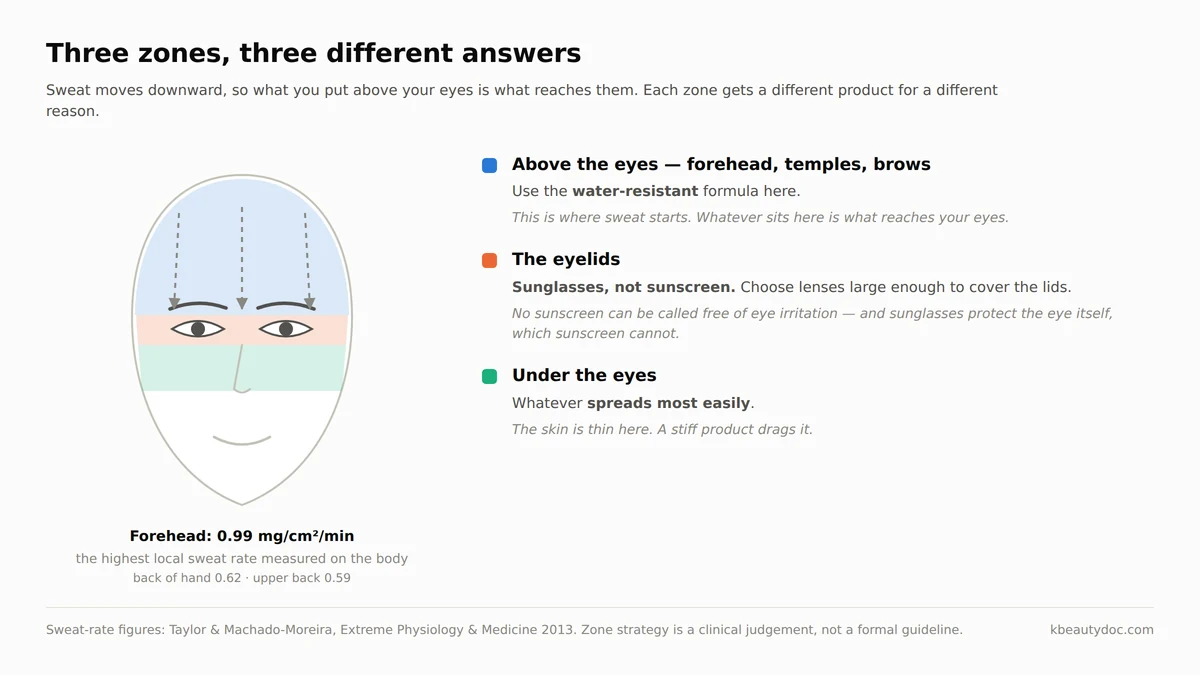
Above your eyes — forehead, temples, brows: the water-resistant formula. This is where sweat starts, and gravity does the rest. Whatever is on your forehead ends up in your eyes.
On the eyelids: rely on sunglasses, not sunscreen. No sunscreen is free of eye irritation. Sunglasses also protect what sunscreen cannot — the eye itself. Choose lenses that cover the lids: large or wraparound.
Under the eyes: use whatever spreads most easily. The skin there is thin, and a stiff product drags it.
Give it time to settle. Apply 15 to 20 minutes before going out; sunscreen that meets sweat before it sets will run.
If it gets in, rinse immediately. Lukewarm running water for 15 to 20 minutes, blinking. Do not rub; take contact lenses out first.
It passed the safety test. It still stings.
Eye-safety testing asks one question: does this damage tissue? Stinging is not damage; it is a pain sensor switching on. Very cold water hurts without injuring you: the nerve fires, the tissue is fine.
Researchers showed this gap with 19 baby bath and shampoo formulas: what people reported feeling did not line up with the standard laboratory irritation tests at all. A test measuring a pain receptor called TRPV1 picked out six of the seven formulas that stung [1].
The same approach was then applied to sunscreen filters. Octocrylene and octinoxate both came out non-irritant on the standard tests. Only octocrylene switched on the pain receptor [2].
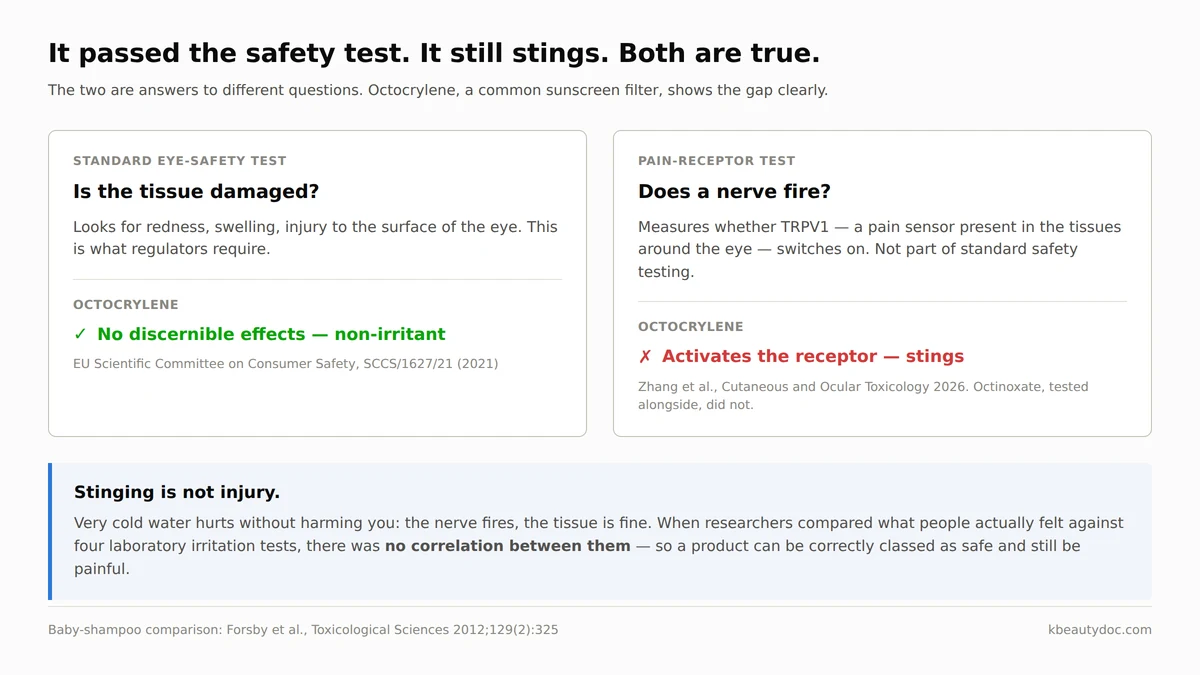
Put those together and your experience makes sense. The product is not defective and the testing is not wrong; they answer a different question from yours, which is whether it will hurt. This is also why hunting for one “bad ingredient” disappoints — where the product sits on your face matters more than which filter is in it.
It starts on your forehead
If it only stings when you sweat, that is the clue. Sweat mapping in athletes found the forehead the wettest part of the face by a wide margin — several times the rate measured on the cheeks or chin [3].
So the sweatiest part of your face sits directly above your eyes, and everything there drains downward. The sunscreen is not attacking your eyes; it is being carried there. Some golfers already use a sturdier product on the forehead and something lighter beneath — experience rather than research, but the right direction.
“Water resistant” is not a sweat test
In the United States a product may say Water Resistant (40 minutes) or (80 minutes). To earn it, the wearer exercises in water, rests without towelling, repeats, air-dries, and the SPF is measured again. Europe compares SPF before and after immersion, and passes the product if at least half the protection remains.
But neither test uses sweat. Both are immersion tests, in fresh water, indoors. The label then tells you to reapply after 40 or 80 minutes of “swimming or sweating“, as if the two were the same. I could not find a recognised standard that tests sweat resistance directly.
That gap is the honest answer to “why does my swim-proof sunscreen run into my eyes on a hot day”. Cosmetics face it from the other side: waterproof makeup versus regular makeup stays put because of film formers, which is why it needs oil to remove. For the rest of a Korean label — SPF, PA rating, filter type — there is a separate guide.
One caution about my own advice: no head-to-head study shows water-resistant formulas reach the eyes less often. The mechanism is sound and it matches what my patients report, but it is clinical judgement, not a proven fact.
“Tear-free” is a marketing phrase, not a standard
Parents assume a children’s product is gentler. Take one children’s “Tear Free” mineral sunscreen as registered with US regulators: alongside zinc oxide it contains octinoxate and octisalate — chemical filters — plus parabens and a formaldehyde-releasing preservative. What was removed was fragrance, dye and oil. It carries the same warning as every other product: keep out of eyes.
There is no regulated definition of “tear-free”. Companies support the claim with questionnaires or a supervised eye-drop test — a test passed, not ingredients left out.
The problem that is bigger than stinging
Researchers photographed faces with a UV camera after people applied sunscreen. The eyelid area was missed twice as often as the rest of the face — a median 14% of it left bare, against 7% elsewhere — and the inner corner of the eye kept being skipped even after people were told it mattered [4].
A second study of 84 people compared sunscreen with an SPF moisturiser, assuming people avoided the area because it stings. The moisturiser did worse, and participants had no idea they had missed anything [5]. So this is not deliberate avoidance — people simply do not know they left a gap.
The inner corner of the eye is a common site for skin cancer. That is why my answer for the lids is sunglasses rather than “try harder” — but only if the lenses genuinely cover the area. If you would rather apply something, a stick is what the American Academy of Dermatology suggests.
If it does get in
It is usually temporary. Discomfort lasting a few hours has been reported, without lasting damage.
Rinse straight away rather than waiting. Hold your eye under a running tap and keep blinking for fifteen to twenty minutes, then rest. Do not rub, and remove contact lenses first.
What actually protects your eyes
I could not find evidence that sunscreen ingredients on skin affect cataract or macular degeneration risk. Ultraviolet light itself is an established risk factor for both.
So the conclusion is not to use less sunscreen. Sunscreen is for skin, and your eyes need their own protection — UV-blocking sunglasses and a wide brim. A brim helps twice: it shades the eyes and slows the sweat coming down your forehead.
And after a laser or energy-based treatment in Korea, sun protection stops being cosmetic — covered separately here.
FAQ
Why do only some sunscreens sting my eyes?
Filters differ in whether they switch on the eye’s pain receptors, which is separate from whether they count as irritants. Octocrylene is classed as non-irritant yet activated TRPV1 in testing; octinoxate did not [2].
It says it passed safety testing. Why does it hurt?
Safety testing asks whether tissue is damaged; stinging is a nerve firing, not injury. When researchers compared what people felt against the standard laboratory tests, the two did not match [1].
Is mineral sunscreen less likely to sting?
Often said, but I could not find a clinical study comparing mineral and chemical sunscreens for eye stinging. Reasonable to try, not an established fact.
Why does it only sting when I sweat?
Your forehead is the sweatiest part of the face and sits above your eyes, so sweat carries the product down [3]. Water resistance helps less than expected, because it is tested by immersion, not sweating.
Should I use different sunscreens on different parts of my face?
It is what I suggest: a water-resistant formula above the eyes, something that spreads easily underneath, sunglasses on the lids. Clinical judgement, not a formal guideline.
I got sunscreen in my eye. What should I do?
Rinse with lukewarm running water for 15 to 20 minutes, blinking, and remove contact lenses first. Do not rub. If pain, redness or blurred vision persists afterwards, see a doctor.
Does “tear-free” mean it is safe for eyes?
It is not a regulated term. Products carrying it can still contain chemical filters and preservatives, and still carry the warning to keep them out of the eyes.
References
- Forsby A, Norman KG, El Andaloussi-Lilja J, et al. Using novel in vitro NociOcular assay based on TRPV1 channel activation for prediction of eye sting potential of baby shampoos. Toxicological Sciences 2012;129(2):325-331. PMID 22705807
- Zhang T, Sun F, Liu Y, et al. Leveraging a TRPV1-overexpressing cell model: an integrated testing strategy for UV filter-induced ocular irritation. Cutaneous and Ocular Toxicology 2026;45(2):243-250. PMID 41985167
- Smith CJ, Havenith G. Body mapping of sweating patterns in male athletes in a hot, humid environment. European Journal of Applied Physiology 2011;111(7):1391-1404. PMID 21153660
- Pratt H, Hassanin K, Troughton LD, et al. UV imaging reveals facial areas that are prone to skin cancer are disproportionately missed during sunscreen application. PLoS One 2017;12(10):e0185297. PMID 28968413
- Lourenco EAJ, Shaw L, Pratt H, et al. Application of SPF moisturisers is inferior to sunscreens in coverage of facial and eyelid regions. PLoS One 2019;14(4):e0212548. PMID 30943192
Disclaimer: I write about cosmetics and shops as general information, not as a recommendation of any particular product or retailer. I receive no sponsorship, samples or payment from the brands mentioned. Skin responds differently from person to person, so patch test anything new, and see a doctor about a skin condition.

Physician in non-surgical aesthetic medicine, practising in Ansan, South Korea. Every article here is written from clinical practice and the published literature.
About the author · Contact