
I want a doctor who actually looks.

So that’s what worries you, right?
Yes.
Let me explain what to check before you book.
Can I check from abroad?
Most of it, yes. One message does it.
You cannot search for “non-factory” on a map. But you can find out in one message.
Short answer:
- “Non-factory” is not a label or a licence. It shows in how a clinic spends time on you.
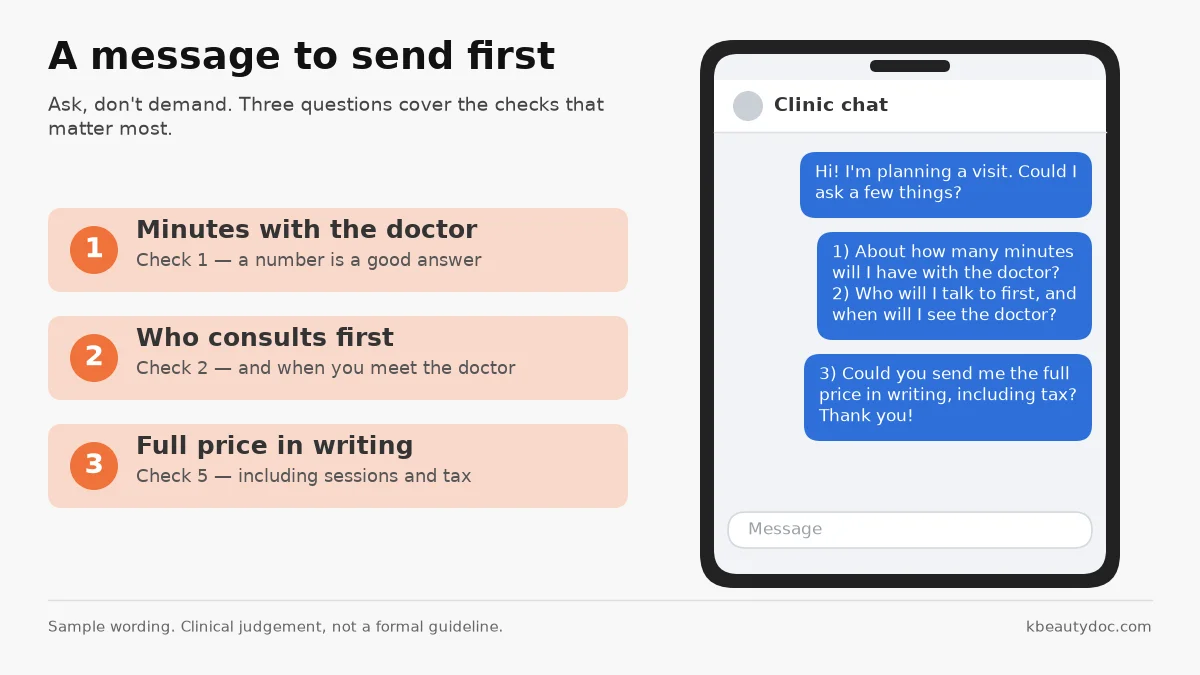
- Most checks fit in one booking message: minutes with the doctor, who consults first, who is there on the day, a written price.
- Then read reviews with care, and check photos and records on the day.
Why can’t I just look it up?
Because it is not an official category. Big and busy does not mean careless, and small does not mean careful.
What you really want is time with the doctor and a plan made for your skin. The checks below tell you, before you pay, whether you will get both.
If you want the background first, here is how the high-volume model works.
What are the 7 things to check?
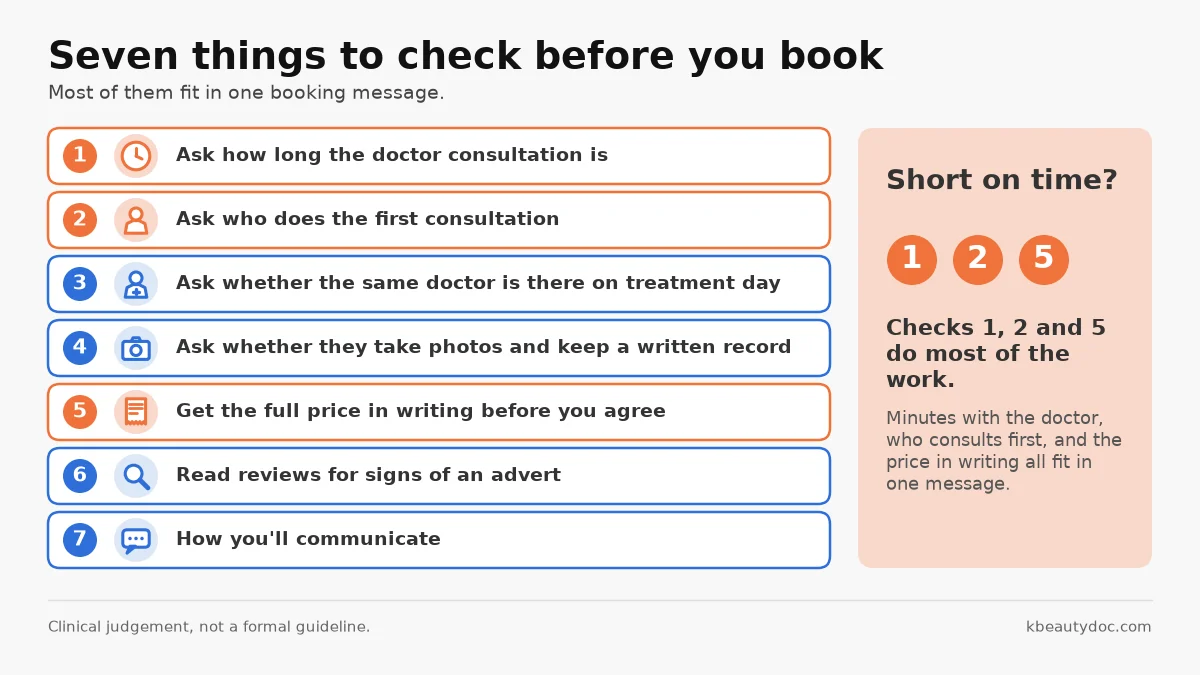
1. Ask how long the doctor consultation is. Put it in your booking message: “How many minutes will I have with the doctor?” A number is a good answer. “The doctor will check briefly” tells you the structure too.
2. Ask who does the first consultation. In Korea a coordinator often talks to you first. That is common, and it surprises many visitors. It is not a bad sign on its own. Just ask: “When will I talk with the doctor, and for how long?” The answer shows when you get time with the doctor, and how much.
3. Ask whether the same doctor is there on treatment day. Ask: “Will the same doctor confirm the plan on the day?”
4. Ask whether they take photos and keep a written record. Before-photos in the same light, and a written note of the product, amount and settings. You will want this record for your next doctor.
5. Get the full price in writing before you agree. Korean law requires clinics to show prices for uninsured treatments clearly, and bans charging more than the posted amount [1]. Ask for the total, including sessions, numbing cream and tax. It is also fair to ask about medical liability insurance; in my experience, most doctor-run clinics carry it.
6. Read reviews for signs of an advert. Korean law bans medical ads built on patient reviews that could mislead [2]. Even so, in a 2022 check of 415 online posts, the health ministry flagged 286 as illegal medical ads [3]. Watch for “sponsored” or “supported” wording, and a “review” that lists the address, phone number and price. Ordinary reviews often mention a downside, like redness or waiting time.
7. Ask how you’ll communicate. In a doctor-run clinic, a translation app like Papago or Google Translate is normal, not a bad sign. We use one at my clinic too. In my experience, an interpreter in the middle can be the harder part: you cannot check what the doctor really said. With an app on a screen, you both see the same words.
Before you go, write your skin problem, your worries and what you want in short English, and show it to the doctor. Korean doctors read English well; we all studied hard for it, and reading is more exact than talking. Get the consent form and price in writing too.
What I tell my patients about the answers
Listen to how a clinic answers, not only what it answers. A calm, specific reply is information. So is silence.
A good answer also names a limit: “this will soften it, not erase it.” When a clinic tells you what a treatment will not do, it is usually telling you the truth about the rest. That is my clinical judgement, not a proven fact.
Short on time? Checks 1, 2 and 5 do most of the work. For what to bring and when to book, see what to know before a skin clinic visit in Korea.
FAQ
Is there a list of non-factory clinics in Korea?
No. “Non-factory” is not a legal category, so use the seven checks.
Do Korean clinics charge for a consultation with the doctor?
Often, yes. In my experience, a first doctor visit usually carries a small consultation fee (often around 10,000–20,000 won). That is not a bad sign. It means the doctor is setting aside time for you.
Have a question about your own case? Ask me on LINE or by email — details on the Contact page.
References
- Medical Service Act (Republic of Korea), Article 45 — notice of non-covered medical fees; clinics may not charge more than the amount notified. Text (Korean)
- Medical Service Act (Republic of Korea), Article 56(2)(2) — ban on advertising with patient treatment reviews that may mislead consumers about results. Text (Korean)
- Ministry of Health and Welfare, Korea. Press release on 286 illegal medical advertisements, including treatment-review ads, 18 April 2022. mohw.go.kr
Disclaimer: This guide is intended to help international visitors understand the Korean aesthetic medical system. I do not provide clinic recommendations or endorse specific facilities. Nothing here is personal medical advice, and decisions about your own care belong with a licensed doctor who has examined you.
14 years in practice · replies to messages herselfPhysician in non-surgical aesthetic medicine, practising in Ansan, South Korea. Every article here is written from clinical practice and the published literature.
About the author · Contact