Three things to know first
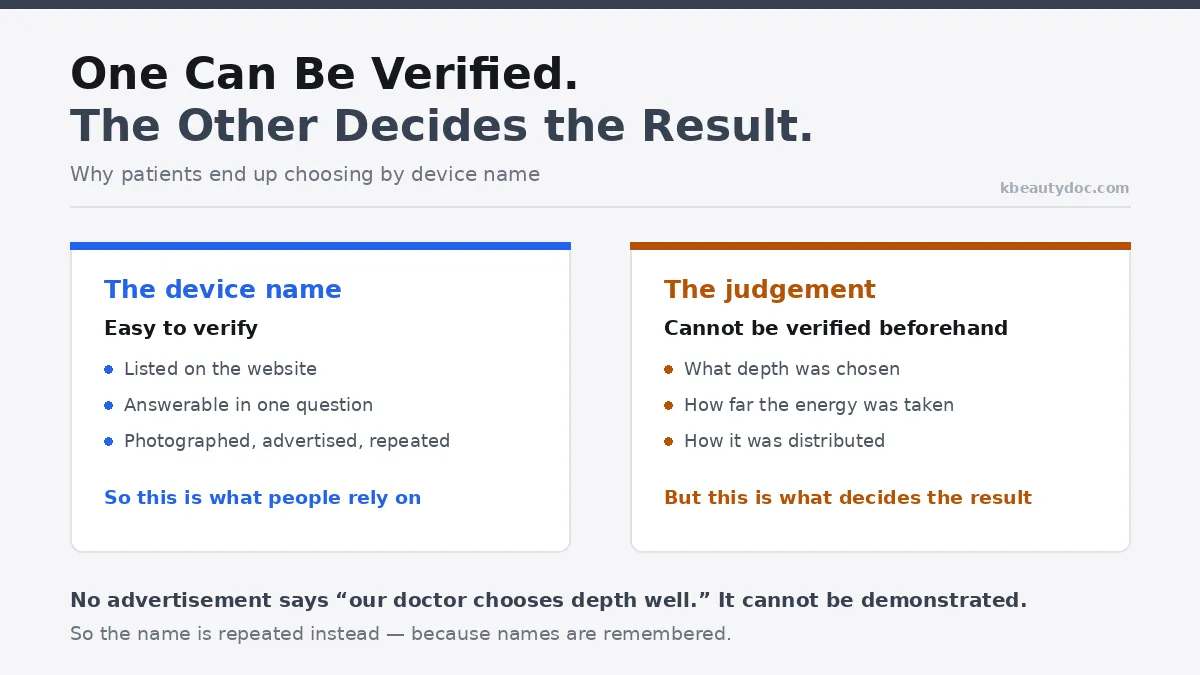
- There is a reason patients arrive with a machine name. A doctor’s judgement cannot be verified. A device name can.
- It used to be who performed it that decided the result. Now it is what the device is called.
- In that gap, the less advertised options get skipped.
When I started practising
The same device produced different results.
A clinic down the road would have the identical machine, and one set of patients would be satisfied while another was not. The reason was never mysterious. What depth was chosen, how far the energy was taken, how many sessions, how it was distributed region by region. The device was a tool; what was done with it decided the outcome.
So the question then was about a person. Who should perform it.
What happens in the consultation room now
These days patients say:
“Do you have [device name]?”
Not what is bothering them — a product name first. Usually without knowing why that device would suit them. They saw it somewhere.
This is not the patient’s fault. They are not thinking about it wrongly. The environment was built to produce exactly this.
Why it happened
The reason is simple. It is a difference in what can be verified.
A device name can be checked. Whether a clinic has it has an answer: the website, the photographs.
A doctor’s judgement cannot be checked. You can find out how many years someone has practised, but not whether they will choose the right depth on your face — not until afterwards. And most people judge from a single session.
People rely on what can be verified. That is rational.
And marketing invests precisely there. Capital arrives, brands are built, patients learn device names. No advertisement says “our doctor chooses depth well.” It cannot be demonstrated. So the name is repeated instead, because names are remembered.
Nobody did anything wrong. And yet the outcome is not good.
What gets skipped
First, the fact that the same device produces different results
Almost every article here repeats the point. The radiofrequency article says shot count and energy settings decide the result. The ultrasound article says tissue depth varies, so experience is required. The acne article says the device is only a tool.
There is a reason for the repetition. It is true.
Second, the less advertised options
Korea has companies manufacturing devices across ultrasound, radiofrequency, microwave and shockwave categories. Many of them do not have large marketing budgets.
That is a question of budget, not performance. Devices are sold to clinics, not to patients. For a name to reach patients, a separate expense is required — and only the companies who can afford that expense become names patients know.
So patients see a portion of the available options. And that portion tends to be the most expensive one.
You may already know this
One thing worth pointing out.
Korea manufactures home beauty devices in volume and sells them worldwide. The ones you bought at duty free.
Producing small ultrasound transducers, radiofrequency circuits, temperature control and safety cut-offs at consumer prices and scale means the base of components, manufacturing and certification is substantial.
And clinical devices sit on the floor above. A home device is an output-limited version, not a different technology. It is one industry divided into tiers.
Which produces something curious. People buy the Korean home device, then go to a clinic and ask for a foreign brand.
The explanation is straightforward. Home devices are advertised directly to consumers, so their names are known. Clinical devices are not. That is a difference in exposure, not in performance.
What this site has covered
I am not going to introduce anything new here.
A considerable number of the devices whose mechanisms this site has explained are manufactured in Korea and widely used domestically. They appear in the radiofrequency article, the ultrasound article, the botulinum toxin article and the collagen stimulator article.
I am not going to restate the case for each of them. The evidence is in those articles; read them if you are interested.
Giving you a list of good Korean devices is not the purpose of this article. That would only be asking you to memorise a different set of names — repeating exactly the problem I am describing.
If there is a case for going into specifics, that belongs in a separate article.
So what should you do
Do not arrive with a device name. Arrive with a concern.
Not “I want [procedure]” but “the line between my brows when I frown bothers me.”
There is a reason. Name a treatment and you will usually receive it. Describe the concern and the doctor decides what fits. That is what an examination is — and what to check before booking a Korean clinic starts from the same place.
And ask this: “Why does this suit my case?”
If the answer is an explanation, that is a good sign. If it is a recommendation, or a description of the equipment, it is worth pausing.
“What did you see in my skin that led you to that?”
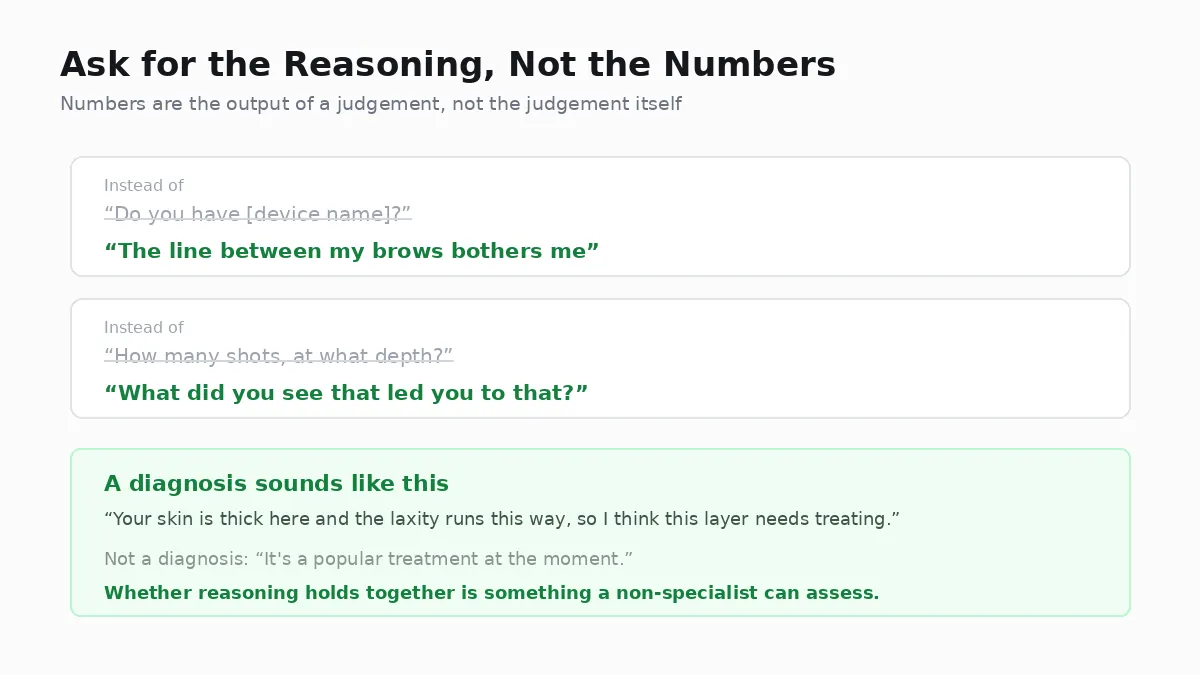
Hearing the reasoning is more useful than collecting numbers. Even if you are told the depth and the shot count, you still cannot tell whether those numbers suit you. The numbers are the output of a judgement, not the judgement itself.
But you can tell whether the reasoning holds. “Your skin is thick here and the laxity runs this way, so I think this layer needs treating” — that is a diagnosis. “It’s a popular treatment at the moment” is not.
Whether reasoning holds together is something a non-specialist can assess.
But what if you barely speak to the doctor?
At larger clinics a coordinator handles most of the consultation and the doctor appears briefly. So how do you judge how the doctor will practise?
The depth of the coordinator’s knowledge is one indicator.
What the staff know is what the doctor taught them. How a clinic works shows up in how that person explains things.
And there is a practical dimension. If the person consulting with you answers your questions properly, they can convey your concerns and your goals to the doctor properly. If they cannot answer, the conveying is unlikely to be better.
What I would like
I am not a doctor who treats international patients in Gangnam or Myeongdong. I practise in Ansan, Gyeonggi Province, treating Korean patients.
So I am not writing this to bring you to my clinic.
But here is how I see it. Korea has companies making good devices, it has skilled practitioners, and by international standards it has reasonable pricing.
When those three meet, the result is good. But choosing a clinic by a device name breaks that meeting. I see people who received the most expensive name, delivered at the shallowest setting, and flew home.
I would rather you arrived informed, paid sensibly, left satisfied, and came back. That is why I wrote this.
FAQ
So the famous devices are bad?
Not at all. Well-known devices generally have solid validation and plenty of published data. But being well known and being right for you are separate questions.
Is a clinic using a lesser-known device better?
Also no. The point is not to judge a clinic by how famous its equipment is — and that works in both directions.
Then how do I choose a clinic?
By the quality of the consultation. Whether they examine your skin, ask about your history, explain why that treatment, and tell you its limits. That predicts the result better than an equipment list.
I barely spoke to the doctor — how do I judge?
The coordinator’s explanation is an indicator. What the staff know is what the doctor taught them. And if they answer your questions properly, they can convey your concerns properly too.
Are Korean devices cheaper?
Generally yes, because there are fewer imported consumables. But choosing by price alone is the same category of mistake as choosing by name.
Can you tell me which Korean devices are good?
Not in this article. Asking you to memorise a different set of names repeats the same problem. The mechanisms and evidence are in the individual treatment articles on this site — read those, and let the judgement happen in the consulting room.
Disclaimer: This guide is intended to help international visitors understand the Korean aesthetic medical system. I do not provide clinic recommendations or endorse specific facilities. Nothing here is personal medical advice, and decisions about your own care belong with a licensed doctor who has examined you.
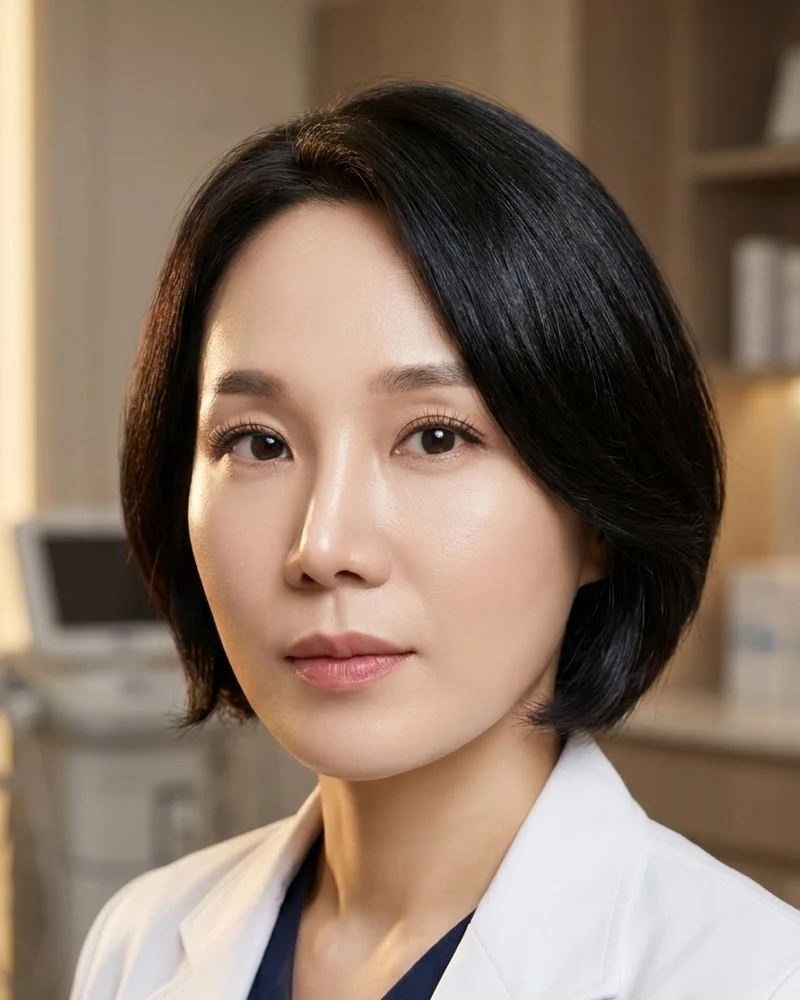
Physician in non-surgical aesthetic medicine, practising in Ansan, South Korea. Every article here is written from clinical practice and the published literature.
About the author · Contact