The short answer
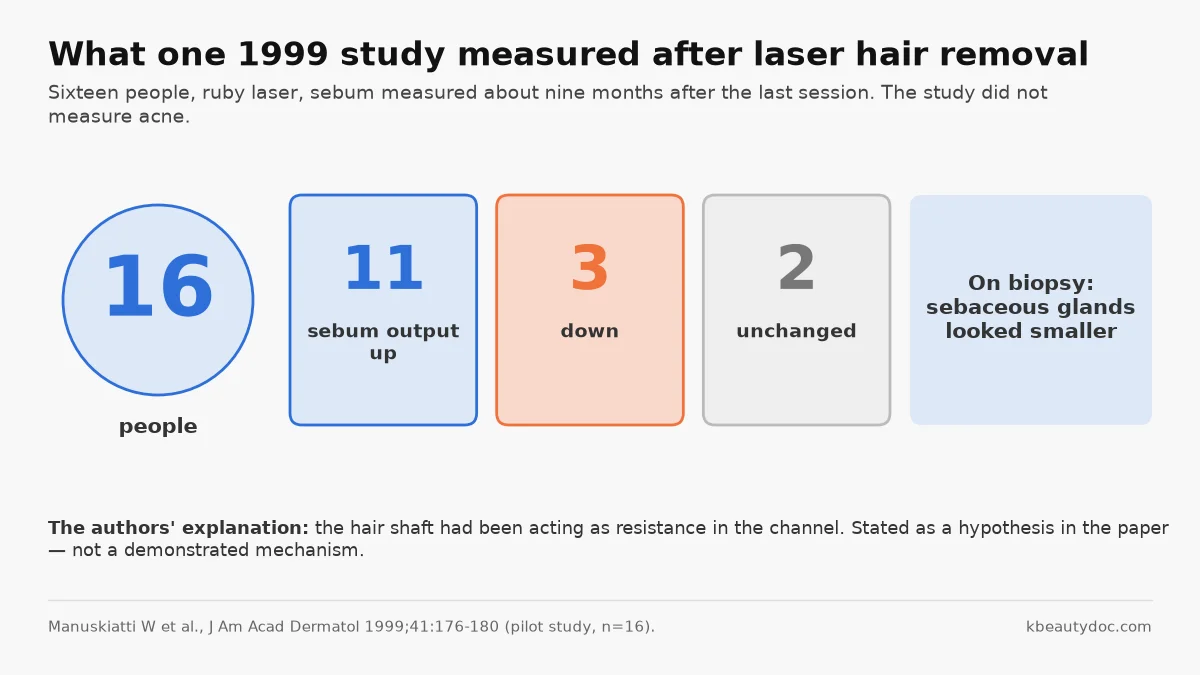
Removing hair from a follicle changes how easily oil leaves it. The one study that measured this — a 1999 pilot study — found that after ruby laser hair removal, sebaceous glands looked smaller on biopsy while measured sebum output at the surface went up [1]. The authors’ own explanation was that the hair shaft had been acting as resistance in the channel, and that removing it let oil out faster.
That finding is the seed of a plausible explanation for why some hair-related breakouts settle after hair reduction. But be clear about what it is not. That study did not measure acne. The steps from “oil leaves faster” to “so fewer spots form” are mechanism, not evidence. Below I separate what is established, what was observed, and what remains hypothesis.
What the 1999 study actually measured
Sixteen people. Ruby laser, high fluences. Sebum excretion rate measured with absorbent tape on treated skin and on adjacent untreated skin, on average nine months after the last session.
The result was not uniform. Eleven of sixteen showed a statistically significant increase in sebum excretion. Three showed a decrease. Two showed no difference. Biopsies — taken in a small subset — showed what the authors described as an apparent reduction in sebaceous gland size, with sporadic gland damage on specimens taken immediately after irradiation.
The honest summary: in most but not all subjects, less hair meant more oil arriving at the surface, from glands that appeared smaller. The authors proposed decreased resistance to sebum outflow, following miniaturisation or absence of the hair shaft. That is their hypothesis, stated as such in the paper — not a demonstrated mechanism.
And more oil at the surface is not automatically good news for acne. It can be read either way. The argument that it helps rests on where the oil is, not how much of it there is.
The five steps in the reasoning
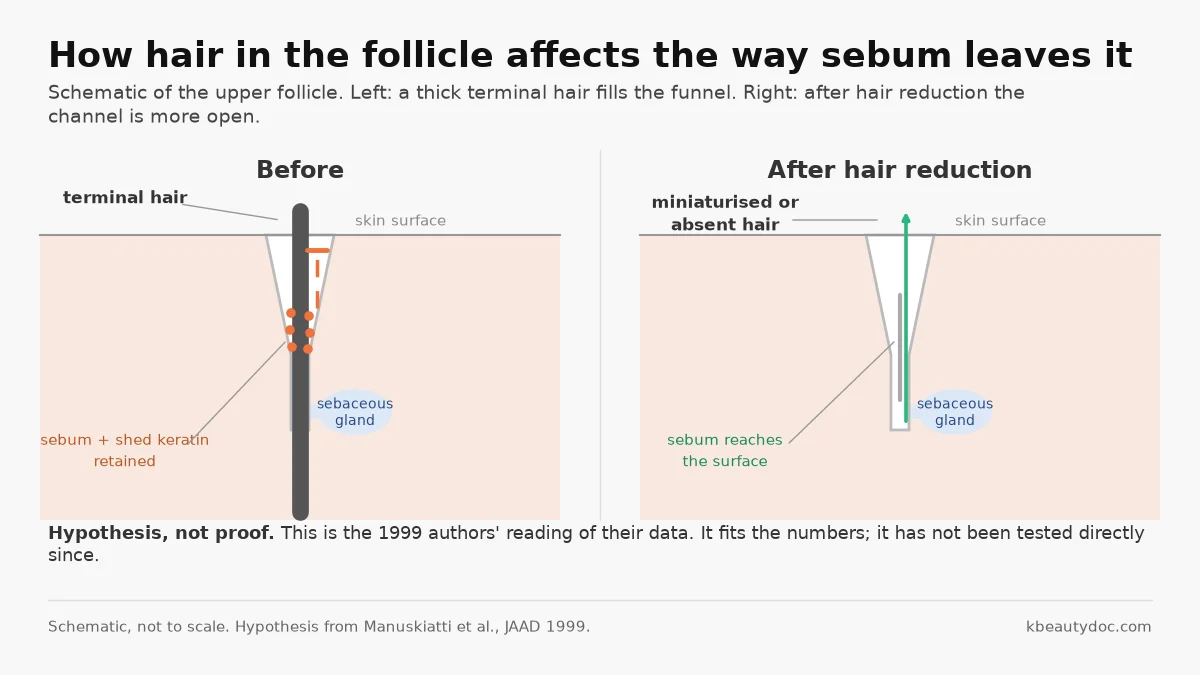
1. Outflow resistance. Established anatomy, hypothesised effect. The sebaceous gland empties into the infundibulum — the funnel-shaped upper follicle — and a thick terminal hair occupies much of that space. That much is anatomy. That the hair acts as meaningful friction, and that removing it drops resistance enough to change flow, is the 1999 authors’ reading of their own data. It has not, as far as I can find, been directly tested since.
2. Microcomedone formation. Established mechanism, hypothesised link. The earliest acne lesion is a microcomedone formed when sebum and shed keratinocytes are retained inside the follicular canal. If the canal drains more freely, retention is less likely — that is the argument. No trial has counted comedones before and after laser hair removal, so this step is inference.
3. Oxygen in the follicle. Established microbiology, hypothesised link. Cutibacterium acnes favours the lipid-rich, oxygen-poor depths of the pilosebaceous unit, and a plugged follicle is what creates that environment. A more open channel may be less hospitable. Whether laser hair removal shifts follicular oxygen tension enough to matter has not been measured.
4. Follicular rupture. Established mechanism, hypothesised link. Inflammatory acne — the tender, deep kind — largely follows rupture of a distended follicle wall into the dermis, as pressure builds behind an obstruction. If outflow is easier, that pressure may not build the same way. Reasonable; not demonstrated for laser hair removal.
5. Dwell time and free fatty acids. Established chemistry, hypothesised link. Bacterial lipases split sebum triglycerides into free fatty acids, which are more irritating and more viscous than what they came from. That takes time, and sebum that leaves quickly spends less time being worked on.
Where there is trial evidence — and it is a different mechanism
The clinical literature on laser hair removal reducing inflammatory lesions is real, but it comes from conditions where the hair itself is the irritant.
- Long-pulsed Nd:YAG for pseudofolliculitis barbae in skin types IV–VI: ninety days after one submental treatment, the treated side had far fewer papules than the control side [2].
- Two Nd:YAG sessions three to four weeks apart in skin types V and VI: significant reductions in papules, pustules and hairs at one, two and three months [3].
- Five Nd:YAG sessions in acne keloidalis nuchae: biopsies showed a marked drop in inflammatory infiltrate [4].
- A within-patient randomised trial in acne keloidalis nuchae: the laser-plus-steroid side improved more than steroid alone, most clearly in papular disease [5].
In all of these the mechanism is ingrown or curved hair acting as a foreign body, which hair reduction takes away. That is not the outflow-resistance story. Both can be true at once, but they are separate arguments, and only the foreign-body one has controlled trials behind it.
No trial has tested laser hair removal as a treatment for ordinary acne vulgaris. If someone tells you otherwise, ask for the paper.
What I see in clinic
Clinical observation, offered as such. I do a lot of hair removal. Patients with dense beard or body hair and recurrent bumps in those areas often report fewer of them once density drops — and separately, some say treated skin feels shinier than before. Both match the picture above. Neither is data.
The second one is worth planning around. If the face becomes oilier at the surface, that is a change to manage rather than a complication. How sebum relates to pore appearance is a separate subject, and for inflamed spots the options are the usual ones — including the topical antibiotic route.
Practical points
Sessions are spaced 3–4 weeks apart, because hair is treatable only during part of its growth cycle. A course is assumed; one session is not the treatment.
The effect on hair is reduction and thinning, not elimination. Regrowth tends to come back finer — the miniaturisation the 1999 paper was describing. That smoothing is now sold under a different heading: a hair removal platform marketed as a lifting laser.
Coarse curly hair on darker skin is where the evidence for reduced inflammatory papules is strongest, and where device choice and settings matter most.
Home devices are a different tool, and the trials above do not transfer to them. Reading the manual properly matters more than people expect.
Active inflammation changes the plan. Whether to treat a breaking-out area now or later is an examination question.
FAQ
Does laser hair removal treat acne?
No trial has tested it as an acne treatment. What exists is trial evidence for reduced inflammatory papules in pseudofolliculitis barbae and acne keloidalis nuchae — conditions driven by the hair itself — plus a mechanism argument extrapolated from a small 1999 sebum study.
The study says sebum went up. Isn’t more oil worse for acne?
A fair objection, and the study cannot settle it. The argument for benefit is about oil moving out rather than being retained inside the follicle. Retention is what forms the early lesion; surface oil is a cosmetic matter.
Did everyone in the study show more sebum?
No. Eleven of sixteen increased, three decreased, two were unchanged. It was a pilot study of sixteen people and should be read as such.
If the glands got smaller, why did output rise?
That is the puzzle the authors were trying to explain, and their answer was reduced resistance in the channel once the hair shaft was gone or miniaturised. A hypothesis that fits the data, not a proven mechanism.
Will my face get oilier after hair removal?
Some people notice more shine in treated areas and some do not. The study found a mix of increases, decreases and no change, so there is no single answer to expect.
How far apart are sessions?
3–4 weeks in the protocols used here, because hair is treatable only during part of its growth cycle.
What should I ask at a consultation?
Whether your hair and skin type suit the device available, how many sessions the plan assumes, whether breakouts in the area change the timing, and what to expect in the skin afterwards. What fits you specifically needs someone to examine the area.
References
- Manuskiatti W, Dierickx CC, González S, et al. Laser hair removal affects sebaceous glands and sebum excretion: a pilot study. J Am Acad Dermatol 1999;41(2):176-180. DOI: 10.1016/S0190-9622(99)70045-9
- Ross EV, Cooke LM, Timko AL, et al. Treatment of pseudofolliculitis barbae in skin types IV, V, and VI with a long-pulsed neodymium:yttrium aluminum garnet laser. J Am Acad Dermatol 2002;47(2):263-270. DOI: 10.1067/mjd.2002.124081
- Weaver SM, Sagaral EC. Treatment of pseudofolliculitis barbae using the long-pulse Nd:YAG laser on skin types V and VI. Dermatol Surg 2003;29(12):1187-1191. DOI: 10.1111/j.1524-4725.2003.29387.x
- Esmat SM, Abdel Hay RM, Abu Zeid OM, Hosni HN. The efficacy of laser-assisted hair removal in the treatment of acne keloidalis nuchae; a pilot study. Eur J Dermatol 2012;22(5):645-650. DOI: 10.1684/ejd.2012.1830
- Woo DK, Treyger G, Henderson M, et al. Prospective controlled trial for the treatment of acne keloidalis nuchae with a long-pulsed neodymium-doped yttrium-aluminum-garnet laser. J Cutan Med Surg 2018;22(2):236-238. DOI: 10.1177/1203475417739846
Disclaimer: This article explains treatments in general terms and is not a diagnosis or a treatment plan. What happens varies from person to person, and no article can tell you what to expect. Please discuss your own case with a licensed medical professional where you live. I do not endorse specific clinics or device brands.

Physician in non-surgical aesthetic medicine, practising in Ansan, South Korea. Every article here is written from clinical practice and the published literature.
About the author · Contact