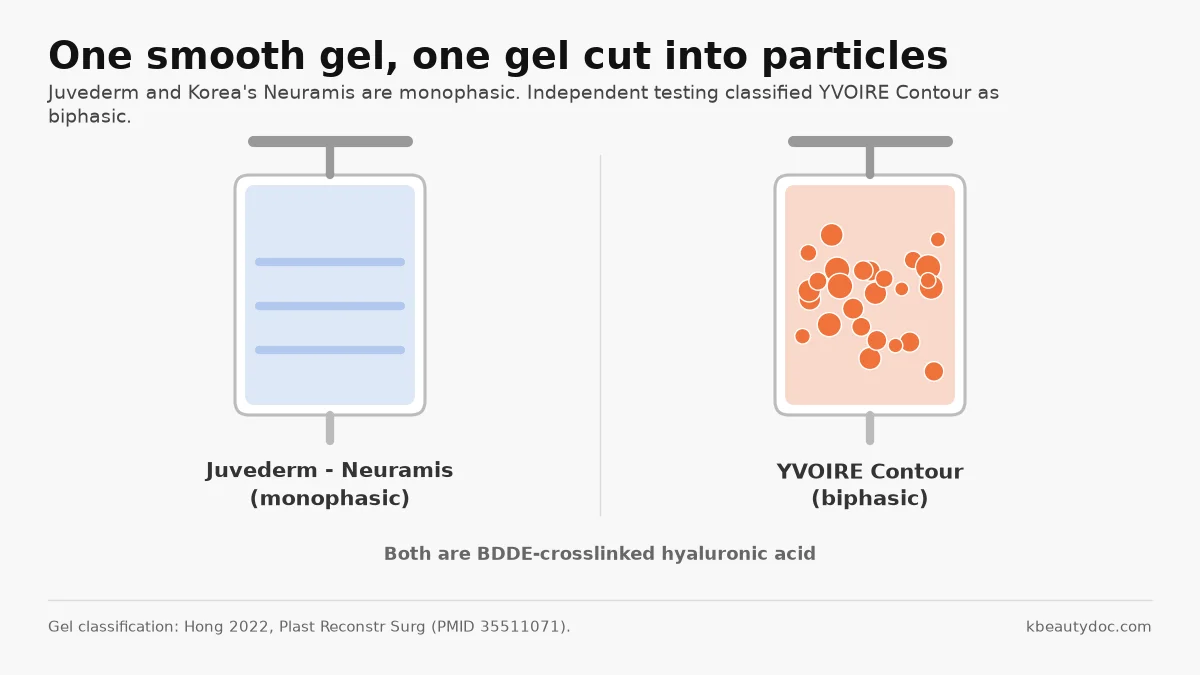
Every hyaluronic acid filler on a Korean clinic menu — the imported one you flew in knowing about and the domestic one you have never heard of — is the same sugar, stiffened with the same chemical. What separates them is how the gel was cut.
The short answer
- Juvederm (Allergan/AbbVie) is a monophasic gel: one smooth mass, no separate particles.
- Among Korean brands, Neuramis (Medytox) is monophasic, YVOIRE (LG Chem) was classified biphasic — a particle gel — in independent testing, and Chaeum (Hugel) is sold as monophasic but has the thinnest published facial evidence.
- Imported or domestic, all use the same crosslinker: BDDE.
- In head-to-head trials the Korean products matched Juvederm rather than beat it — the realistic result, and the one worth having.
I am a doctor practising in Korea, and “is the Korean filler as good as the one I know?” comes up most weeks.
Three words that explain the whole category
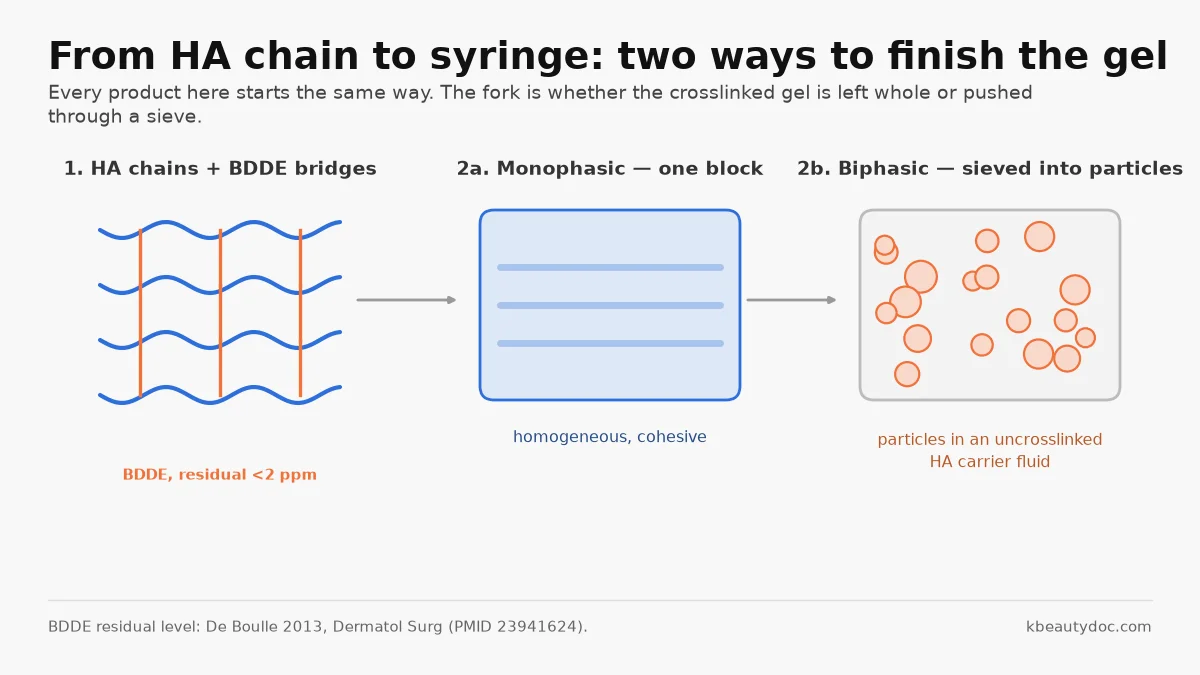
BDDE — 1,4-butanediol diglycidyl ether. Pure hyaluronic acid dissolves within days, so makers tie the chains together chemically. A 2021 review calls BDDE the worldwide standard, with 20 years of clinical record — though its authors work for a filler maker [1]. A safety review reports only trace unreacted BDDE afterwards, under 2 parts per million [2]. All four brands use it.
Monophasic — the gel is left as one homogeneous mass: smooth-spreading and more cohesive.
Biphasic — the gel is pushed through a sieve into particles suspended in uncrosslinked HA. Particle size sets the character.
That is the real fork in the road. Country of origin is not.
Where each product sits
I chose these three because each maker has a record outside Korea (Hugel’s Letybo toxin was approved by the US FDA in 2024), each appears in peer-reviewed literature rather than only in catalogues, and you will be offered all three in Seoul.
Juvederm uses two generations, Hylacross and the newer Vycross, both BDDE-crosslinked and monophasic. Vycross blends high and low molecular weight HA before crosslinking.
Neuramis is a monophasic cohesive gel, described that way in its phase III trial against Restylane [3] and in the Neuramis Deep Lidocaine trial [4].
YVOIRE is the interesting one. The maker markets a hybrid concept, but a 2022 split-face study using 3D scanning classified Yvoire Contour as biphasic against monophasic comparators [5]. Over two years the monophasic gels held more of their early volume, though all retained at least half — small and single-clinic, but measured rather than claimed.
Chaeum is Hugel’s HA line, widely distributed abroad. I could not open Hugel’s official page to verify concentration or lidocaine content, so I do not quote reseller numbers. Its facial literature is thin — the one indexed study I found used a Chaeum gel outside the face [6].
What the trials actually show
Monophasic versus biphasic. Two meta-analyses of nasolabial folds agree: monophasic gels scored modestly better on wrinkle severity, with no difference in pain or adverse events [7][8]. Small, real differences — describing gel types, not nationalities.
Neuramis against Juvederm, directly. In a split-face trial, Neuramis Volume Lidocaine on one cheek and Juvederm Voluma on the other gave equivalent responder rates at 24 weeks [9], and both still responded at similar rates at 104 weeks [10]. A Medytox employee co-authored it — but a blinded split-face design limits how far a sponsor can shape the result.
YVOIRE against no treatment. A multicentre randomised trial in China compared YVOIRE Y-Solution 720 in the midface with an untreated control; a large majority improved by at least one grade at 26 and 52 weeks [11]. That tells you it works, not how it compares with Juvederm.
The rare one: how rare, and what it looks like
Bruising, swelling and small lumps are common and settle. The complication that matters is a vascular event — gel entering or pressing on a blood vessel and cutting off blood supply to skin, or very rarely to the eye.
Rare how? In a survey of 370 US dermatologists covering 1.7 million syringes, occlusion occurred about once per 6,410 syringes injected with a needle and once per 40,882 with a cannula, and 85% of those events left no lasting damage [12]. Lips and nasolabial folds were most often involved.
The early signs matter more than the number: pain out of proportion to the injection, skin turning white, dusky or mottled, or any change in vision. If any appear — in the chair or hours later — contact the doctor who injected you straight away instead of waiting to see whether it settles.
Why I ask patients not to fly the next morning
Filler gets treated as a light errand, so every so often someone books it for the evening before their flight home. I ask to move it earlier — clinical judgement, not a proven fact.
Swelling and bruising keep shifting for 24 to 72 hours, so the result cannot be judged on the way to the airport. More to the point, the rare problems above can appear hours or days later, and in the air or back home you cannot easily return to the doctor who treated you. Cabin dryness and low pressure are often blamed for extra swelling; that evidence is weak, so I treat it as a footnote. I suggest leaving at least several days, ideally a week — and the same wait applies to the makeup you plan to cover it with, as in when to restart a cushion foundation.
What I actually think
This is clinical judgement, not advice for your face.
The choice that changes your result is where the gel goes and how much, not whose logo is on the syringe. Gel type is second-order: a cohesive monophasic gel is my starting thought for areas that move a lot, a firmer particle gel for deep support. A doctor who has examined you may reason differently, and reasonably so. What I would not do is assume the imported product is the careful choice and the domestic one the cheap compromise — or the reverse.
One point that rarely appears on a menu: people who are pregnant or breastfeeding, who have an active infection or inflamed spots at the injection site, or who take anticoagulants are generally not candidates that day, and a history of keloid scarring changes the conversation. A doctor who examines you decides.
For why Korean menus are written as brand names, see choosing a treatment by device name, and for the non-filler injections on the same page, Re2O, Rejuran and Juvelook compared. First-time visitors may also want what surprises foreign patients in a Korean clinic.
FAQ
Is Juvederm better than Korean fillers?
The head-to-head data does not support that framing. In the one long split-face comparison I could find, a Korean monophasic filler and Juvederm Voluma performed comparably over two years.
Are Korean fillers safe?
They hold Korean MFDS licences and use the same crosslinker as imported brands, and pooled trials show no difference in adverse events between gel types. Every HA filler carries the same risks: bruising, swelling, lumps, infection, and rarely a vascular event.
What does BDDE do, and should I worry about it?
It ties hyaluronic acid chains together so the gel lasts months instead of days. Residue afterwards is reported under 2 parts per million, and the breakdown products are substances already present in skin.
Why does my Korean clinic offer a brand I have never heard of?
Because the Korean market is supplied mainly by Korean manufacturers, and imports carry extra cost. A supply-chain fact, not a quality signal.
Can I ask which product is being used?
Yes, and you should. Ask for the brand, the product within the line, and the volume in millilitres. Those three answers let any doctor abroad understand what you had.
How long does HA filler last?
It depends on the product, the site and how much that area moves. Published follow-up above runs from 24 weeks to two years for volumising gels in the midface.
Can I fly home the day after filler?
I would rather you did not. Swelling and bruising still change for one to three days, and the uncommon problems that need quick attention tend to declare themselves in that window — when you are furthest from the clinic.
References
- Faivre J, Pigweh AI, Iehl J, et al. Crosslinking hyaluronic acid soft-tissue fillers: current status and perspectives from an industrial point of view. Expert Rev Med Devices 2021;18(12):1175-1187. DOI: 10.1080/17434440.2021.2014320
- De Boulle K, Glogau R, Kono T, et al. A review of the metabolism of 1,4-butanediol diglycidyl ether-crosslinked hyaluronic acid dermal fillers. Dermatol Surg 2013;39(12):1758-1766. DOI: 10.1111/dsu.12301
- Pak C, Park JH, Hong JP, et al. A phase III, randomized, multi-center, double-masked, matched-pairs, active-controlled trial to compare the efficacy and safety between Neuramis Deep and Restylane in the correction of nasolabial folds. Arch Plast Surg 2015;42(6):721-728. DOI: 10.5999/aps.2015.42.6.721
- Joo HJ, Woo YJ, Kim JE, et al. A randomized clinical trial to evaluate the efficacy and safety of lidocaine-containing monophasic hyaluronic acid filler for nasolabial folds. Plast Reconstr Surg 2016;137(3):799-808. DOI: 10.1097/01.prs.0000479965.14775.f0
- Hong JK, Park SJ, Seo SJ, et al. Quantitative evaluation of volume augmentation and durational changes in the anteromedial cheek with hyaluronic acid fillers using three-dimensional measurement: 2-year results from a comparative split-face study. Plast Reconstr Surg 2022;150(1):87e-91e. DOI: 10.1097/PRS.0000000000009244
- Park MG, Ahn ST, Cho SY, et al. Real practice confirmatory study of adjustable initial injection volume and necessity of retouch and reinjection in penile girth enhancement with hyaluronic acid gel. World J Mens Health 2026;44. DOI: 10.5534/wjmh.250332
- Ghaddaf AA, Aljefri YA, Alharbi FA, et al. Monophasic versus biphasic hyaluronic acid filler for correcting nasolabial folds: a systematic review and meta-analysis. J Cosmet Dermatol 2022;21(2):627-635. DOI: 10.1111/jocd.14632
- Huang Y, Zhang Y, Fei X, et al. Monophasic and biphasic hyaluronic acid fillers for esthetic correction of nasolabial folds: a meta-analysis of randomized controlled trials. Aesthetic Plast Surg 2022;46(3):1407-1422. DOI: 10.1007/s00266-021-02729-y
- Jung JM, Lee WS, Kim HJ, et al. A multi-center, randomized, double blinded, comparative study of two hyaluronic acid fillers for temporary restoration of mid-face volume in Asians. J Cosmet Dermatol 2020;19(7):1619-1626. DOI: 10.1111/jocd.13218
- Jung JM, Lee WS, Yoon JS, et al. A multicenter, randomized, double-blind comparison of two hyaluronic acid fillers in mid-face volume restoration in Asians: a 2-year extension study. Dermatol Ther 2021;34(2):e14787. DOI: 10.1111/dth.14787
- Yu N, Ting W, Xu J, et al. A multicenter, randomized, evaluator-blind, no-treatment controlled study of YVOIRE Y-Solution 720: a volumizing hyaluronic acid filler for midface volume deficit. Aesthetic Plast Surg 2026;50(3):776-785. DOI: 10.1007/s00266-025-05246-4
- Alam M, Kakar R, Dover JS, et al. Rates of vascular occlusion associated with using needles vs cannulas for filler injection. JAMA Dermatol 2021;157(2):174-180. DOI: 10.1001/jamadermatol.2020.5102
Disclaimer: This is general information, not a diagnosis or a treatment plan. Brand names are discussed for information only and are not endorsements. Injections and prescription medicines should be chosen and given only by a licensed professional who has examined you, and what suits another person may not suit you.

Physician in non-surgical aesthetic medicine, practising in Ansan, South Korea. Every article here is written from clinical practice and the published literature.
About the author · Contact