If you are being offered a Korean botulinum toxin brand in Seoul and wondering what it is, here is the short answer: Botox is Allergan’s brand name, not the name of the drug. Botulax, Meditoxin, Liztox and the others are separate botulinum toxin type A products made by Korean manufacturers, licensed and regulated in Korea, and increasingly registered abroad. They are not counterfeits or copies of Botox in any legal sense. They are different products in the same drug class.
But units are not interchangeable between brands, and that single fact matters more to your result than which name is on the vial. Here is the full picture.
The accident that created an industry
Botulinum toxin did not begin in a beauty clinic. It began in an eye clinic.
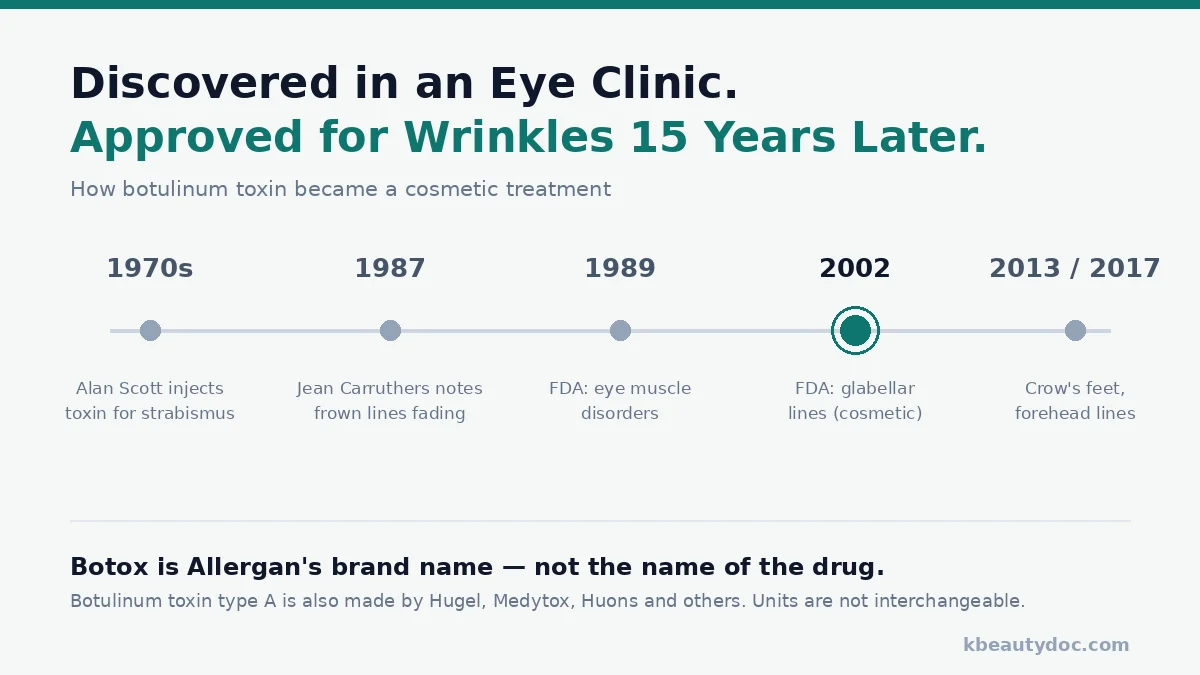
The bacterium was identified in the 1890s and a purified type A toxin produced in the 1940s. Clinical use came in the 1970s, when the ophthalmologist Alan Scott injected it into eye muscles for strabismus — weakening an overactive muscle instead of operating.
The cosmetic discovery was an observation, not a plan. In 1987, the ophthalmologist Jean Carruthers was treating patients for blepharospasm — involuntary eyelid spasm — and noticed that the frown lines between their eyebrows were disappearing. She and her husband, the dermatologist Alastair Carruthers, published one of the first papers on the cosmetic application [1] shortly afterward.
Approval followed slowly: eye muscle disorders in 1989, cervical dystonia in 2000, and glabellar lines in 2002, roughly a decade after the first published report. Crow’s feet and forehead lines followed in 2013 and 2017. Non-cosmetic research continued alongside, which is how the same frown-line injection came to be tested for depression, where evidence and claims do not match.
The sequence is worth holding onto: a toxin studied for muscle disorders, an incidental observation in an eye clinic, then fifteen years of trials before the cosmetic use most people assume was the original purpose.
Botox is a brand, not a drug
This is the single most useful thing to understand before comparing products.
The drug is botulinum toxin type A. Botox is Allergan’s brand of it — now part of AbbVie — with the generic name onabotulinumtoxinA. Other manufacturers make their own botulinum toxin type A products with their own strains, purification processes, formulations and clinical data.
That is why Allergan’s own labelling states that Botox dosing units are not comparable to any other botulinum toxin product. Units are defined by each manufacturer’s own potency assay, so “20 units” of one brand is not automatically “20 units” of another.
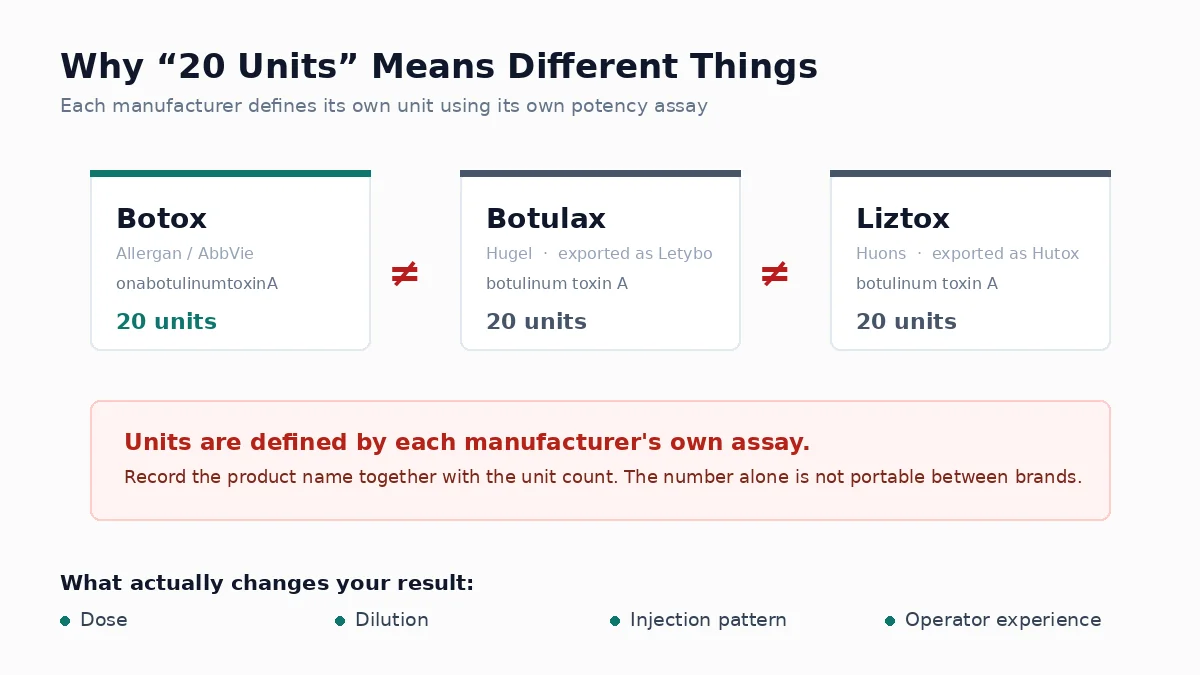
Practical consequence: if you have been treated before with one brand and switch to another, the number of units you remember is not a reliable reference. Tell your injector what you had, how much, and how it behaved — that history is more useful than the number alone.
The Korean products
Korea has an unusually crowded domestic botulinum toxin market, which is part of why prices here are low by global standards. Three names come up most often.
Botulax (Hugel). Korea’s leading domestic product by revenue, exported as Letybo, and one of only a handful of botulinum toxins approved in China — alongside Botox, Dysport and Xeomin.
Meditoxin (Medytox). One of the earliest Korean entrants, and historically the market leader before competition intensified. Exported as Neuronox. Medytox also produces Innotox, a liquid formulation, and Coretox.
Liztox (Huons BioPharma). Spun off into a dedicated subsidiary in 2021, sold in 50, 100 and 200 unit vials — the smaller aimed at aesthetic use, the larger at therapeutic indications. Exported as Hutox, and approved in China in 2026.
The regulatory history, stated plainly
Korean patients and physicians know this history; visitors generally do not. It is worth stating accurately, because it shows how the system responded.
In 2020, Korea’s Ministry of Food and Drug Safety cancelled licences for several Meditoxin presentations over pharmaceutical law compliance — national lot release, distribution and labelling. Medytox contested the actions in court and prevailed on appeal. Separately, a dispute over the origin of botulinum strains has run since 2017; in the Hugel case Medytox withdrew its claims and Hugel prevailed in the final ITC determination, while parts of the Daewoong dispute remain open.
What a patient should take from this: Korean products are subject to national lot release and active enforcement, the disputes were commercial and legal rather than safety findings, and none of it is a reason to prefer or avoid a brand on clinical grounds.
The more relevant risk is counterfeit and unofficial supply. Korean manufacturers have reported unauthorised and counterfeit product circulating internationally — including material produced outside official channels — and have responded with barcoding and UV security labelling. If you are treated outside a licensed clinic, or the price is dramatically below market, that is where the actual danger sits.
What happens afterwards, and who should wait
Most of it is minor and short-lived: small bruises at the needle points, a headache for a day or two, occasional tenderness. The one worth knowing by name is spread beyond the target muscle — a heavy or uneven brow, or a drooping upper eyelid — which usually appears in the first one to two weeks and eases as the effect fades over weeks rather than days.
Two timing points follow. Judge the result at two weeks, not on day 3; and repeat treatments are generally spaced at least three months apart, because topping up sooner is the pattern associated with antibody formation.
Botulinum toxin is generally not used in pregnancy or breastfeeding, in people with a neuromuscular disorder such as myasthenia gravis, where there is an infection at the injection site, or after a previous reaction to a toxin product. A doctor who examines you decides.
What to ask at your consultation
Product name is a fair question, but it is not the most important one.
Which product, and how many units. Ask for both, and note them. This becomes your reference for future treatments — including with a different injector in a different country.
How is it reconstituted. Botulinum toxin comes as a powder and is diluted before injection. Dilution affects spread, and it is one reason the effect can appear on day 3 for one person and day 10 for another. Two clinics using the same product and unit count can produce different results.
Who injects. In Korea this is a physician procedure. The anatomy of the glabellar and periorbital region is unforgiving, and outcome tracks operator experience more closely than brand.
What are you treating. Frown lines, forehead lines and crow’s feet respond to different dose patterns, which is why injectors moved from a fixed grid to a plan built around your own muscle. A treatment described only as “Botox” is underspecified.
FAQ
Is Korean botulinum toxin the same as Botox?
It is the same drug class — botulinum toxin type A — but a different product from a different manufacturer with its own strain, formulation and potency assay. It is not a generic version of Botox in the way a generic pill is identical to a brand pill.
Are units the same across brands?
No. Units are defined by each manufacturer’s own assay. Allergan’s own labelling states that Botox units are not comparable to other botulinum toxin products. Record the product name alongside the unit count.
Why is botulinum toxin cheaper in Korea?
A crowded domestic market with many licensed manufacturers, and no import cost for domestic products. Price differences within Korea largely reflect product choice, dilution, and clinic positioning rather than a difference in the underlying drug class.
Which Korean brand is best?
There is no single answer supported by evidence for an individual patient. All licensed products are subject to national lot release. Dose, dilution, injection pattern and operator experience influence your result more than brand selection.
How long does it last?
Effect typically develops over several days and lasts around three to four months for aesthetic use, with individual variation. Duration is influenced by dose, muscle mass and treatment area.
Should I worry about the licence cancellations I read about?
Those actions concerned pharmaceutical law compliance — lot release, distribution and labelling — and were contested in court, with the manufacturer prevailing on appeal. They were not findings of patient harm. The practical safeguard is a licensed clinic using product from official supply.
References
- Carruthers JD, Carruthers JA. Treatment of glabellar frown lines with C. botulinum-A exotoxin. Journal of Dermatologic Surgery and Oncology 1992;18(1):17-21. PMID 1740562
Disclaimer: This is general information, not a diagnosis or a treatment plan. Brand names are discussed for information only and are not endorsements. Injections and prescription medicines should be chosen and given only by a licensed professional who has examined you, and what suits another person may not suit you.

Physician in non-surgical aesthetic medicine, practising in Ansan, South Korea. Every article here is written from clinical practice and the published literature.
About the author · Contact