

Is there a Korean Botox?

Yes. Like Botox, but Korean-made and usually cheaper here.
So is cheaper worse?
Not as a rule. Some pairs were tested head to head.
How do I choose, then?
Start with your skin problem, not the famous name.
Every famous name on a Western clinic menu has a Korean cousin, and in Seoul the cousin is usually the cheaper line on the price list.
Short answer:
- Korea has its own version of all five. Botulax and Nabota for Botox, Oligio and 10Therma for Thermage, Shurink for Ultherapy, Juvelook for Sculptra, Neuramis and YVOIRE for Juvederm.
- “Cheaper” is a Korean price-list fact, not a quality grade. Domestic products skip import costs.
- The proof is uneven. Neuramis has a head-to-head trial against Juvederm; Shurink has none against Ultherapy.
Is there a Korean alternative to Botox?
Yes, several: Botulax, Meditoxin, Liztox, Nabota and Coretox. Each is its own licensed botulinum toxin type A, the same drug class as Botox, from a different maker: not a copy. Korea tests every batch before release.
Nabota goes further: it is approved by the US FDA and sold in America as Jeuveau. In one randomised trial of four toxins that included it, the peak effect was similar across all four.
The catch is the units. Each maker measures them its own way, so “20 units” of one brand is not 20 of another. More in Botulax vs Botox and Dysport vs Xeomin vs Nabota.
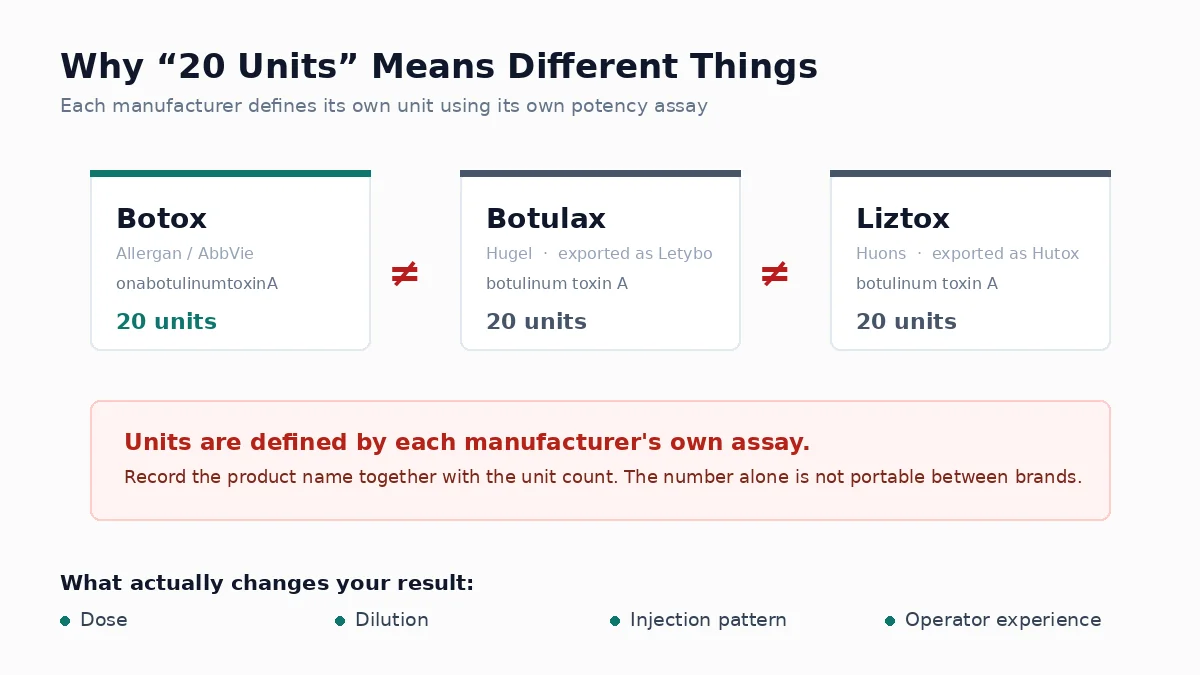
Same drug class, different measuring sticks.
Is there a Korean alternative to Thermage?
Oligio and 10Therma heat the deeper skin with the same kind of energy, monopolar radiofrequency. In Korean clinics Oligio is usually the lowest price, 10Therma sits in the middle, and Thermage costs the most, partly because its single-use tip is imported.
The honest gap: Thermage has the longest record, and its US clearance names a cosmetic use. The Korean devices’ US clearances cover a general electrosurgical use instead, and Oligio’s published data on loose skin is one small study. Details in 10Therma vs Oligio X vs Thermage.
Is there a Korean alternative to Ultherapy?
Shurink, sold abroad as Ultraformer, is the everyday Korean ultrasound lift. It aims tiny heat points under the skin the same way, and sessions are usually quicker and cheaper.
What it does not have: Ultherapy’s live screen that shows the layers, and its much longer research record. No study has compared the two directly. See Shurink vs Ulthera, and if a past session disappointed you, why Ultherapy works less on some faces.
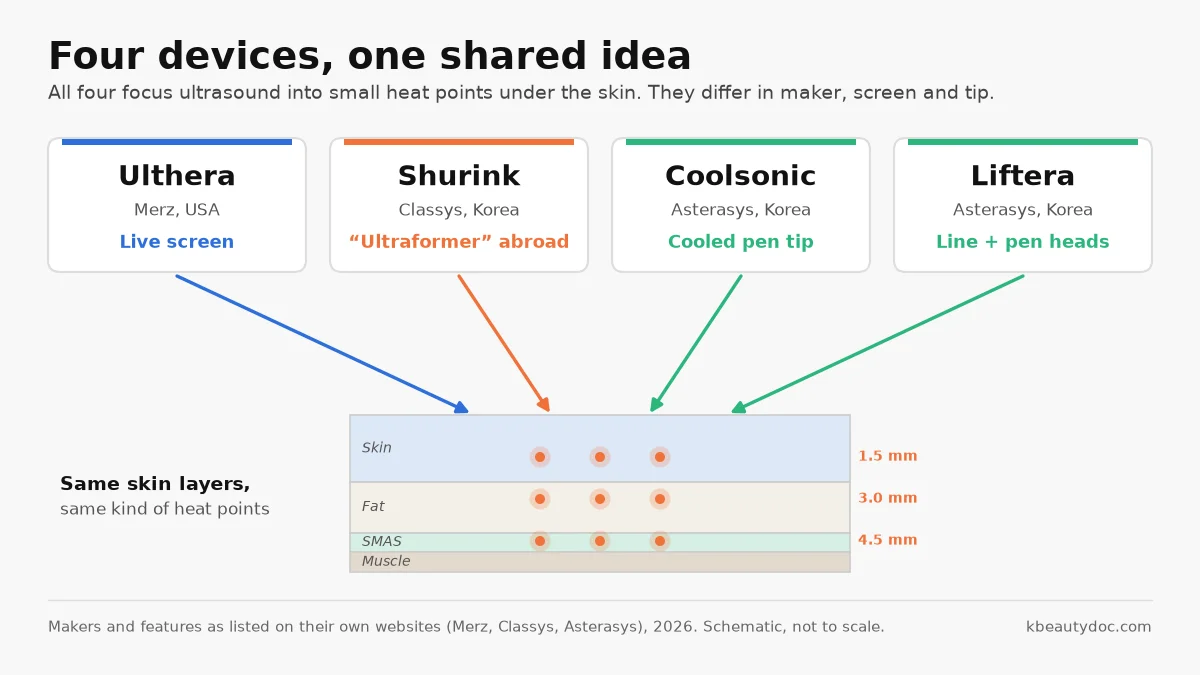
Four names, one ultrasound idea.
Is Juvelook a Korean alternative to Sculptra?
It is the closest Korean match, not a twin. Both ask your skin to make its own collagen over weeks. Sculptra is PLLA alone; Juvelook is PDLLA mixed with hyaluronic acid, which gives a little hydration early, and it is placed at a different depth. A separate Juvelook Volume is the version for deeper volume.
Two cautions. Juvelook is licensed in Korea and CE-marked in Europe, but not approved by the US FDA. And it can still leave firm lumps weeks later if placed wrong.
People also mix it up with Rejuran, which is something else: a salmon-DNA repair signal for damaged, red skin. Start with Juvelook vs Rejuran, and for the human-collagen option, Re2O vs Rejuran vs Juvelook.
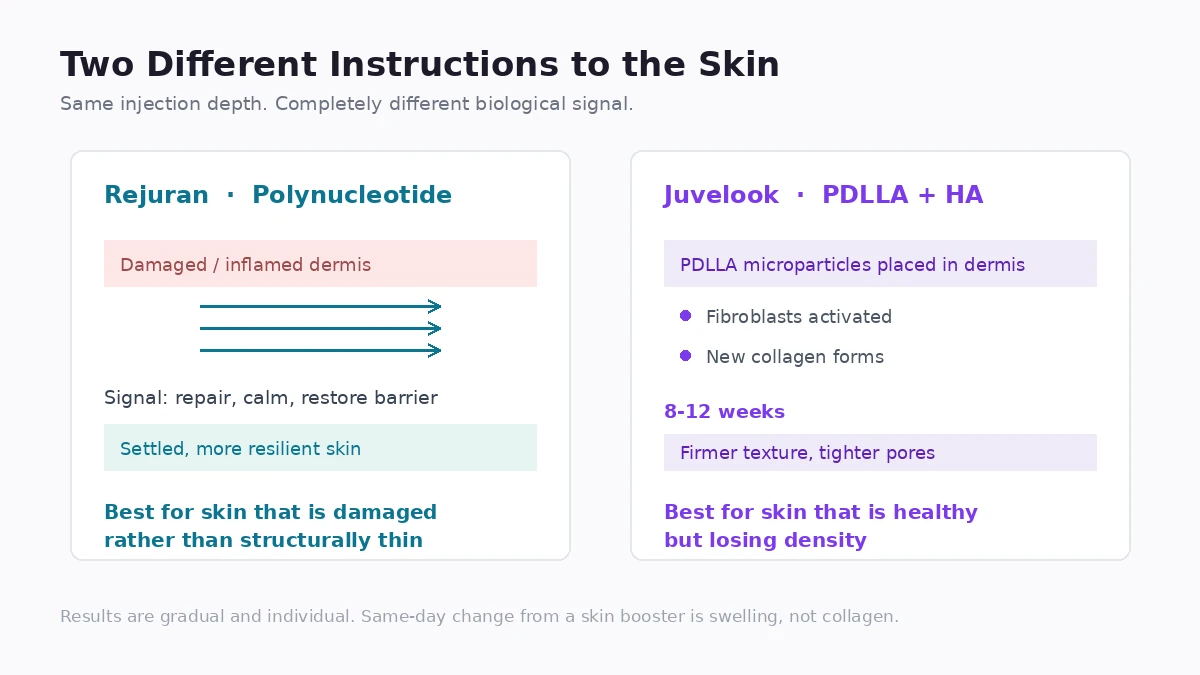
A repair signal and a collagen builder are different jobs.
Is there a Korean alternative to Juvederm?
Neuramis, YVOIRE and Chaeum are Korean hyaluronic acid fillers, held together with the same chemical link, BDDE, that Juvederm uses.
This pair has a direct, long comparison. In a blinded split-face trial, Neuramis on one cheek and Juvederm Voluma on the other gave comparable responder rates at 24 weeks and still similar rates at two years. A Medytox employee co-wrote it. YVOIRE has been tested against no treatment, not against Juvederm, and Chaeum has the thinnest record. Full story: Neuramis vs Juvederm vs YVOIRE.
What I tell my patients about “the Korean version”
- Pick the problem first. Frown lines, loose skin, thinning skin and lost volume each have their own family of treatments.
- Ask what is in the syringe or the machine. Product name, plus units, shots or millilitres.
- Ask how good the proof is for that pair. Some have head-to-head trials, some have none.
- A low price can hide less treatment. Fewer units, fewer lines or lower energy all cost less too.
In Seoul, from Gangnam to Hongdae, you will usually see the imported and the Korean names on the same menu. Every comparison on this site is collected in Korean clinics, honestly.
Have a question about your own case? Ask me on LINE or by email — details on the Contact page.
FAQ
Is Korean Botox a dupe for Botox?
Not in the copycat sense. Botulax, Nabota and the others are separately licensed botulinum toxin type A products with their own makers and their own unit scales, so treat them as different brands of the same drug class.
Are Korean alternatives FDA approved?
It depends on the product. Nabota is approved by the US FDA; Juvelook and Rejuran are not; Oligio and 10Therma are cleared in the US for a general electrosurgical use rather than the cosmetic one. Ask “approved for what, and by whom?”
Is the Korean version always cheaper?
In Korean clinics it usually is, because domestic products skip import costs. But a low total can also mean fewer units, fewer shots or lower energy, so compare what is included, not only the price.
Disclaimer: This is general information, not a diagnosis or a treatment plan. Brand names are discussed for information only and are not endorsements. Injections and prescription medicines should be chosen and given only by a licensed professional who has examined you, and what suits another person may not suit you.
14 years in practice · replies to messages herselfA doctor in Korea, in practice since 2012 — your K-Beauty Doc. Physician in non-surgical aesthetic medicine, practising in Ansan, South Korea. Every article here is written from clinical practice and the published literature. Not medical advice.
About the author · Contact